 Add to Chrome
 Add to Firefox
 Add to Edge
Rendering Multi-Human and Multi-Object with 3D Gaussian Splatting
Apr 03, 2026
Reconstructing dynamic scenes with multiple interacting humans and objects from sparse-view inputs is a critical yet challenging task, essential for creating high-fidelity digital twins for robotics and VR/AR. This problem, which we term Multi-Human Multi-Object (MHMO) rendering, presents two significant obstacles: achieving view-consistent representations for individual instances under severe mutual occlusion, and explicitly modeling the complex and combinatorial dependencies that arise from their interactions. To overcome these challenges, we propose MM-GS, a novel hierarchical framework built upon 3D Gaussian Splatting. Our method first employs a Per-Instance Multi-View Fusion module to establish a robust and consistent representation for each instance by aggregating visual information across all available views. Subsequently, a Scene-Level Instance Interaction module operates on a global scene graph to reason about relationships between all participants, refining their attributes to capture subtle interaction effects. Extensive experiments on challenging datasets demonstrate that our method significantly outperforms strong baselines, producing state-of-the-art results with high-fidelity details and plausible inter-instance contacts.

Uncertainty-Aware 4D Gaussian Splatting for Monocular Occluded Human Rendering
Feb 06, 2026High-fidelity rendering of dynamic humans from monocular videos typically degrades catastrophically under occlusions. Existing solutions incorporate external priors-either hallucinating missing content via generative models, which induces severe temporal flickering, or imposing rigid geometric heuristics that fail to capture diverse appearances. To this end, we reformulate the task as a Maximum A Posteriori estimation problem under heteroscedastic observation noise. In this paper, we propose U-4DGS, a framework integrating a Probabilistic Deformation Network and a Double Rasterization pipeline. This architecture renders pixel-aligned uncertainty maps that act as an adaptive gradient modulator, automatically attenuating artifacts from unreliable observations. Furthermore, to prevent geometric drift in regions lacking reliable visual cues, we enforce Confidence-Aware Regularizations, which leverage the learned uncertainty to selectively propagate spatial-temporal validity. Extensive experiments on ZJU-MoCap and OcMotion demonstrate that U-4DGS achieves SOTA rendering fidelity and robustness.
$\text{Di}^2\text{Pose}$: Discrete Diffusion Model for Occluded 3D Human Pose Estimation
May 27, 2024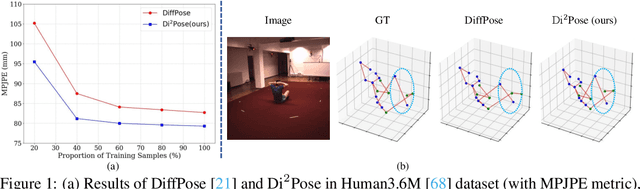
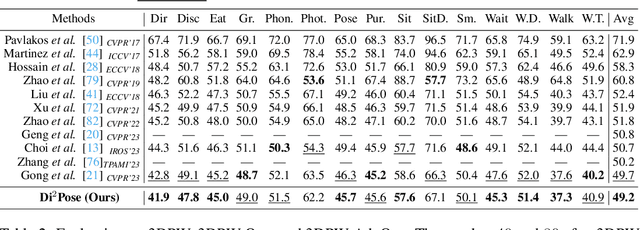
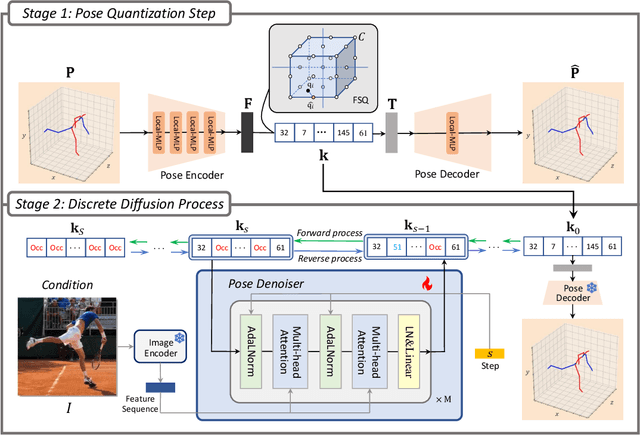
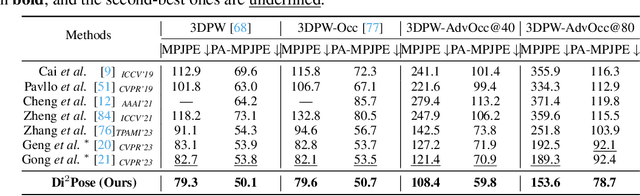
Continuous diffusion models have demonstrated their effectiveness in addressing the inherent uncertainty and indeterminacy in monocular 3D human pose estimation (HPE). Despite their strengths, the need for large search spaces and the corresponding demand for substantial training data make these models prone to generating biomechanically unrealistic poses. This challenge is particularly noticeable in occlusion scenarios, where the complexity of inferring 3D structures from 2D images intensifies. In response to these limitations, we introduce the Discrete Diffusion Pose ($\text{Di}^2\text{Pose}$), a novel framework designed for occluded 3D HPE that capitalizes on the benefits of a discrete diffusion model. Specifically, $\text{Di}^2\text{Pose}$ employs a two-stage process: it first converts 3D poses into a discrete representation through a \emph{pose quantization step}, which is subsequently modeled in latent space through a \emph{discrete diffusion process}. This methodological innovation restrictively confines the search space towards physically viable configurations and enhances the model's capability to comprehend how occlusions affect human pose within the latent space. Extensive evaluations conducted on various benchmarks (e.g., Human3.6M, 3DPW, and 3DPW-Occ) have demonstrated its effectiveness.