 Add to Chrome
 Add to Firefox
 Add to Edge
Large Language Model-Powered Evolutionary Code Optimization on a Phylogenetic Tree
Jan 20, 2026
Optimizing scientific computing algorithms for modern GPUs is a labor-intensive and iterative process involving repeated code modification, benchmarking, and tuning across complex hardware and software stacks. Recent work has explored large language model (LLM)-assisted evolutionary methods for automated code optimization, but these approaches primarily rely on outcome-based selection and random mutation, underutilizing the rich trajectory information generated during iterative optimization. We propose PhyloEvolve, an LLM-agent system that reframes GPU-oriented algorithm optimization as an In-Context Reinforcement Learning (ICRL) problem. This formulation enables trajectory-conditioned reuse of optimization experience without model retraining. PhyloEvolve integrates Algorithm Distillation and prompt-based Decision Transformers into an iterative workflow, treating sequences of algorithm modifications and performance feedback as first-class learning signals. To organize optimization history, we introduce a phylogenetic tree representation that captures inheritance, divergence, and recombination among algorithm variants, enabling backtracking, cross-lineage transfer, and reproducibility. The system combines elite trajectory pooling, multi-island parallel exploration, and containerized execution to balance exploration and exploitation across heterogeneous hardware. We evaluate PhyloEvolve on scientific computing workloads including PDE solvers, manifold learning, and spectral graph algorithms, demonstrating consistent improvements in runtime, memory efficiency, and correctness over baseline and evolutionary methods. Code is published at: https://github.com/annihi1ation/phylo_evolve

Time Travel is Cheating: Going Live with DeepFund for Real-Time Fund Investment Benchmarking
May 16, 2025Large Language Models (LLMs) have demonstrated notable capabilities across financial tasks, including financial report summarization, earnings call transcript analysis, and asset classification. However, their real-world effectiveness in managing complex fund investment remains inadequately assessed. A fundamental limitation of existing benchmarks for evaluating LLM-driven trading strategies is their reliance on historical back-testing, inadvertently enabling LLMs to "time travel"-leveraging future information embedded in their training corpora, thus resulting in possible information leakage and overly optimistic performance estimates. To address this issue, we introduce DeepFund, a live fund benchmark tool designed to rigorously evaluate LLM in real-time market conditions. Utilizing a multi-agent architecture, DeepFund connects directly with real-time stock market data-specifically data published after each model pretraining cutoff-to ensure fair and leakage-free evaluations. Empirical tests on nine flagship LLMs from leading global institutions across multiple investment dimensions-including ticker-level analysis, investment decision-making, portfolio management, and risk control-reveal significant practical challenges. Notably, even cutting-edge models such as DeepSeek-V3 and Claude-3.7-Sonnet incur net trading losses within DeepFund real-time evaluation environment, underscoring the present limitations of LLMs for active fund management. Our code is available at https://github.com/HKUSTDial/DeepFund.
AdaCo: Overcoming Visual Foundation Model Noise in 3D Semantic Segmentation via Adaptive Label Correction
Dec 24, 2024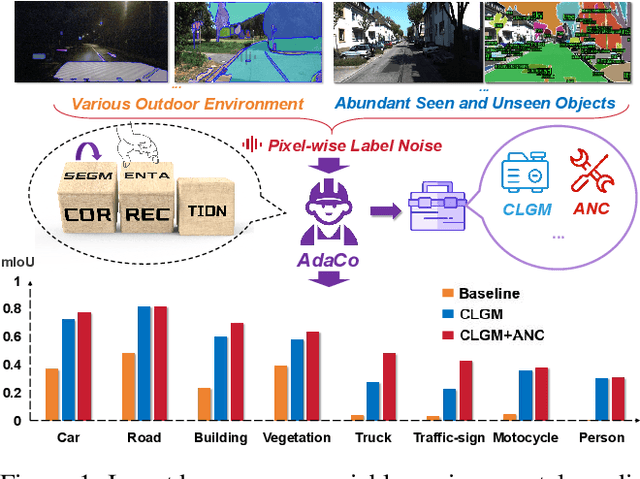
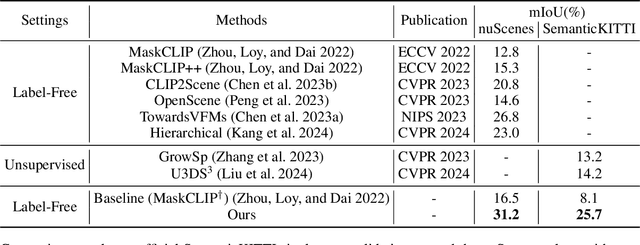
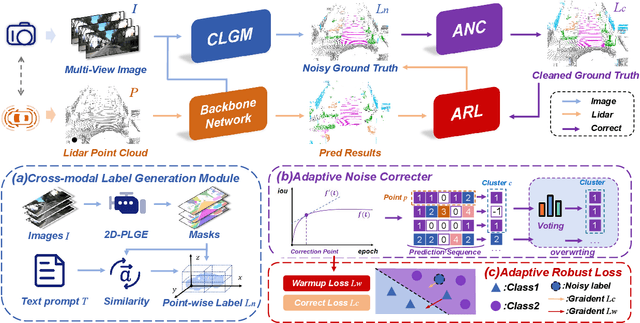
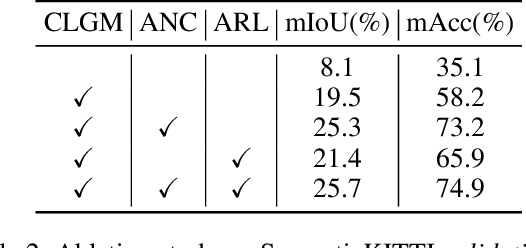
Recently, Visual Foundation Models (VFMs) have shown a remarkable generalization performance in 3D perception tasks. However, their effectiveness in large-scale outdoor datasets remains constrained by the scarcity of accurate supervision signals, the extensive noise caused by variable outdoor conditions, and the abundance of unknown objects. In this work, we propose a novel label-free learning method, Adaptive Label Correction (AdaCo), for 3D semantic segmentation. AdaCo first introduces the Cross-modal Label Generation Module (CLGM), providing cross-modal supervision with the formidable interpretive capabilities of the VFMs. Subsequently, AdaCo incorporates the Adaptive Noise Corrector (ANC), updating and adjusting the noisy samples within this supervision iteratively during training. Moreover, we develop an Adaptive Robust Loss (ARL) function to modulate each sample's sensitivity to noisy supervision, preventing potential underfitting issues associated with robust loss. Our proposed AdaCo can effectively mitigate the performance limitations of label-free learning networks in 3D semantic segmentation tasks. Extensive experiments on two outdoor benchmark datasets highlight the superior performance of our method.
Character-level Convolutional Network for Text Classification Applied to Chinese Corpus
Nov 15, 2016


This article provides an interesting exploration of character-level convolutional neural network solving Chinese corpus text classification problem. We constructed a large-scale Chinese language dataset, and the result shows that character-level convolutional neural network works better on Chinese corpus than its corresponding pinyin format dataset. This is the first time that character-level convolutional neural network applied to text classification problem.