 Add to Chrome
 Add to Firefox
 Add to Edge
OptiVote: Non-Coherent FSO Over-the-Air Majority Vote for Communication-Efficient Distributed Federated Learning in Space Data Centers
Dec 30, 2025
The rapid deployment of mega-constellations is driving the long-term vision of space data centers (SDCs), where interconnected satellites form in-orbit distributed computing and learning infrastructures. Enabling distributed federated learning in such systems is challenging because iterative training requires frequent aggregation over inter-satellite links that are bandwidth- and energy-constrained, and the link conditions can be highly dynamic. In this work, we exploit over-the-air computation (AirComp) as an in-network aggregation primitive. However, conventional coherent AirComp relies on stringent phase alignment, which is difficult to maintain in space environments due to satellite jitter and Doppler effects. To overcome this limitation, we propose OptiVote, a robust and communication-efficient non-coherent free-space optical (FSO) AirComp framework for federated learning toward Space Data Centers. OptiVote integrates sign stochastic gradient descent (signSGD) with a majority-vote (MV) aggregation principle and pulse-position modulation (PPM), where each satellite conveys local gradient signs by activating orthogonal PPM time slots. The aggregation node performs MV detection via non-coherent energy accumulation, transforming phase-sensitive field superposition into phase-agnostic optical intensity combining, thereby eliminating the need for precise phase synchronization and improving resilience under dynamic impairments. To mitigate aggregation bias induced by heterogeneous FSO channels, we further develop an importance-aware, channel state information (CSI)-free dynamic power control scheme that balances received energies without additional signaling. We provide theoretical analysis by characterizing the aggregate error probability under statistical FSO channels and establishing convergence guarantees for non-convex objectives.

TrainBo: An Interactive Robot-assisted Scenario Training System for Older Adults with Dementia
May 17, 2025Dementia is an overall decline in memory and cognitive skills severe enough to reduce an elders ability to perform everyday activities. There is an increasing need for accessible technologies for cognitive training to slow down the cognitive decline. With the ability to provide instant feedback and assistance, social robotic systems have been proven effective in enhancing learning abilities across various age groups. This study focuses on the design of an interactive robot-assisted scenario training system TrainBo with self-determination theory, derives design requirements through formative and formal studies and the system usability is also be evaluated. A pilot test is conducted on seven older adults with dementia in an elderly care center in Hong Kong for four weeks. Our finding shows that older adults with dementia have an improvement in behavioural engagement, emotional engagement, and intrinsic motivation after using Trainbo. These findings can provide valuable insights into the development of more captivating interactive robots for extensive training purposes.
Deep Multi-Task Learning for Cooperative NOMA: System Design and Principles
Jul 27, 2020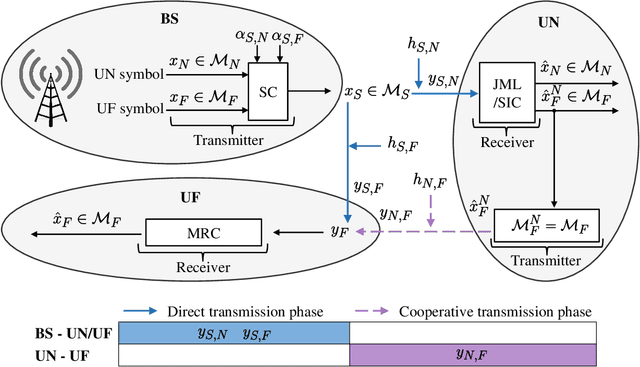
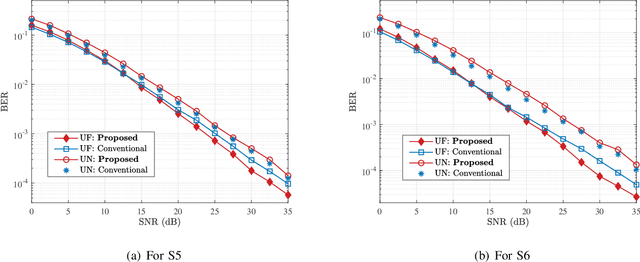
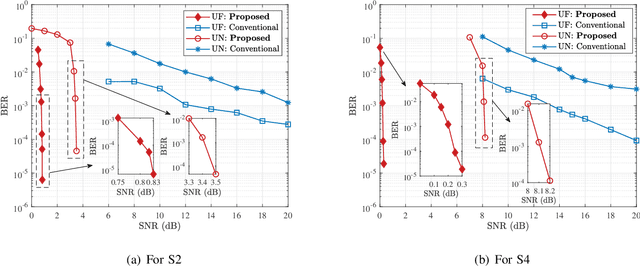
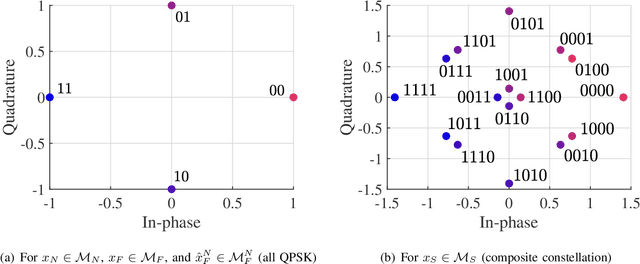
Envisioned as a promising component of the future wireless Internet-of-Things (IoT) networks, the non-orthogonal multiple access (NOMA) technique can support massive connectivity with a significantly increased spectral efficiency. Cooperative NOMA is able to further improve the communication reliability of users under poor channel conditions. However, the conventional system design suffers from several inherent limitations and is not optimized from the bit error rate (BER) perspective. In this paper, we develop a novel deep cooperative NOMA scheme, drawing upon the recent advances in deep learning (DL). We develop a novel hybrid-cascaded deep neural network (DNN) architecture such that the entire system can be optimized in a holistic manner. On this basis, we construct multiple loss functions to quantify the BER performance and propose a novel multi-task oriented two-stage training method to solve the end-to-end training problem in a self-supervised manner. The learning mechanism of each DNN module is then analyzed based on information theory, offering insights into the proposed DNN architecture and its corresponding training method. We also adapt the proposed scheme to handle the power allocation (PA) mismatch between training and inference and incorporate it with channel coding to combat signal deterioration. Simulation results verify its advantages over orthogonal multiple access (OMA) and the conventional cooperative NOMA scheme in various scenarios.