 Add to Chrome
 Add to Firefox
 Add to Edge
CAPS: Unifying Attention, Recurrence, and Alignment in Transformer-based Time Series Forecasting
Feb 02, 2026
This paper presents $\textbf{CAPS}$ (Clock-weighted Aggregation with Prefix-products and Softmax), a structured attention mechanism for time series forecasting that decouples three distinct temporal structures: global trends, local shocks, and seasonal patterns. Standard softmax attention entangles these through global normalization, while recent recurrent models sacrifice long-term, order-independent selection for order-dependent causal structure. CAPS combines SO(2) rotations for phase alignment with three additive gating paths -- Riemann softmax, prefix-product gates, and a Clock baseline -- within a single attention layer. We introduce the Clock mechanism, a learned temporal weighting that modulates these paths through a shared notion of temporal importance. Experiments on long- and short-term forecasting benchmarks surpass vanilla softmax and linear attention mechanisms and demonstrate competitive performance against seven strong baselines with linear complexity. Our code implementation is available at https://github.com/vireshpati/CAPS-Attention.

Dynamic Context-Aware Streaming Pretrained Language Model For Inverse Text Normalization
May 30, 2025Inverse Text Normalization (ITN) is crucial for converting spoken Automatic Speech Recognition (ASR) outputs into well-formatted written text, enhancing both readability and usability. Despite its importance, the integration of streaming ITN within streaming ASR remains largely unexplored due to challenges in accuracy, efficiency, and adaptability, particularly in low-resource and limited-context scenarios. In this paper, we introduce a streaming pretrained language model for ITN, leveraging pretrained linguistic representations for improved robustness. To address streaming constraints, we propose Dynamic Context-Aware during training and inference, enabling adaptive chunk size adjustments and the integration of right-context information. Experimental results demonstrate that our method achieves accuracy comparable to non-streaming ITN and surpasses existing streaming ITN models on a Vietnamese dataset, all while maintaining low latency, ensuring seamless integration into ASR systems.
AAM-VDT: Vehicle Digital Twin for Tele-Operations in Advanced Air Mobility
Apr 15, 2024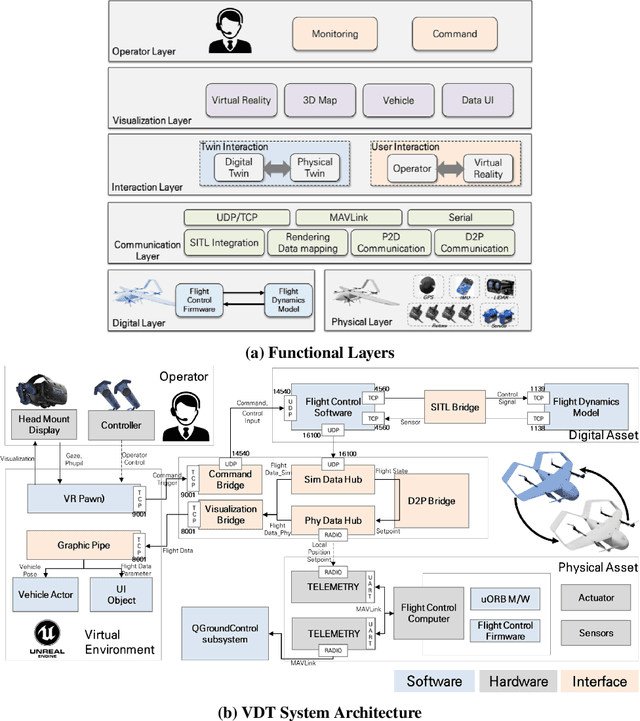
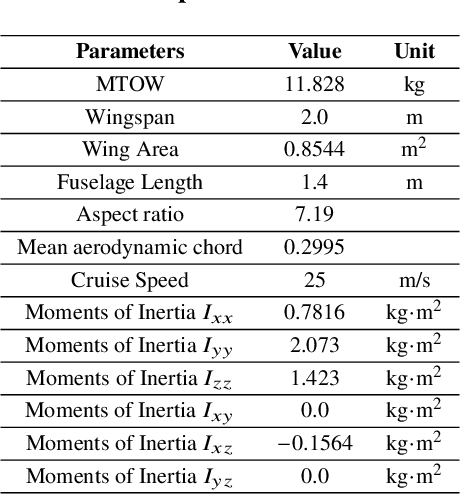
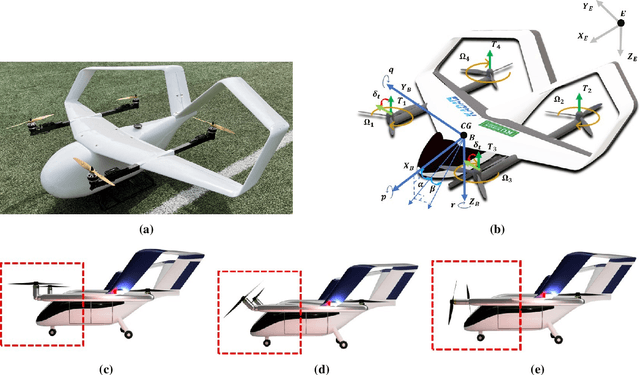
This study advanced tele-operations in Advanced Air Mobility (AAM) through the creation of a Vehicle Digital Twin (VDT) system for eVTOL aircraft, tailored to enhance remote control safety and efficiency, especially for Beyond Visual Line of Sight (BVLOS) operations. By synergizing digital twin technology with immersive Virtual Reality (VR) interfaces, we notably elevate situational awareness and control precision for remote operators. Our VDT framework integrates immersive tele-operation with a high-fidelity aerodynamic database, essential for authentically simulating flight dynamics and control tactics. At the heart of our methodology lies an eVTOL's high-fidelity digital replica, placed within a simulated reality that accurately reflects physical laws, enabling operators to manage the aircraft via a master-slave dynamic, substantially outperforming traditional 2D interfaces. The architecture of the designed system ensures seamless interaction between the operator, the digital twin, and the actual aircraft, facilitating exact, instantaneous feedback. Experimental assessments, involving propulsion data gathering, simulation database fidelity verification, and tele-operation testing, verify the system's capability in precise control command transmission and maintaining the digital-physical eVTOL synchronization. Our findings underscore the VDT system's potential in augmenting AAM efficiency and safety, paving the way for broader digital twin application in autonomous aerial vehicles.