 Add to Chrome
 Add to Firefox
 Add to Edge
Disentangled Representation Learning via Flow Matching
Feb 05, 2026
Disentangled representation learning aims to capture the underlying explanatory factors of observed data, enabling a principled understanding of the data-generating process. Recent advances in generative modeling have introduced new paradigms for learning such representations. However, existing diffusion-based methods encourage factor independence via inductive biases, yet frequently lack strong semantic alignment. In this work, we propose a flow matching-based framework for disentangled representation learning, which casts disentanglement as learning factor-conditioned flows in a compact latent space. To enforce explicit semantic alignment, we introduce a non-overlap (orthogonality) regularizer that suppresses cross-factor interference and reduces information leakage between factors. Extensive experiments across multiple datasets demonstrate consistent improvements over representative baselines, yielding higher disentanglement scores as well as improved controllability and sample fidelity.

Efficient Novelty-Driven Neural Architecture Search
Jul 22, 2019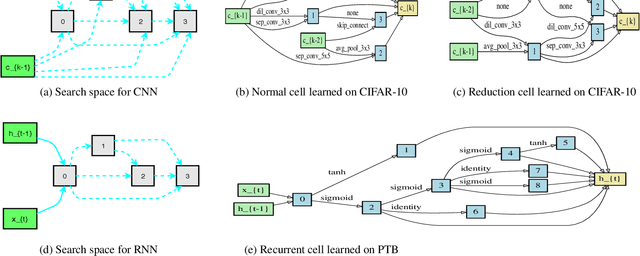
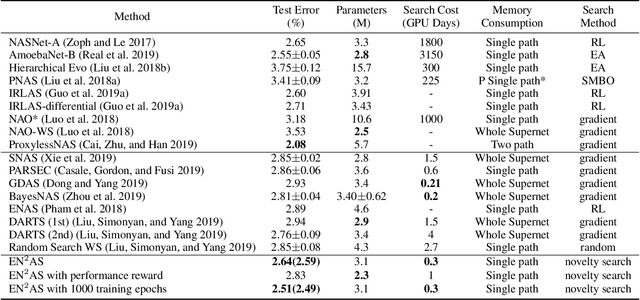


One-Shot Neural architecture search (NAS) attracts broad attention recently due to its capacity to reduce the computational hours through weight sharing. However, extensive experiments on several recent works show that there is no positive correlation between the validation accuracy with inherited weights from the supernet and the test accuracy after re-training for One-Shot NAS. Different from devising a controller to find the best performing architecture with inherited weights, this paper focuses on how to sample architectures to train the supernet to make it more predictive. A single-path supernet is adopted, where only a small part of weights are optimized in each step, to reduce the memory demand greatly. Furthermore, we abandon devising complicated reward based architecture sampling controller, and sample architectures to train supernet based on novelty search. An efficient novelty search method for NAS is devised in this paper, and extensive experiments demonstrate the effectiveness and efficiency of our novelty search based architecture sampling method. The best architecture obtained by our algorithm with the same search space achieves the state-of-the-art test error rate of 2.51\% on CIFAR-10 with only 7.5 hours search time in a single GPU, and a validation perplexity of 60.02 and a test perplexity of 57.36 on PTB. We also transfer these search cell structures to larger datasets ImageNet and WikiText-2, respectively.