 Add to Chrome
 Add to Firefox
 Add to Edge
A Stepwise-Enhanced Reasoning Framework for Large Language Models Based on External Subgraph Generation
Dec 29, 2025
Large Language Models (LLMs) have achieved strong performance across a wide range of natural language processing tasks in recent years, including machine translation, text generation, and question answering. As their applications extend to increasingly complex scenarios, however, LLMs continue to face challenges in tasks that require deep reasoning and logical inference. In particular, models trained on large scale textual corpora may incorporate noisy or irrelevant information during generation, which can lead to incorrect predictions or outputs that are inconsistent with factual knowledge. To address this limitation, we propose a stepwise reasoning enhancement framework for LLMs based on external subgraph generation, termed SGR. The proposed framework dynamically constructs query relevant subgraphs from external knowledge bases and leverages their semantic structure to guide the reasoning process. By performing reasoning in a step by step manner over structured subgraphs, SGR reduces the influence of noisy information and improves reasoning accuracy. Specifically, the framework first generates an external subgraph tailored to the input query, then guides the model to conduct multi step reasoning grounded in the subgraph, and finally integrates multiple reasoning paths to produce the final answer. Experimental results on multiple benchmark datasets demonstrate that SGR consistently outperforms strong baselines, indicating its effectiveness in enhancing the reasoning capabilities of LLMs.

SAM2-UNet: Segment Anything 2 Makes Strong Encoder for Natural and Medical Image Segmentation
Aug 16, 2024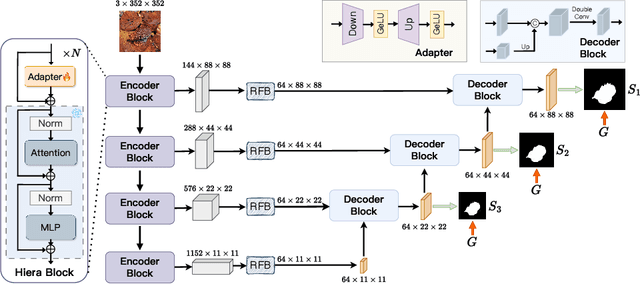
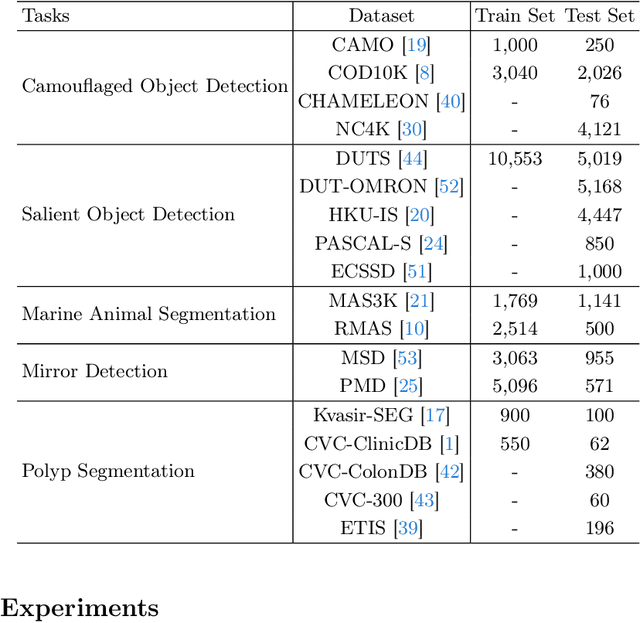
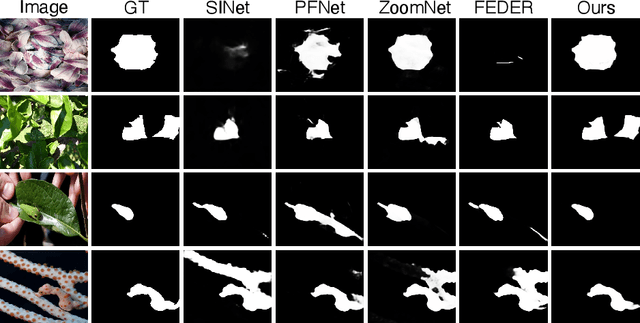
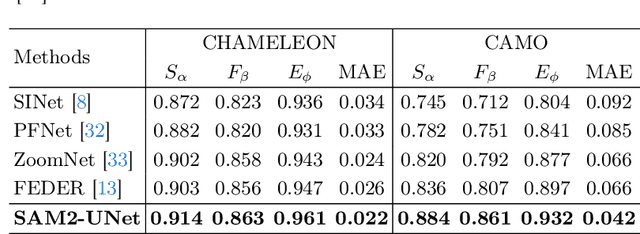
Image segmentation plays an important role in vision understanding. Recently, the emerging vision foundation models continuously achieved superior performance on various tasks. Following such success, in this paper, we prove that the Segment Anything Model 2 (SAM2) can be a strong encoder for U-shaped segmentation models. We propose a simple but effective framework, termed SAM2-UNet, for versatile image segmentation. Specifically, SAM2-UNet adopts the Hiera backbone of SAM2 as the encoder, while the decoder uses the classic U-shaped design. Additionally, adapters are inserted into the encoder to allow parameter-efficient fine-tuning. Preliminary experiments on various downstream tasks, such as camouflaged object detection, salient object detection, marine animal segmentation, mirror detection, and polyp segmentation, demonstrate that our SAM2-UNet can simply beat existing specialized state-of-the-art methods without bells and whistles. Project page: \url{https://github.com/WZH0120/SAM2-UNet}.
Knowledge Graph Assisted Automatic Sports News Writing
Feb 17, 2024In this paper, we present a novel method for automatically generating sports news, which employs a unique algorithm that extracts pivotal moments from live text broadcasts and uses them to create an initial draft of the news. This draft is further refined by incorporating key details and background information from a specially designed sports knowledge graph. This graph contains 5,893 entities, which are classified into three distinct conceptual categories, interconnected through four relationship types, and characterized by 27 unique attributes. In addition, we create a multi-stage learning model by combining convolutional neural networks and a transformer encoder. This model expresses entity-task interactions using convolutional neural networks and enriches entity representations in the query set with the transformer encoder. It also includes a processor to compute matching scores for incomplete triples, addressing few-shot knowledge graph completion problem. The efficiency of this approach has been confirmed through both subjective and objective evaluations of 50 selected test cases, demonstrating its capability in revolutionizing the creation of sports news.