 Add to Chrome
 Add to Firefox
 Add to Edge
Toward Effective Multimodal Graph Foundation Model: A Divide-and-Conquer Based Approach
Feb 04, 2026
Graph Foundation Models (GFMs) have achieved remarkable success in generalizing across diverse domains. However, they mainly focus on Text-Attributed Graphs (TAGs), leaving Multimodal-Attributed Graphs (MAGs) largely untapped. Developing Multimodal Graph Foundation Models (MGFMs) allows for leveraging the rich multimodal information in MAGs, and extends applicability to broader types of downstream tasks. While recent MGFMs integrate diverse modality information, our empirical investigation reveals two fundamental limitations of existing MGFMs: (1)they fail to explicitly model modality interaction, essential for capturing intricate cross-modal semantics beyond simple aggregation, and (2)they exhibit sub-optimal modality alignment, which is critical for bridging the significant semantic disparity between distinct modal spaces. To address these challenges, we propose PLANET (graPh topoLogy-aware modAlity iNteraction and alignmEnT), a novel framework employing a Divide-and-Conquer strategy to decouple modality interaction and alignment across distinct granularities. At the embedding granularity, (1)Embedding-wise Domain Gating (EDG) performs local semantic enrichment by adaptively infusing topology-aware cross-modal context, achieving modality interaction. At the node granularity, (2)Node-wise Discretization Retrieval (NDR) ensures global modality alignment by constructing a Discretized Semantic Representation Space (DSRS) to bridge modality gaps. Extensive experiments demonstrate that PLANET significantly outperforms state-of-the-art baselines across diverse graph-centric and multimodal generative tasks.

DOGMA: Weaving Structural Information into Data-centric Single-cell Transcriptomics Analysis
Feb 02, 2026Recently, data-centric AI methodology has been a dominant paradigm in single-cell transcriptomics analysis, which treats data representation rather than model complexity as the fundamental bottleneck. In the review of current studies, earlier sequence methods treat cells as independent entities and adapt prevalent ML models to analyze their directly inherited sequence data. Despite their simplicity and intuition, these methods overlook the latent intercellular relationships driven by the functional mechanisms of biological systems and the inherent quality issues of the raw sequence data. Therefore, a series of structured methods has emerged. Although they employ various heuristic rules to capture intricate intercellular relationships and enhance the raw sequencing data, these methods often neglect biological prior knowledge. This omission incurs substantial overhead and yields suboptimal graph representations, thereby hindering the utility of ML models. To address them, we propose DOGMA, a holistic data-centric framework designed for the structural reshaping and semantic enhancement of raw data through multi-level biological prior knowledge. Transcending reliance on stochastic heuristics, DOGMA redefines graph construction by integrating Statistical Anchors with Cell Ontology and Phylogenetic Trees to enable deterministic structure discovery and robust cross-species alignment. Furthermore, Gene Ontology is utilized to bridge the feature-level semantic gap by incorporating functional priors. In complex multi-species and multi-organ benchmarks, DOGMA achieves SOTA performance, exhibiting superior zero-shot robustness and sample efficiency while operating with significantly lower computational cost.
Two Sides of the Same Optimization Coin: Model Degradation and Representation Collapse in Graph Foundation Models
Sep 11, 2025Graph foundation models, inspired by the success of LLMs, are designed to learn the optimal embedding from multi-domain TAGs for the downstream cross-task generalization capability. During our investigation, graph VQ-MAE stands out among the increasingly diverse landscape of GFM architectures. This is attributed to its ability to jointly encode topology and textual attributes from multiple domains into discrete embedding spaces with clear semantic boundaries. Despite its potential, domain generalization conflicts cause imperceptible pitfalls. In this paper, we instantiate two of them, and they are just like two sides of the same GFM optimization coin - Side 1 Model Degradation: The encoder and codebook fail to capture the diversity of inputs; Side 2 Representation Collapse: The hidden embedding and codebook vector fail to preserve semantic separability due to constraints from narrow representation subspaces. These two pitfalls (sides) collectively impair the decoder and generate the low-quality reconstructed supervision, causing the GFM optimization dilemma during pre-training (coin). Through empirical investigation, we attribute the above challenges to Information Bottleneck and Regularization Deficit. To address them, we propose MoT (Mixture-of-Tinkers) - (1) Information Tinker for Two Pitfalls, which utilizes an edge-wise semantic fusion strategy and a mixture-of-codebooks with domain-aware routing to improve information capacity. (2) Regularization Tinker for Optimization Coin, which utilizes two additional regularizations to further improve gradient supervision in our proposed Information Tinker. Notably, as a flexible architecture, MoT adheres to the scaling laws of GFM, offering a controllable model scale. Compared to SOTA baselines, experiments on 22 datasets across 6 domains demonstrate that MoT achieves significant improvements in supervised, few-shot, and zero-shot scenarios.
A Graph-Enhanced DeepONet Approach for Real-Time Estimating Hydrogen-Enriched Natural Gas Flow under Variable Operations
Apr 09, 2025Blending green hydrogen into natural gas presents a promising approach for renewable energy integration and fuel decarbonization. Accurate estimation of hydrogen fraction in hydrogen-enriched natural gas (HENG) pipeline networks is crucial for operational safety and efficiency, yet it remains challenging due to complex dynamics. While existing data-driven approaches adopt end-to-end architectures for HENG flow state estimation, their limited adaptability to varying operational conditions hinders practical applications. To this end, this study proposes a graph-enhanced DeepONet framework for the real-time estimation of HENG flow, especially hydrogen fractions. First, a dual-network architecture, called branch network and trunk network, is employed to characterize operational conditions and sparse sensor measurements to estimate the HENG state at targeted locations and time points. Second, a graph-enhance branch network is proposed to incorporate pipeline topology, improving the estimation accuracy in large-scale pipeline networks. Experimental results demonstrate that the proposed method achieves superior estimation accuracy for HCNG flow under varying operational conditions compared to conventional approaches.
SITransformer: Shared Information-Guided Transformer for Extreme Multimodal Summarization
Aug 29, 2024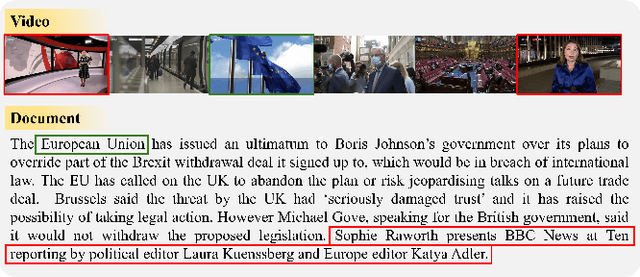
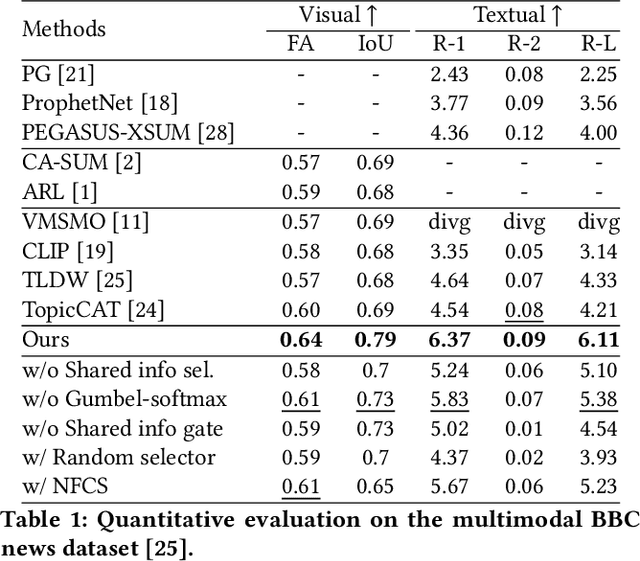
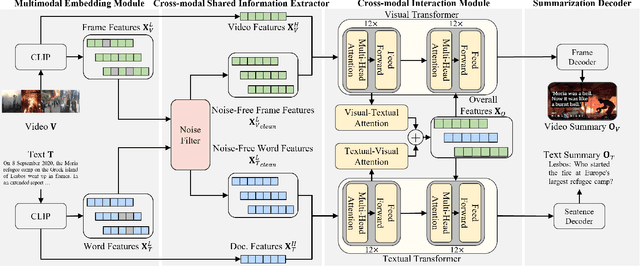
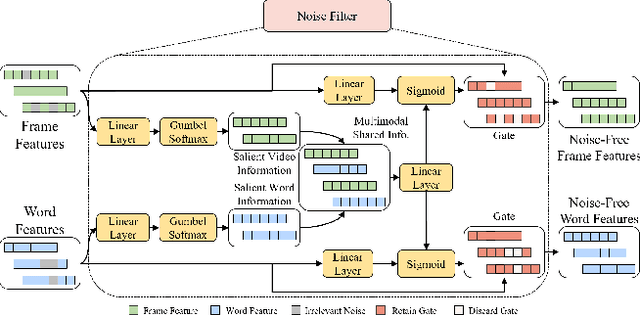
Extreme Multimodal Summarization with Multimodal Output (XMSMO) becomes an attractive summarization approach by integrating various types of information to create extremely concise yet informative summaries for individual modalities. Existing methods overlook the issue that multimodal data often contains more topic irrelevant information, which can mislead the model into producing inaccurate summaries especially for extremely short ones. In this paper, we propose SITransformer, a Shared Information-guided Transformer for extreme multimodal summarization. It has a shared information guided pipeline which involves a cross-modal shared information extractor and a cross-modal interaction module. The extractor formulates semantically shared salient information from different modalities by devising a novel filtering process consisting of a differentiable top-k selector and a shared-information guided gating unit. As a result, the common, salient, and relevant contents across modalities are identified. Next, a transformer with cross-modal attentions is developed for intra- and inter-modality learning with the shared information guidance to produce the extreme summary. Comprehensive experiments demonstrate that SITransformer significantly enhances the summarization quality for both video and text summaries for XMSMO. Our code will be publicly available at https://github.com/SichengLeoLiu/MMAsia24-XMSMO.
A General-Purpose Device for Interaction with LLMs
Aug 02, 2024This paper investigates integrating large language models (LLMs) with advanced hardware, focusing on developing a general-purpose device designed for enhanced interaction with LLMs. Initially, we analyze the current landscape, where virtual assistants and LLMs are reshaping human-technology interactions, highlighting pivotal advancements and setting the stage for a new era of intelligent hardware. Despite substantial progress in LLM technology, a significant gap exists in hardware development, particularly concerning scalability, efficiency, affordability, and multimodal capabilities. This disparity presents both challenges and opportunities, underscoring the need for hardware that is not only powerful but also versatile and capable of managing the sophisticated demands of modern computation. Our proposed device addresses these needs by emphasizing scalability, multimodal data processing, enhanced user interaction, and privacy considerations, offering a comprehensive platform for LLM integration in various applications.