 Add to Chrome
 Add to Firefox
 Add to Edge
VTONGuard: Automatic Detection and Authentication of AI-Generated Virtual Try-On Content
Jan 20, 2026
With the rapid advancement of generative AI, virtual try-on (VTON) systems are becoming increasingly common in e-commerce and digital entertainment. However, the growing realism of AI-generated try-on content raises pressing concerns about authenticity and responsible use. To address this, we present VTONGuard, a large-scale benchmark dataset containing over 775,000 real and synthetic try-on images. The dataset covers diverse real-world conditions, including variations in pose, background, and garment styles, and provides both authentic and manipulated examples. Based on this benchmark, we conduct a systematic evaluation of multiple detection paradigms under unified training and testing protocols. Our results reveal each method's strengths and weaknesses and highlight the persistent challenge of cross-paradigm generalization. To further advance detection, we design a multi-task framework that integrates auxiliary segmentation to enhance boundary-aware feature learning, achieving the best overall performance on VTONGuard. We expect this benchmark to enable fair comparisons, facilitate the development of more robust detection models, and promote the safe and responsible deployment of VTON technologies in practice.

Self-Supervised Vision Transformer for Enhanced Virtual Clothes Try-On
Jun 15, 2024Virtual clothes try-on has emerged as a vital feature in online shopping, offering consumers a critical tool to visualize how clothing fits. In our research, we introduce an innovative approach for virtual clothes try-on, utilizing a self-supervised Vision Transformer (ViT) coupled with a diffusion model. Our method emphasizes detail enhancement by contrasting local clothing image embeddings, generated by ViT, with their global counterparts. Techniques such as conditional guidance and focus on key regions have been integrated into our approach. These combined strategies empower the diffusion model to reproduce clothing details with increased clarity and realism. The experimental results showcase substantial advancements in the realism and precision of details in virtual try-on experiences, significantly surpassing the capabilities of existing technologies.
Variable fusion for Bayesian linear regression via spike-and-slab priors
Mar 30, 2020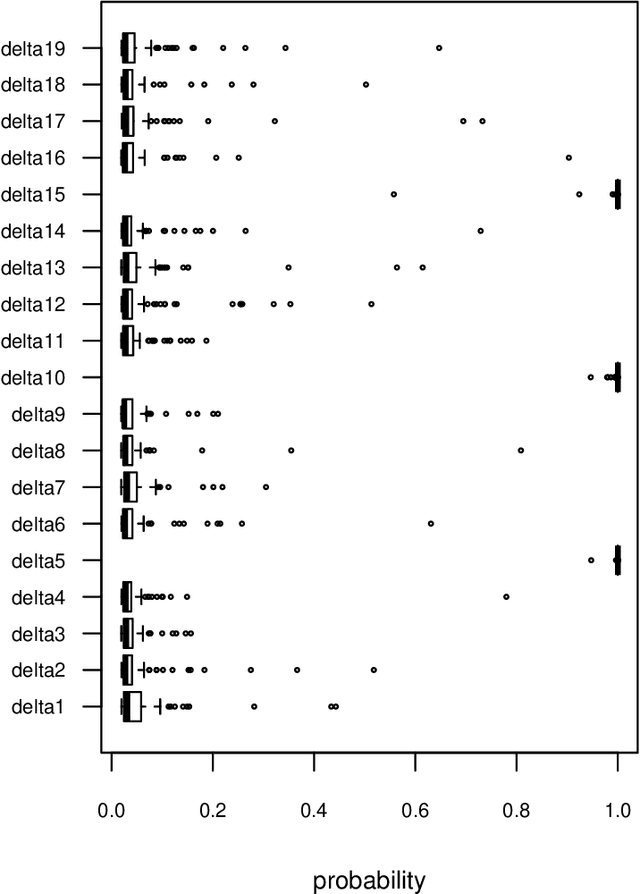
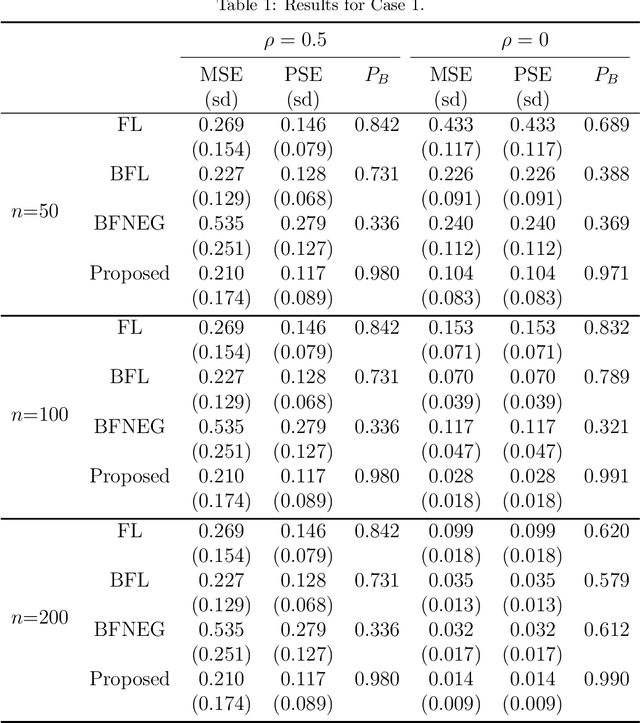
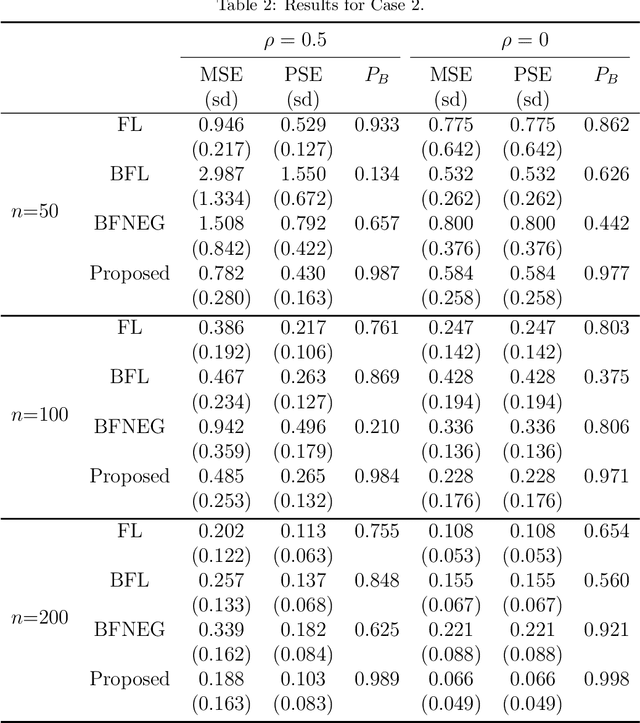
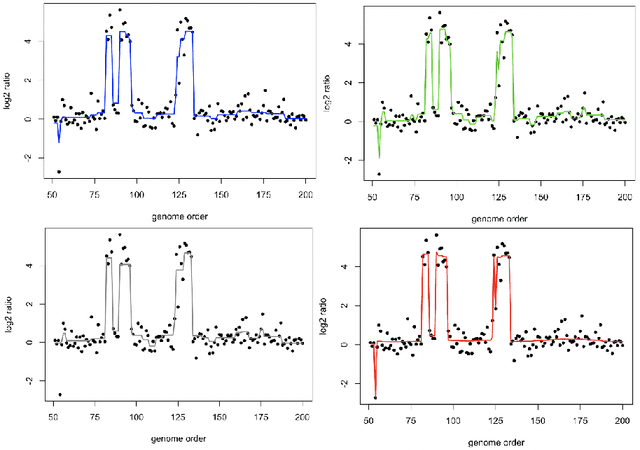
In linear regression models, a fusion of the coefficients is used to identify the predictors having similar relationships with the response. This is called variable fusion. This paper presents a novel variable fusion method in terms of Bayesian linear regression models. We focus on hierarchical Bayesian models based on a spike-and-slab prior approach. A spike-and-slab prior is designed to perform variable fusion. To obtain estimates of parameters, we develop a Gibbs sampler for the parameters. Simulation studies and a real data analysis show that our proposed method has better performances than previous methods.