 Add to Chrome
 Add to Firefox
 Add to Edge
DOS: Dual-Flow Orthogonal Semantic IDs for Recommendation in Meituan
Feb 04, 2026
Semantic IDs serve as a key component in generative recommendation systems. They not only incorporate open-world knowledge from large language models (LLMs) but also compress the semantic space to reduce generation difficulty. However, existing methods suffer from two major limitations: (1) the lack of contextual awareness in generation tasks leads to a gap between the Semantic ID codebook space and the generation space, resulting in suboptimal recommendations; and (2) suboptimal quantization methods exacerbate semantic loss in LLMs. To address these issues, we propose Dual-Flow Orthogonal Semantic IDs (DOS) method. Specifically, DOS employs a user-item dual flow-framework that leverages collaborative signals to align the Semantic ID codebook space with the generation space. Furthermore, we introduce an orthogonal residual quantization scheme that rotates the semantic space to an appropriate orientation, thereby maximizing semantic preservation. Extensive offline experiments and online A/B testing demonstrate the effectiveness of DOS. The proposed method has been successfully deployed in Meituan's mobile application, serving hundreds of millions of users.

NLGR: Utilizing Neighbor Lists for Generative Rerank in Personalized Recommendation Systems
Feb 10, 2025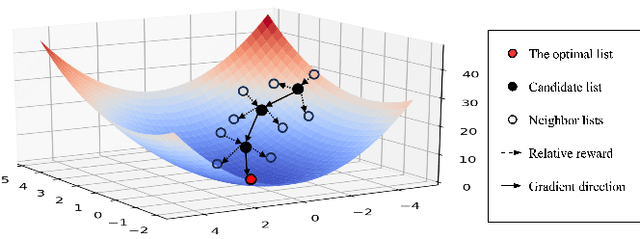

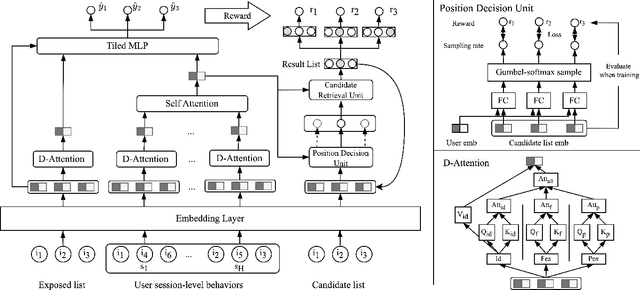
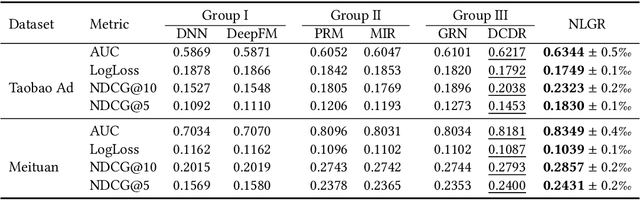
Reranking plays a crucial role in modern multi-stage recommender systems by rearranging the initial ranking list. Due to the inherent challenges of combinatorial search spaces, some current research adopts an evaluator-generator paradigm, with a generator generating feasible sequences and an evaluator selecting the best sequence based on the estimated list utility. However, these methods still face two issues. Firstly, due to the goal inconsistency problem between the evaluator and generator, the generator tends to fit the local optimal solution of exposure distribution rather than combinatorial space optimization. Secondly, the strategy of generating target items one by one is difficult to achieve optimality because it ignores the information of subsequent items. To address these issues, we propose a utilizing Neighbor Lists model for Generative Reranking (NLGR), which aims to improve the performance of the generator in the combinatorial space. NLGR follows the evaluator-generator paradigm and improves the generator's training and generating methods. Specifically, we use neighbor lists in combination space to enhance the training process, making the generator perceive the relative scores and find the optimization direction. Furthermore, we propose a novel sampling-based non-autoregressive generation method, which allows the generator to jump flexibly from the current list to any neighbor list. Extensive experiments on public and industrial datasets validate NLGR's effectiveness and we have successfully deployed NLGR on the Meituan food delivery platform.