 Add to Chrome
 Add to Firefox
 Add to Edge
SMoFi: Step-wise Momentum Fusion for Split Federated Learning on Heterogeneous Data
Nov 16, 2025

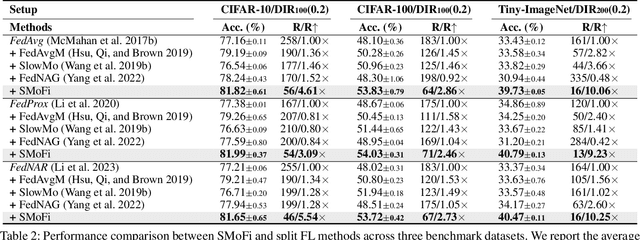


Split Federated Learning is a system-efficient federated learning paradigm that leverages the rich computing resources at a central server to train model partitions. Data heterogeneity across silos, however, presents a major challenge undermining the convergence speed and accuracy of the global model. This paper introduces Step-wise Momentum Fusion (SMoFi), an effective and lightweight framework that counteracts gradient divergence arising from data heterogeneity by synchronizing the momentum buffers across server-side optimizers. To control gradient divergence over the training process, we design a staleness-aware alignment mechanism that imposes constraints on gradient updates of the server-side submodel at each optimization step. Extensive validations on multiple real-world datasets show that SMoFi consistently improves global model accuracy (up to 7.1%) and convergence speed (up to 10.25$\times$). Furthermore, SMoFi has a greater impact with more clients involved and deeper learning models, making it particularly suitable for model training in resource-constrained contexts.

dots.llm1 Technical Report
Jun 06, 2025Mixture of Experts (MoE) models have emerged as a promising paradigm for scaling language models efficiently by activating only a subset of parameters for each input token. In this report, we present dots.llm1, a large-scale MoE model that activates 14B parameters out of a total of 142B parameters, delivering performance on par with state-of-the-art models while reducing training and inference costs. Leveraging our meticulously crafted and efficient data processing pipeline, dots.llm1 achieves performance comparable to Qwen2.5-72B after pretraining on 11.2T high-quality tokens and post-training to fully unlock its capabilities. Notably, no synthetic data is used during pretraining. To foster further research, we open-source intermediate training checkpoints at every one trillion tokens, providing valuable insights into the learning dynamics of large language models.
DeepAVO: Efficient Pose Refining with Feature Distilling for Deep Visual Odometry
May 20, 2021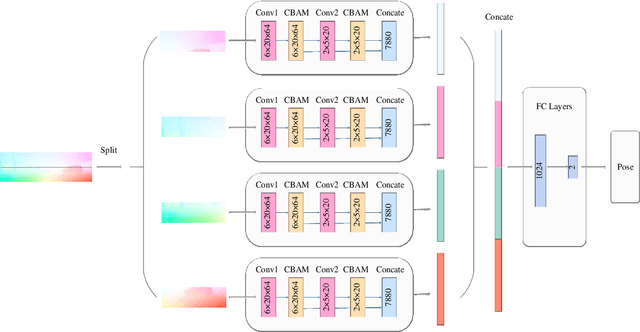
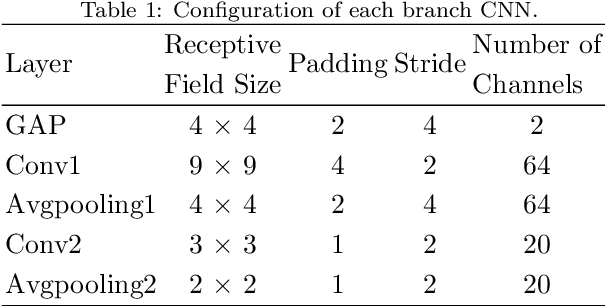
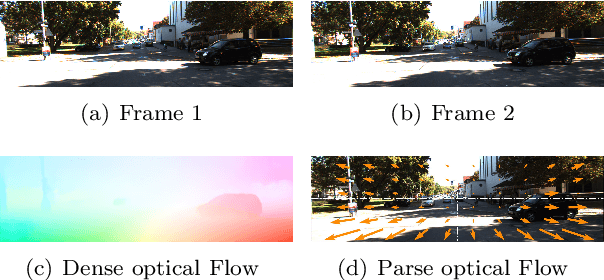
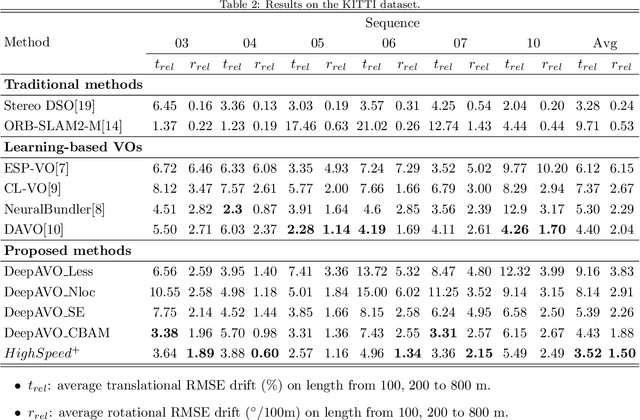
The technology for Visual Odometry (VO) that estimates the position and orientation of the moving object through analyzing the image sequences captured by on-board cameras, has been well investigated with the rising interest in autonomous driving. This paper studies monocular VO from the perspective of Deep Learning (DL). Unlike most current learning-based methods, our approach, called DeepAVO, is established on the intuition that features contribute discriminately to different motion patterns. Specifically, we present a novel four-branch network to learn the rotation and translation by leveraging Convolutional Neural Networks (CNNs) to focus on different quadrants of optical flow input. To enhance the ability of feature selection, we further introduce an effective channel-spatial attention mechanism to force each branch to explicitly distill related information for specific Frame to Frame (F2F) motion estimation. Experiments on various datasets involving outdoor driving and indoor walking scenarios show that the proposed DeepAVO outperforms the state-of-the-art monocular methods by a large margin, demonstrating competitive performance to the stereo VO algorithm and verifying promising potential for generalization.