 Add to Chrome
 Add to Firefox
 Add to Edge
SOM Directions are Better than One: Multi-Directional Refusal Suppression in Language Models
Nov 13, 2025
Refusal refers to the functional behavior enabling safety-aligned language models to reject harmful or unethical prompts. Following the growing scientific interest in mechanistic interpretability, recent work encoded refusal behavior as a single direction in the model's latent space; e.g., computed as the difference between the centroids of harmful and harmless prompt representations. However, emerging evidence suggests that concepts in LLMs often appear to be encoded as a low-dimensional manifold embedded in the high-dimensional latent space. Motivated by these findings, we propose a novel method leveraging Self-Organizing Maps (SOMs) to extract multiple refusal directions. To this end, we first prove that SOMs generalize the prior work's difference-in-means technique. We then train SOMs on harmful prompt representations to identify multiple neurons. By subtracting the centroid of harmless representations from each neuron, we derive a set of multiple directions expressing the refusal concept. We validate our method on an extensive experimental setup, demonstrating that ablating multiple directions from models' internals outperforms not only the single-direction baseline but also specialized jailbreak algorithms, leading to an effective suppression of refusal. Finally, we conclude by analyzing the mechanistic implications of our approach.

HO-FMN: Hyperparameter Optimization for Fast Minimum-Norm Attacks
Jul 11, 2024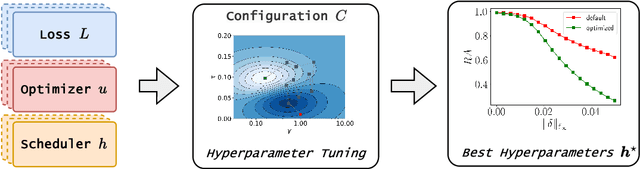
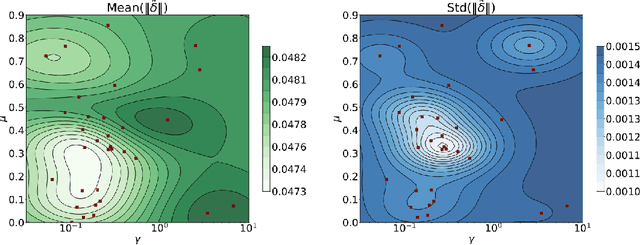
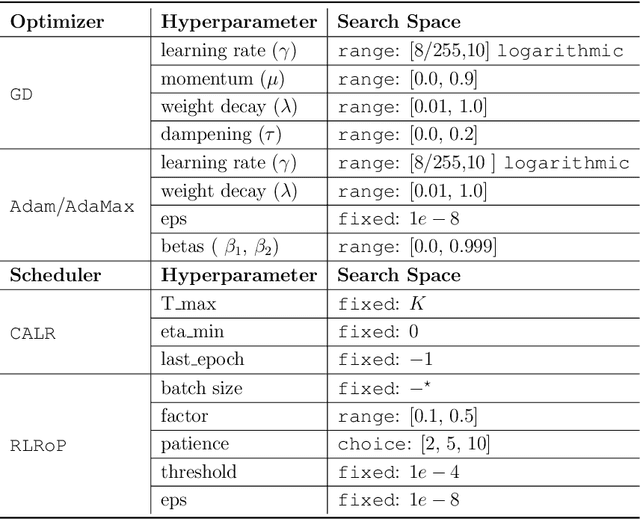
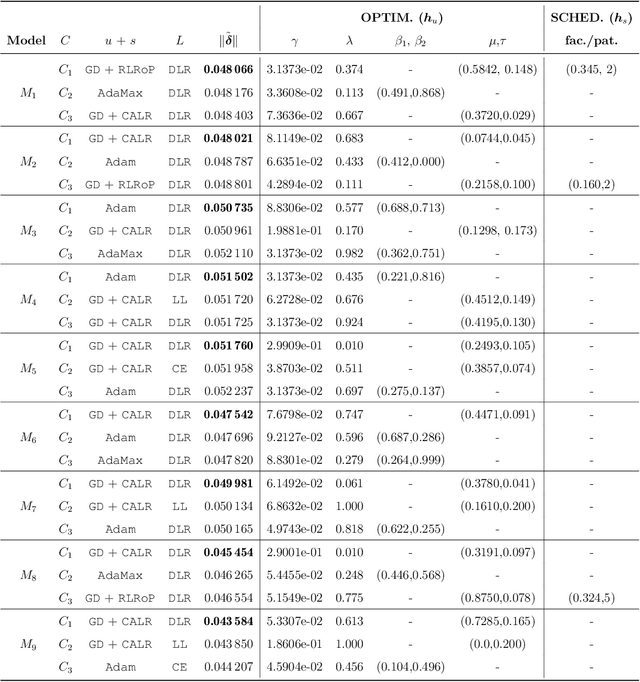
Gradient-based attacks are a primary tool to evaluate robustness of machine-learning models. However, many attacks tend to provide overly-optimistic evaluations as they use fixed loss functions, optimizers, step-size schedulers, and default hyperparameters. In this work, we tackle these limitations by proposing a parametric variation of the well-known fast minimum-norm attack algorithm, whose loss, optimizer, step-size scheduler, and hyperparameters can be dynamically adjusted. We re-evaluate 12 robust models, showing that our attack finds smaller adversarial perturbations without requiring any additional tuning. This also enables reporting adversarial robustness as a function of the perturbation budget, providing a more complete evaluation than that offered by fixed-budget attacks, while remaining efficient. We release our open-source code at https://github.com/pralab/HO-FMN.
Improving Fast Minimum-Norm Attacks with Hyperparameter Optimization
Oct 12, 2023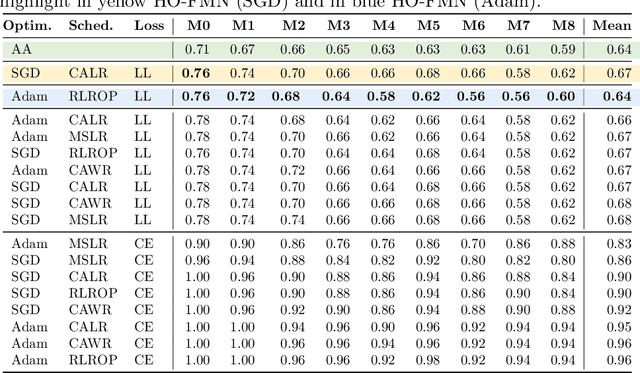
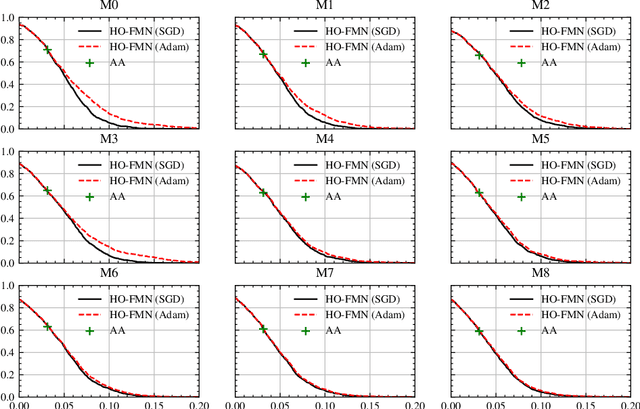
Evaluating the adversarial robustness of machine learning models using gradient-based attacks is challenging. In this work, we show that hyperparameter optimization can improve fast minimum-norm attacks by automating the selection of the loss function, the optimizer and the step-size scheduler, along with the corresponding hyperparameters. Our extensive evaluation involving several robust models demonstrates the improved efficacy of fast minimum-norm attacks when hyper-up with hyperparameter optimization. We release our open-source code at https://github.com/pralab/HO-FMN.