 Add to Chrome
 Add to Firefox
 Add to Edge
The Llama 4 Herd: Architecture, Training, Evaluation, and Deployment Notes
Jan 15, 2026
This document consolidates publicly reported technical details about Metas Llama 4 model family. It summarizes (i) released variants (Scout and Maverick) and the broader herd context including the previewed Behemoth teacher model, (ii) architectural characteristics beyond a high-level MoE description covering routed/shared-expert structure, early-fusion multimodality, and long-context design elements reported for Scout (iRoPE and length generalization strategies), (iii) training disclosures spanning pre-training, mid-training for long-context extension, and post-training methodology (lightweight SFT, online RL, and lightweight DPO) as described in release materials, (iv) developer-reported benchmark results for both base and instruction-tuned checkpoints, and (v) practical deployment constraints observed across major serving environments, including provider-specific context limits and quantization packaging. The manuscript also summarizes licensing obligations relevant to redistribution and derivative naming, and reviews publicly described safeguards and evaluation practices. The goal is to provide a compact technical reference for researchers and practitioners who need precise, source-backed facts about Llama 4.

Meta 3D TextureGen: Fast and Consistent Texture Generation for 3D Objects
Jul 02, 2024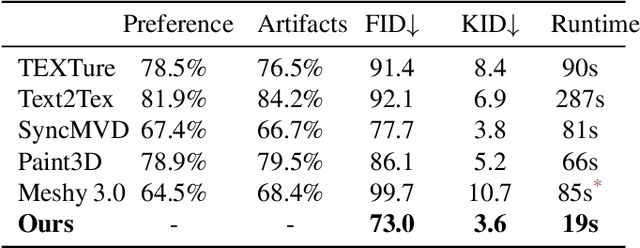
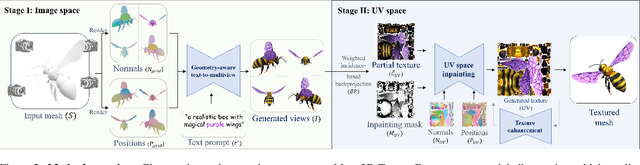
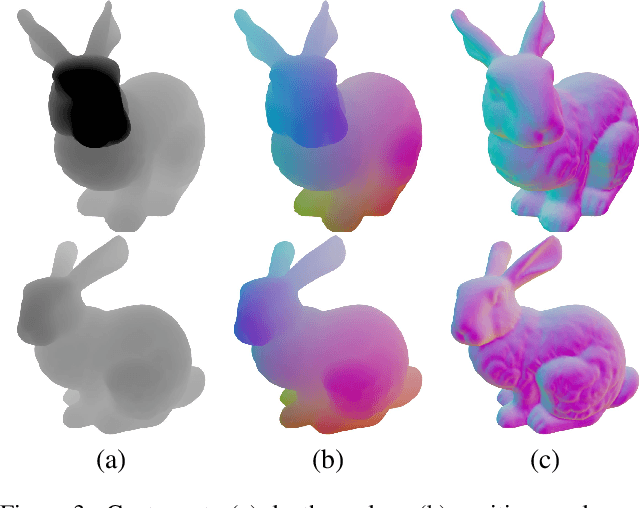
The recent availability and adaptability of text-to-image models has sparked a new era in many related domains that benefit from the learned text priors as well as high-quality and fast generation capabilities, one of which is texture generation for 3D objects. Although recent texture generation methods achieve impressive results by using text-to-image networks, the combination of global consistency, quality, and speed, which is crucial for advancing texture generation to real-world applications, remains elusive. To that end, we introduce Meta 3D TextureGen: a new feedforward method comprised of two sequential networks aimed at generating high-quality and globally consistent textures for arbitrary geometries of any complexity degree in less than 20 seconds. Our method achieves state-of-the-art results in quality and speed by conditioning a text-to-image model on 3D semantics in 2D space and fusing them into a complete and high-resolution UV texture map, as demonstrated by extensive qualitative and quantitative evaluations. In addition, we introduce a texture enhancement network that is capable of up-scaling any texture by an arbitrary ratio, producing 4k pixel resolution textures.
Meta 3D Gen
Jul 02, 2024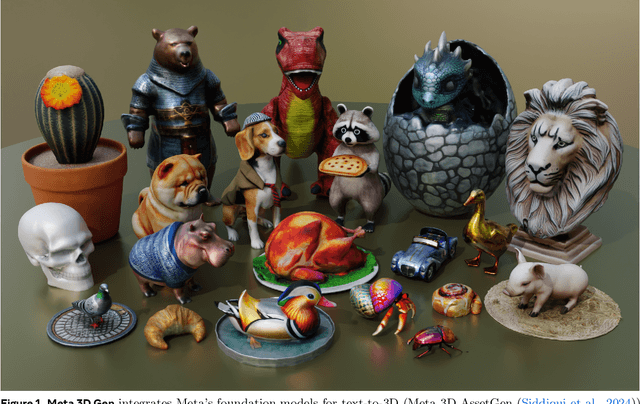
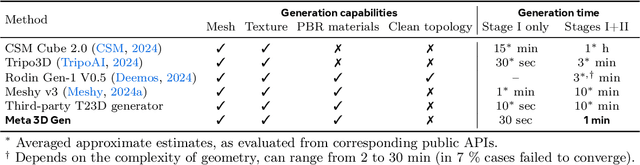
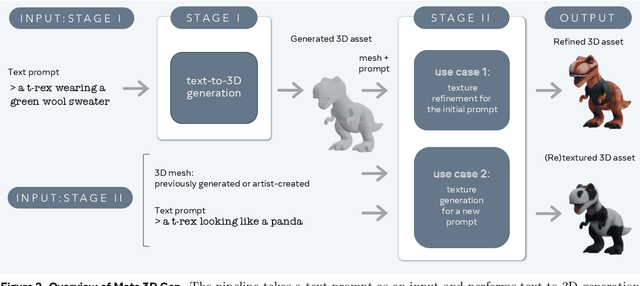
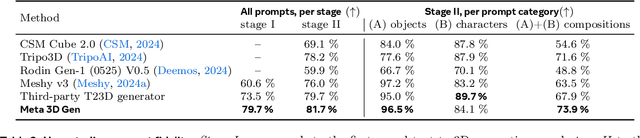
We introduce Meta 3D Gen (3DGen), a new state-of-the-art, fast pipeline for text-to-3D asset generation. 3DGen offers 3D asset creation with high prompt fidelity and high-quality 3D shapes and textures in under a minute. It supports physically-based rendering (PBR), necessary for 3D asset relighting in real-world applications. Additionally, 3DGen supports generative retexturing of previously generated (or artist-created) 3D shapes using additional textual inputs provided by the user. 3DGen integrates key technical components, Meta 3D AssetGen and Meta 3D TextureGen, that we developed for text-to-3D and text-to-texture generation, respectively. By combining their strengths, 3DGen represents 3D objects simultaneously in three ways: in view space, in volumetric space, and in UV (or texture) space. The integration of these two techniques achieves a win rate of 68% with respect to the single-stage model. We compare 3DGen to numerous industry baselines, and show that it outperforms them in terms of prompt fidelity and visual quality for complex textual prompts, while being significantly faster.