 Add to Chrome
 Add to Firefox
 Add to Edge
Sycophancy Hides Linearly in the Attention Heads
Jan 23, 2026
We find that correct-to-incorrect sycophancy signals are most linearly separable within multi-head attention activations. Motivated by the linear representation hypothesis, we train linear probes across the residual stream, multilayer perceptron (MLP), and attention layers to analyze where these signals emerge. Although separability appears in the residual stream and MLPs, steering using these probes is most effective in a sparse subset of middle-layer attention heads. Using TruthfulQA as the base dataset, we find that probes trained on it transfer effectively to other factual QA benchmarks. Furthermore, comparing our discovered direction to previously identified "truthful" directions reveals limited overlap, suggesting that factual accuracy, and deference resistance, arise from related but distinct mechanisms. Attention-pattern analysis further indicates that the influential heads attend disproportionately to expressions of user doubt, contributing to sycophantic shifts. Overall, these findings suggest that sycophancy can be mitigated through simple, targeted linear interventions that exploit the internal geometry of attention activations.

Llama-3.1-Sherkala-8B-Chat: An Open Large Language Model for Kazakh
Mar 03, 2025Llama-3.1-Sherkala-8B-Chat, or Sherkala-Chat (8B) for short, is a state-of-the-art instruction-tuned open generative large language model (LLM) designed for Kazakh. Sherkala-Chat (8B) aims to enhance the inclusivity of LLM advancements for Kazakh speakers. Adapted from the LLaMA-3.1-8B model, Sherkala-Chat (8B) is trained on 45.3B tokens across Kazakh, English, Russian, and Turkish. With 8 billion parameters, it demonstrates strong knowledge and reasoning abilities in Kazakh, significantly outperforming existing open Kazakh and multilingual models of similar scale while achieving competitive performance in English. We release Sherkala-Chat (8B) as an open-weight instruction-tuned model and provide a detailed overview of its training, fine-tuning, safety alignment, and evaluation, aiming to advance research and support diverse real-world applications.
Qorgau: Evaluating LLM Safety in Kazakh-Russian Bilingual Contexts
Feb 19, 2025Large language models (LLMs) are known to have the potential to generate harmful content, posing risks to users. While significant progress has been made in developing taxonomies for LLM risks and safety evaluation prompts, most studies have focused on monolingual contexts, primarily in English. However, language- and region-specific risks in bilingual contexts are often overlooked, and core findings can diverge from those in monolingual settings. In this paper, we introduce Qorgau, a novel dataset specifically designed for safety evaluation in Kazakh and Russian, reflecting the unique bilingual context in Kazakhstan, where both Kazakh (a low-resource language) and Russian (a high-resource language) are spoken. Experiments with both multilingual and language-specific LLMs reveal notable differences in safety performance, emphasizing the need for tailored, region-specific datasets to ensure the responsible and safe deployment of LLMs in countries like Kazakhstan. Warning: this paper contains example data that may be offensive, harmful, or biased.
KazMMLU: Evaluating Language Models on Kazakh, Russian, and Regional Knowledge of Kazakhstan
Feb 18, 2025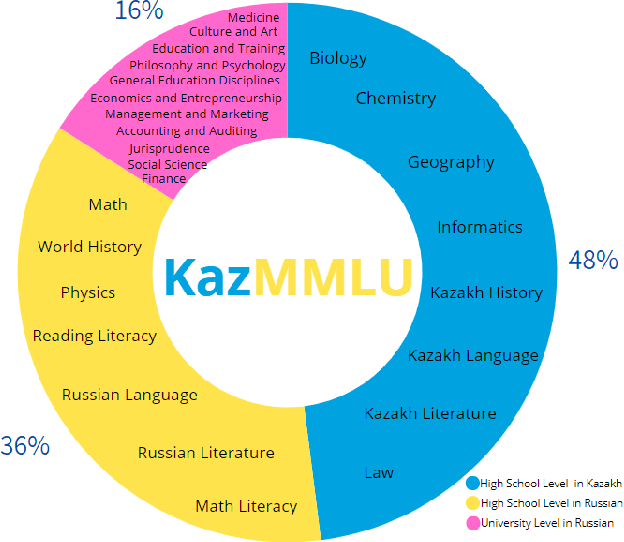
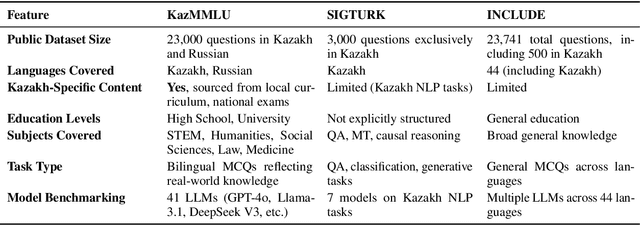
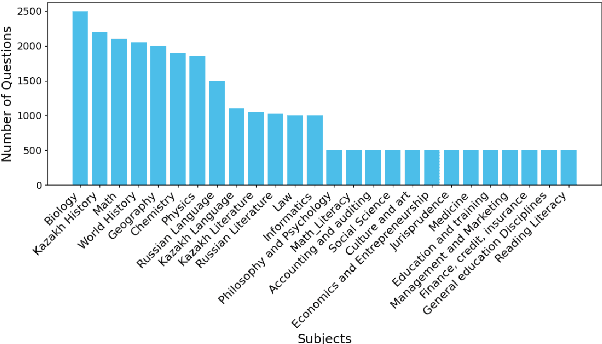
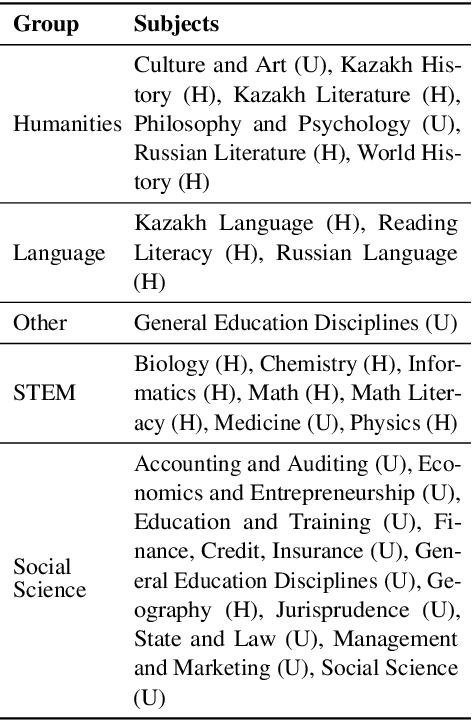
Despite having a population of twenty million, Kazakhstan's culture and language remain underrepresented in the field of natural language processing. Although large language models (LLMs) continue to advance worldwide, progress in Kazakh language has been limited, as seen in the scarcity of dedicated models and benchmark evaluations. To address this gap, we introduce KazMMLU, the first MMLU-style dataset specifically designed for Kazakh language. KazMMLU comprises 23,000 questions that cover various educational levels, including STEM, humanities, and social sciences, sourced from authentic educational materials and manually validated by native speakers and educators. The dataset includes 10,969 Kazakh questions and 12,031 Russian questions, reflecting Kazakhstan's bilingual education system and rich local context. Our evaluation of several state-of-the-art multilingual models (Llama-3.1, Qwen-2.5, GPT-4, and DeepSeek V3) demonstrates substantial room for improvement, as even the best-performing models struggle to achieve competitive performance in Kazakh and Russian. These findings underscore significant performance gaps compared to high-resource languages. We hope that our dataset will enable further research and development of Kazakh-centric LLMs. Data and code will be made available upon acceptance.