 Add to Chrome
 Add to Firefox
 Add to Edge
ProDCARL: Reinforcement Learning-Aligned Diffusion Models for De Novo Antimicrobial Peptide Design
Jan 29, 2026
Antimicrobial resistance threatens healthcare sustainability and motivates low-cost computational discovery of antimicrobial peptides (AMPs). De novo peptide generation must optimize antimicrobial activity and safety through low predicted toxicity, but likelihood-trained generators do not enforce these goals explicitly. We introduce ProDCARL, a reinforcement-learning alignment framework that couples a diffusion-based protein generator (EvoDiff OA-DM 38M) with sequence property predictors for AMP activity and peptide toxicity. We fine-tune the diffusion prior on AMP sequences to obtain a domain-aware generator. Top-k policy-gradient updates use classifier-derived rewards plus entropy regularization and early stopping to preserve diversity and reduce reward hacking. In silico experiments show ProDCARL increases the mean predicted AMP score from 0.081 after fine-tuning to 0.178. The joint high-quality hit rate reaches 6.3\% with pAMP $>$0.7 and pTox $<$0.3. ProDCARL maintains high diversity, with $1-$mean pairwise identity equal to 0.929. Qualitative analyses with AlphaFold3 and ProtBERT embeddings suggest candidates show plausible AMP-like structural and semantic characteristics. ProDCARL serves as a candidate generator that narrows experimental search space, and experimental validation remains future work.

Externally Validated Longitudinal GRU Model for Visit-Level 180-Day Mortality Risk in Metastatic Castration-Resistant Prostate Cancer
Jan 27, 2026Metastatic castration-resistant prostate cancer (mCRPC) is a highly aggressive disease with poor prognosis and heterogeneous treatment response. In this work, we developed and externally validated a visit-level 180-day mortality risk model using longitudinal data from two Phase III cohorts (n=526 and n=640). Only visits with observable 180-day outcomes were labeled; right-censored cases were excluded from analysis. We compared five candidate architectures: Long Short-Term Memory, Gated Recurrent Unit (GRU), Cox Proportional Hazards, Random Survival Forest (RSF), and Logistic Regression. For each dataset, we selected the smallest risk-threshold that achieved an 85% sensitivity floor. The GRU and RSF models showed high discrimination capabilities initially (C-index: 87% for both). In external validation, the GRU obtained a higher calibration (slope: 0.93; intercept: 0.07) and achieved an PR-AUC of 0.87. Clinical impact analysis showed a median time-in-warning of 151.0 days for true positives (59.0 days for false positives) and 18.3 alerts per 100 patient-visits. Given late-stage frailty or cachexia and hemodynamic instability, permutation importance ranked BMI and systolic blood pressure as the strongest associations. These results suggest that longitudinal routine clinical markers can estimate short-horizon mortality risk in mCRPC and support proactive care planning over a multi-month window.
Perimeter Control Using Deep Reinforcement Learning: A Model-free Approach towards Homogeneous Flow Rate Optimization
May 29, 2023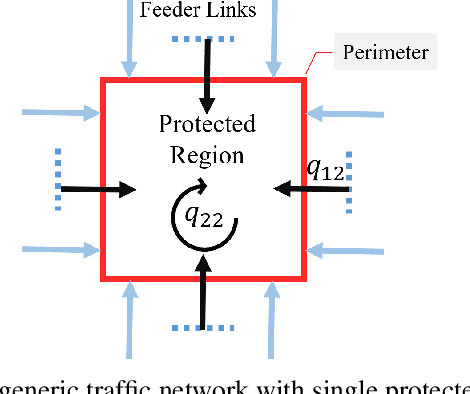
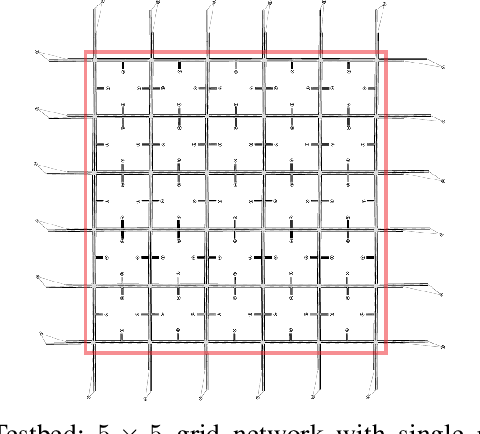
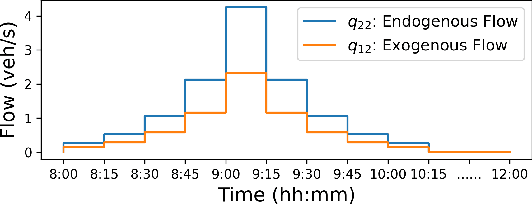
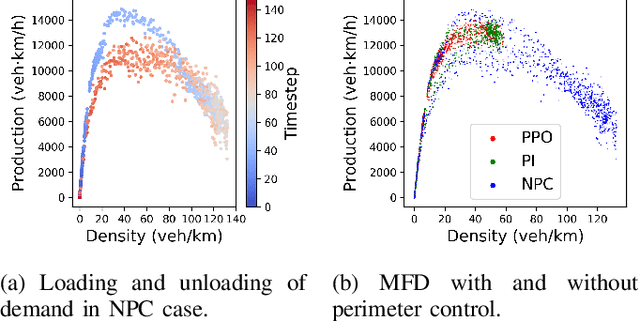
Perimeter control maintains high traffic efficiency within protected regions by controlling transfer flows among regions to ensure that their traffic densities are below critical values. Existing approaches can be categorized as either model-based or model-free, depending on whether they rely on network transmission models (NTMs) and macroscopic fundamental diagrams (MFDs). Although model-based approaches are more data efficient and have performance guarantees, they are inherently prone to model bias and inaccuracy. For example, NTMs often become imprecise for a large number of protected regions, and MFDs can exhibit scatter and hysteresis that are not captured in existing model-based works. Moreover, no existing studies have employed reinforcement learning for homogeneous flow rate optimization in microscopic simulation, where spatial characteristics, vehicle-level information, and metering realizations -- often overlooked in macroscopic simulations -- are taken into account. To circumvent issues of model-based approaches and macroscopic simulation, we propose a model-free deep reinforcement learning approach that optimizes the flow rate homogeneously at the perimeter at the microscopic level. Results demonstrate that our model-free reinforcement learning approach without any knowledge of NTMs or MFDs can compete and match the performance of a model-based approach, and exhibits enhanced generalizability and scalability.