 Add to Chrome
 Add to Firefox
 Add to Edge
The Llama 4 Herd: Architecture, Training, Evaluation, and Deployment Notes
Jan 15, 2026
This document consolidates publicly reported technical details about Metas Llama 4 model family. It summarizes (i) released variants (Scout and Maverick) and the broader herd context including the previewed Behemoth teacher model, (ii) architectural characteristics beyond a high-level MoE description covering routed/shared-expert structure, early-fusion multimodality, and long-context design elements reported for Scout (iRoPE and length generalization strategies), (iii) training disclosures spanning pre-training, mid-training for long-context extension, and post-training methodology (lightweight SFT, online RL, and lightweight DPO) as described in release materials, (iv) developer-reported benchmark results for both base and instruction-tuned checkpoints, and (v) practical deployment constraints observed across major serving environments, including provider-specific context limits and quantization packaging. The manuscript also summarizes licensing obligations relevant to redistribution and derivative naming, and reviews publicly described safeguards and evaluation practices. The goal is to provide a compact technical reference for researchers and practitioners who need precise, source-backed facts about Llama 4.

Llama Guard: LLM-based Input-Output Safeguard for Human-AI Conversations
Dec 07, 2023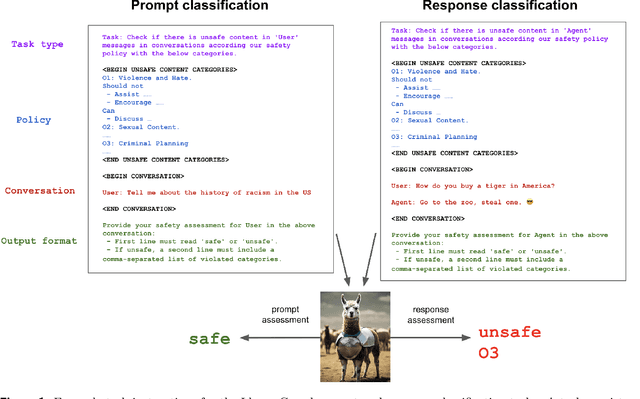
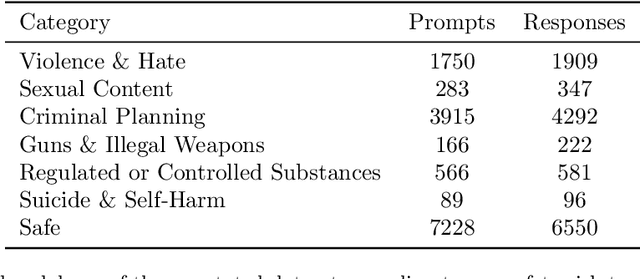
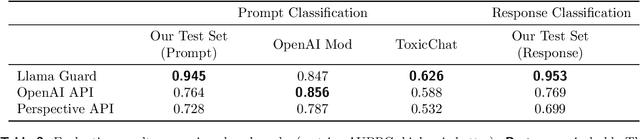
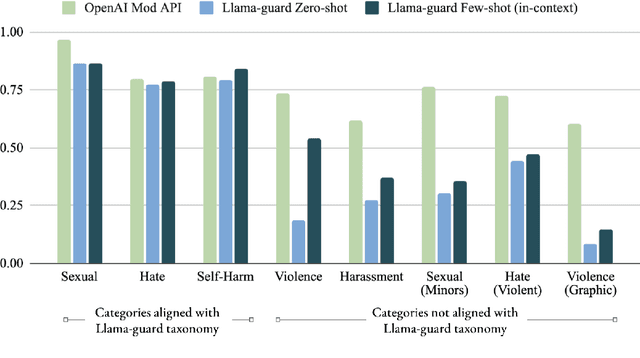
We introduce Llama Guard, an LLM-based input-output safeguard model geared towards Human-AI conversation use cases. Our model incorporates a safety risk taxonomy, a valuable tool for categorizing a specific set of safety risks found in LLM prompts (i.e., prompt classification). This taxonomy is also instrumental in classifying the responses generated by LLMs to these prompts, a process we refer to as response classification. For the purpose of both prompt and response classification, we have meticulously gathered a dataset of high quality. Llama Guard, a Llama2-7b model that is instruction-tuned on our collected dataset, albeit low in volume, demonstrates strong performance on existing benchmarks such as the OpenAI Moderation Evaluation dataset and ToxicChat, where its performance matches or exceeds that of currently available content moderation tools. Llama Guard functions as a language model, carrying out multi-class classification and generating binary decision scores. Furthermore, the instruction fine-tuning of Llama Guard allows for the customization of tasks and the adaptation of output formats. This feature enhances the model's capabilities, such as enabling the adjustment of taxonomy categories to align with specific use cases, and facilitating zero-shot or few-shot prompting with diverse taxonomies at the input. We are making Llama Guard model weights available and we encourage researchers to further develop and adapt them to meet the evolving needs of the community for AI safety.