 Add to Chrome
 Add to Firefox
 Add to Edge
AFD-INSTRUCTION: A Comprehensive Antibody Instruction Dataset with Functional Annotations for LLM-Based Understanding and Design
Feb 04, 2026
Large language models (LLMs) have significantly advanced protein representation learning. However, their capacity to interpret and design antibodies through natural language remains limited. To address this challenge, we present AFD-Instruction, the first large-scale instruction dataset with functional annotations tailored to antibodies. This dataset encompasses two key components: antibody understanding, which infers functional attributes directly from sequences, and antibody design, which enables de novo sequence generation under functional constraints. These components provide explicit sequence-function alignment and support antibody design guided by natural language instructions. Extensive instruction-tuning experiments on general-purpose LLMs demonstrate that AFD-Instruction consistently improves performance across diverse antibody-related tasks. By linking antibody sequences with textual descriptions of function, AFD-Instruction establishes a new foundation for advancing antibody modeling and accelerating therapeutic discovery.

ST-Align: A Multimodal Foundation Model for Image-Gene Alignment in Spatial Transcriptomics
Nov 25, 2024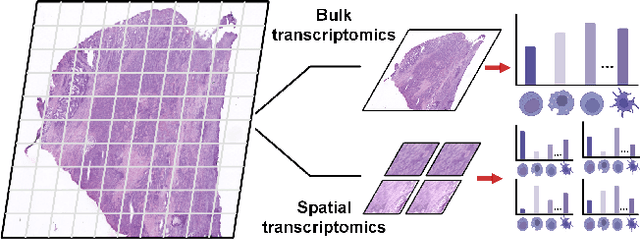
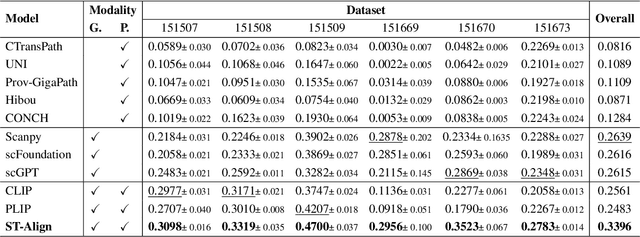
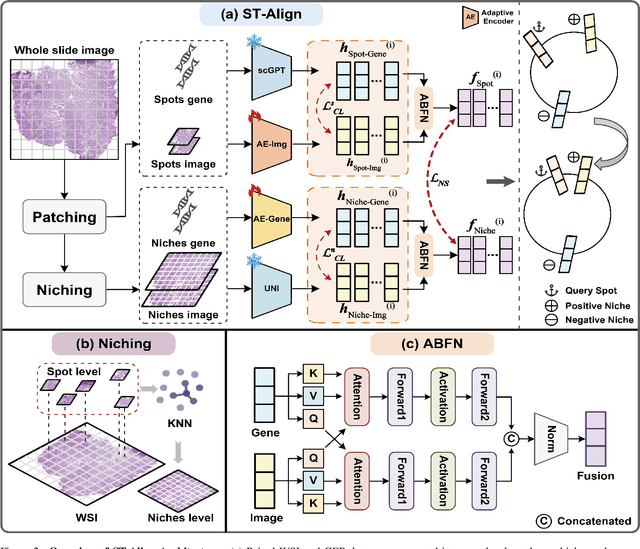
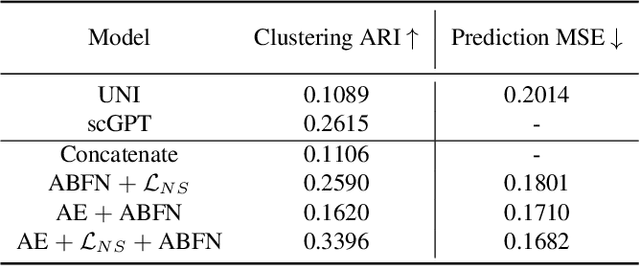
Spatial transcriptomics (ST) provides high-resolution pathological images and whole-transcriptomic expression profiles at individual spots across whole-slide scales. This setting makes it an ideal data source to develop multimodal foundation models. Although recent studies attempted to fine-tune visual encoders with trainable gene encoders based on spot-level, the absence of a wider slide perspective and spatial intrinsic relationships limits their ability to capture ST-specific insights effectively. Here, we introduce ST-Align, the first foundation model designed for ST that deeply aligns image-gene pairs by incorporating spatial context, effectively bridging pathological imaging with genomic features. We design a novel pretraining framework with a three-target alignment strategy for ST-Align, enabling (1) multi-scale alignment across image-gene pairs, capturing both spot- and niche-level contexts for a comprehensive perspective, and (2) cross-level alignment of multimodal insights, connecting localized cellular characteristics and broader tissue architecture. Additionally, ST-Align employs specialized encoders tailored to distinct ST contexts, followed by an Attention-Based Fusion Network (ABFN) for enhanced multimodal fusion, effectively merging domain-shared knowledge with ST-specific insights from both pathological and genomic data. We pre-trained ST-Align on 1.3 million spot-niche pairs and evaluated its performance through two downstream tasks across six datasets, demonstrating superior zero-shot and few-shot capabilities. ST-Align highlights the potential for reducing the cost of ST and providing valuable insights into the distinction of critical compositions within human tissue.