 Add to Chrome
 Add to Firefox
 Add to Edge
Erosion Attack for Adversarial Training to Enhance Semantic Segmentation Robustness
Jan 21, 2026
Existing segmentation models exhibit significant vulnerability to adversarial attacks.To improve robustness, adversarial training incorporates adversarial examples into model training. However, existing attack methods consider only global semantic information and ignore contextual semantic relationships within the samples, limiting the effectiveness of adversarial training. To address this issue, we propose EroSeg-AT, a vulnerability-aware adversarial training framework that leverages EroSeg to generate adversarial examples. EroSeg first selects sensitive pixels based on pixel-level confidence and then progressively propagates perturbations to higher-confidence pixels, effectively disrupting the semantic consistency of the samples. Experimental results show that, compared to existing methods, our approach significantly improves attack effectiveness and enhances model robustness under adversarial training.

PB-UAP: Hybrid Universal Adversarial Attack For Image Segmentation
Dec 21, 2024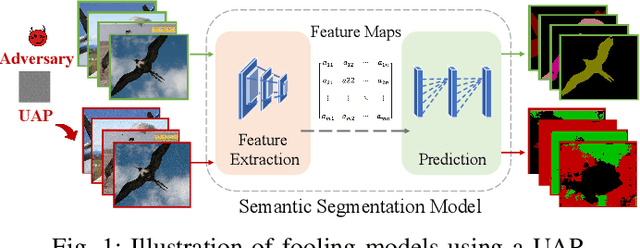
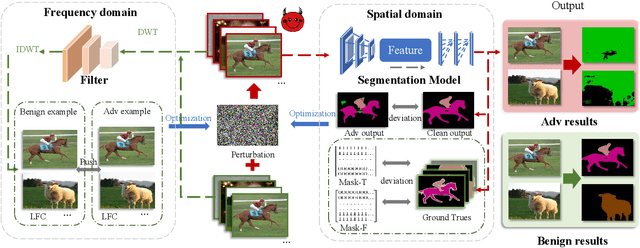
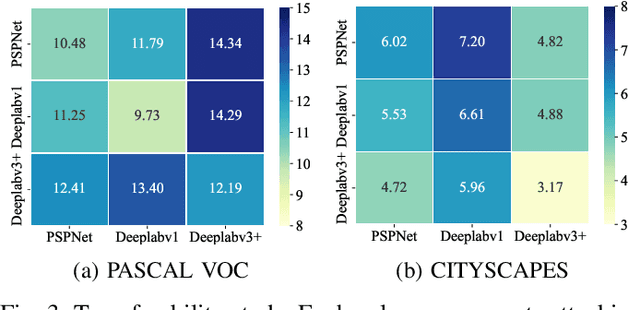
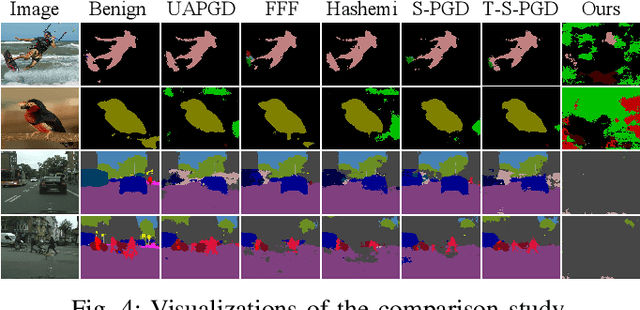
With the rapid advancement of deep learning, the model robustness has become a significant research hotspot, \ie, adversarial attacks on deep neural networks. Existing works primarily focus on image classification tasks, aiming to alter the model's predicted labels. Due to the output complexity and deeper network architectures, research on adversarial examples for segmentation models is still limited, particularly for universal adversarial perturbations. In this paper, we propose a novel universal adversarial attack method designed for segmentation models, which includes dual feature separation and low-frequency scattering modules. The two modules guide the training of adversarial examples in the pixel and frequency space, respectively. Experiments demonstrate that our method achieves high attack success rates surpassing the state-of-the-art methods, and exhibits strong transferability across different models.