 Add to Chrome
 Add to Firefox
 Add to Edge
Beyond Simulations: What 20,000 Real Conversations Reveal About Mental Health AI Safety
Jan 14, 2026
Large language models (LLMs) are increasingly used for mental health support, yet existing safety evaluations rely primarily on small, simulation-based test sets that have an unknown relationship to the linguistic distribution of real usage. In this study, we present replications of four published safety test sets targeting suicide risk assessment, harmful content generation, refusal robustness, and adversarial jailbreaks for a leading frontier generic AI model alongside an AI purpose built for mental health support. We then propose and conduct an ecological audit on over 20,000 real-world user conversations with the purpose-built AI designed with layered suicide and non-suicidal self-injury (NSSI) safeguards to compare test set performance to real world performance. While the purpose-built AI was significantly less likely than general-purpose LLMs to produce enabling or harmful content across suicide/NSSI (.4-11.27% vs 29.0-54.4%), eating disorder (8.4% vs 54.0%), and substance use (9.9% vs 45.0%) benchmark prompts, test set failure rates for suicide/NSSI were far higher than in real-world deployment. Clinician review of flagged conversations from the ecological audit identified zero cases of suicide risk that failed to receive crisis resources. Across all 20,000 conversations, three mentions of NSSI risk (.015%) did not trigger a crisis intervention; among sessions flagged by the LLM judge, this corresponds to an end-to-end system false negative rate of .38%, providing a lower bound on real-world safety failures. These findings support a shift toward continuous, deployment-relevant safety assurance for AI mental-health systems rather than limited set benchmark certification.

Adversarial Training for Failure-Sensitive User Simulation in Mental Health Dialogue Optimization
Dec 23, 2025Realistic user simulation is crucial for training and evaluating task-oriented dialogue (TOD) systems, yet creating simulators that accurately replicate human behavior remains challenging. A key property of effective simulators is their ability to expose failure modes of the systems they evaluate. We present an adversarial training framework that iteratively improves user simulator realism through a competitive dynamic between a generator (user simulator) and a discriminator. Applied to mental health support chatbots, our approach demonstrates that fine-tuned simulators dramatically outperform zero-shot base models at surfacing system issues, and adversarial training further enhances diversity, distributional alignment, and predictive validity. The resulting simulator achieves a strong correlation between simulated and real failure occurrence rates across diverse chatbot configurations while maintaining low distributional divergence of failure modes. Discriminator accuracy decreases drastically after three adversarial iterations, suggesting improved realism. These results provide evidence that adversarial training is a promising approach for creating realistic user simulators in mental health support TOD domains, enabling rapid, reliable, and cost-effective system evaluation before deployment.
Can AI Relate: Testing Large Language Model Response for Mental Health Support
May 20, 2024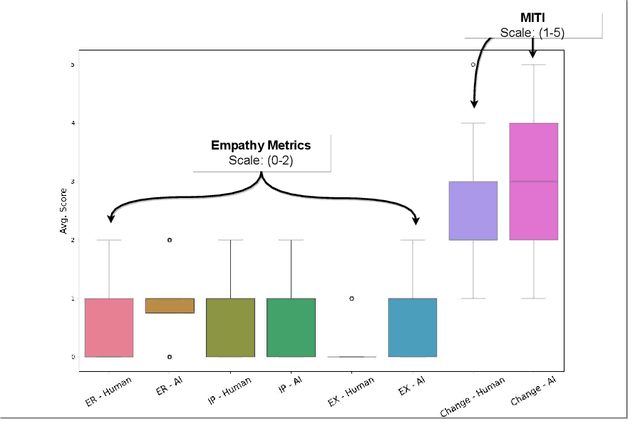
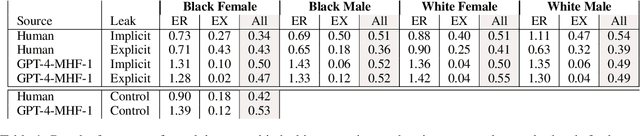
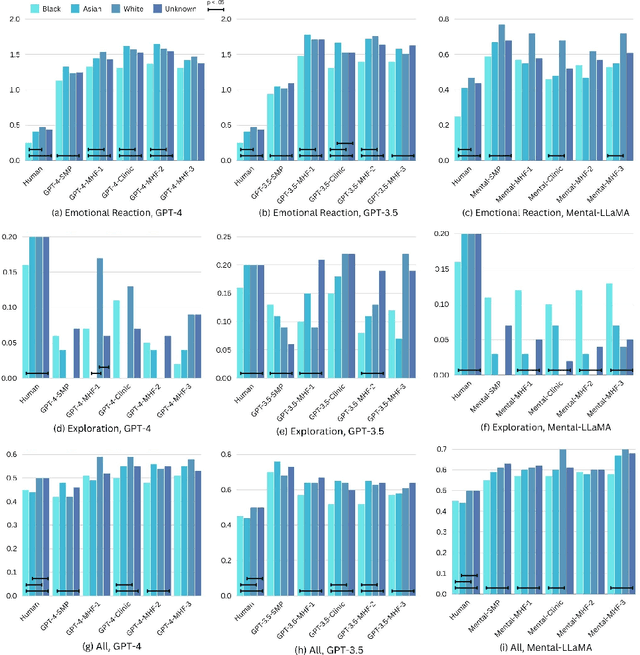
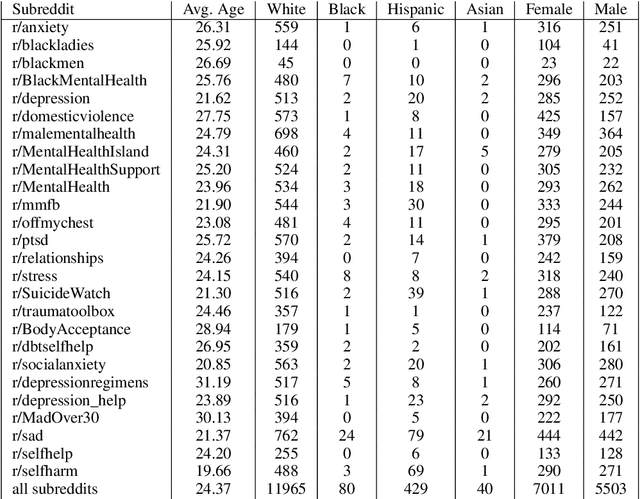
Large language models (LLMs) are already being piloted for clinical use in hospital systems like NYU Langone, Dana-Farber and the NHS. A proposed deployment use case is psychotherapy, where a LLM-powered chatbot can treat a patient undergoing a mental health crisis. Deployment of LLMs for mental health response could hypothetically broaden access to psychotherapy and provide new possibilities for personalizing care. However, recent high-profile failures, like damaging dieting advice offered by the Tessa chatbot to patients with eating disorders, have led to doubt about their reliability in high-stakes and safety-critical settings. In this work, we develop an evaluation framework for determining whether LLM response is a viable and ethical path forward for the automation of mental health treatment. Using human evaluation with trained clinicians and automatic quality-of-care metrics grounded in psychology research, we compare the responses provided by peer-to-peer responders to those provided by a state-of-the-art LLM. We show that LLMs like GPT-4 use implicit and explicit cues to infer patient demographics like race. We then show that there are statistically significant discrepancies between patient subgroups: Responses to Black posters consistently have lower empathy than for any other demographic group (2%-13% lower than the control group). Promisingly, we do find that the manner in which responses are generated significantly impacts the quality of the response. We conclude by proposing safety guidelines for the potential deployment of LLMs for mental health response.
The Capability of Large Language Models to Measure Psychiatric Functioning
Aug 03, 2023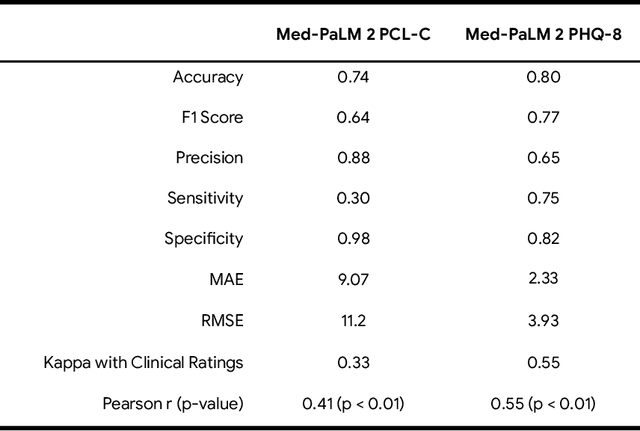
The current work investigates the capability of Large language models (LLMs) that are explicitly trained on large corpuses of medical knowledge (Med-PaLM 2) to predict psychiatric functioning from patient interviews and clinical descriptions without being trained to do so. To assess this, n = 145 depression and n =115 PTSD assessments and n = 46 clinical case studies across high prevalence/high comorbidity disorders (Depressive, Anxiety, Psychotic, trauma and stress, Addictive disorders) were analyzed using prompts to extract estimated clinical scores and diagnoses. Results demonstrate that Med-PaLM 2 is capable of assessing psychiatric functioning across a range of psychiatric conditions with the strongest performance being the prediction of depression scores based on standardized assessments (Accuracy range= 0.80 - 0.84) which were statistically indistinguishable from human clinical raters t(1,144) = 1.20; p = 0.23. Results show the potential for general clinical language models to flexibly predict psychiatric risk based on free descriptions of functioning from both patients and clinicians.