 Add to Chrome
 Add to Firefox
 Add to Edge
Unifying Ranking and Generation in Query Auto-Completion via Retrieval-Augmented Generation and Multi-Objective Alignment
Feb 03, 2026
Query Auto-Completion (QAC) suggests query completions as users type, helping them articulate intent and reach results more efficiently. Existing approaches face fundamental challenges: traditional retrieve-and-rank pipelines have limited long-tail coverage and require extensive feature engineering, while recent generative methods suffer from hallucination and safety risks. We present a unified framework that reformulates QAC as end-to-end list generation through Retrieval-Augmented Generation (RAG) and multi-objective Direct Preference Optimization (DPO). Our approach combines three key innovations: (1) reformulating QAC as end-to-end list generation with multi-objective optimization; (2) defining and deploying a suite of rule-based, model-based, and LLM-as-judge verifiers for QAC, and using them in a comprehensive methodology that combines RAG, multi-objective DPO, and iterative critique-revision for high-quality synthetic data; (3) a hybrid serving architecture enabling efficient production deployment under strict latency constraints. Evaluation on a large-scale commercial search platform demonstrates substantial improvements: offline metrics show gains across all dimensions, human evaluation yields +0.40 to +0.69 preference scores, and a controlled online experiment achieves 5.44\% reduction in keystrokes and 3.46\% increase in suggestion adoption, validating that unified generation with RAG and multi-objective alignment provides an effective solution for production QAC. This work represents a paradigm shift to end-to-end generation powered by large language models, RAG, and multi-objective alignment, establishing a production-validated framework that can benefit the broader search and recommendation industry.

Class-wise Thresholding for Detecting Out-of-Distribution Data
Nov 24, 2021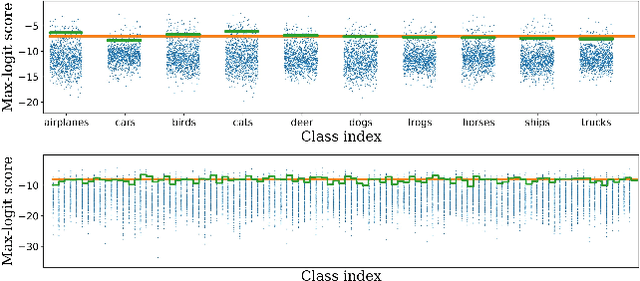

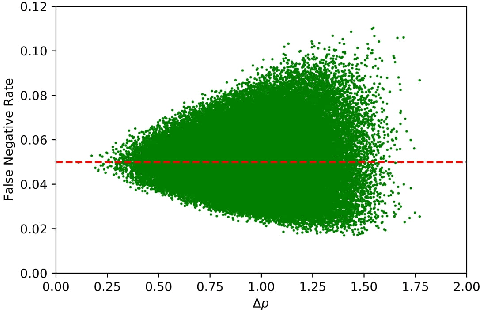
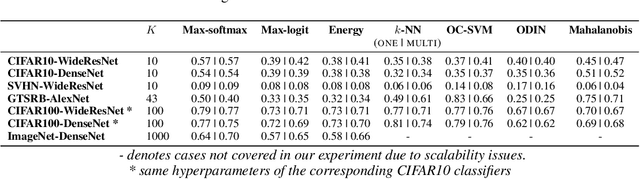
We consider the problem of detecting OoD(Out-of-Distribution) input data when using deep neural networks, and we propose a simple yet effective way to improve the robustness of several popular OoD detection methods against label shift. Our work is motivated by the observation that most existing OoD detection algorithms consider all training/test data as a whole, regardless of which class entry each input activates (inter-class differences). Through extensive experimentation, we have found that such practice leads to a detector whose performance is sensitive and vulnerable to label shift. To address this issue, we propose a class-wise thresholding scheme that can apply to most existing OoD detection algorithms and can maintain similar OoD detection performance even in the presence of label shift in the test distribution.
TorchXRayVision: A library of chest X-ray datasets and models
Oct 31, 2021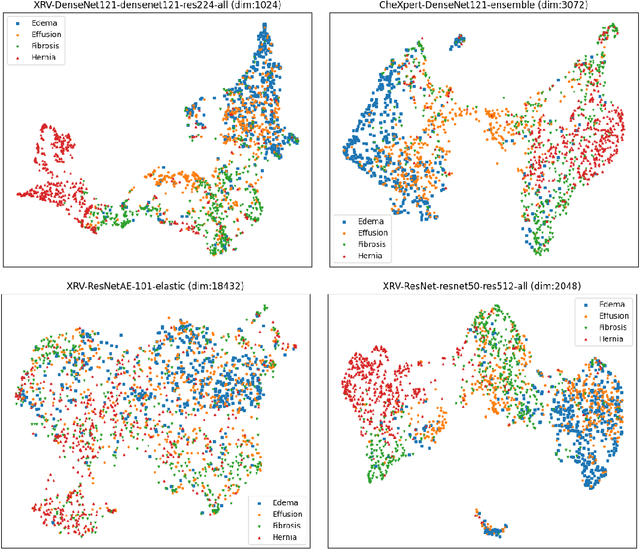
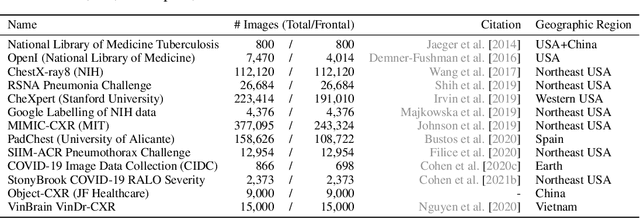
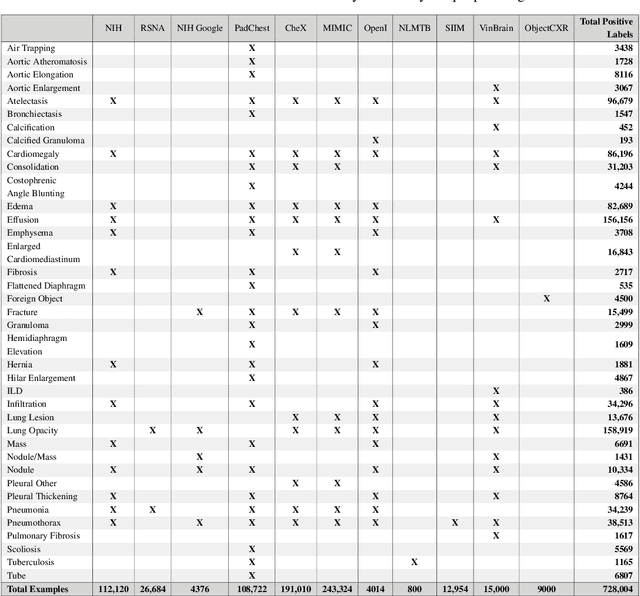
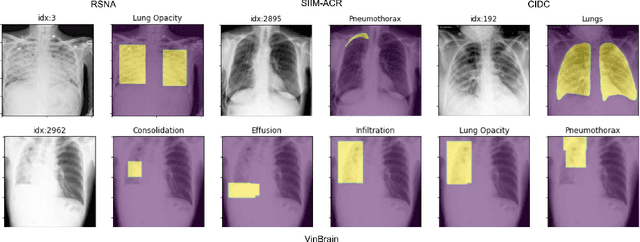
TorchXRayVision is an open source software library for working with chest X-ray datasets and deep learning models. It provides a common interface and common pre-processing chain for a wide set of publicly available chest X-ray datasets. In addition, a number of classification and representation learning models with different architectures, trained on different data combinations, are available through the library to serve as baselines or feature extractors.