 Add to Chrome
 Add to Firefox
 Add to Edge
Scalable Construction of Spiking Neural Networks using up to thousands of GPUs
Dec 10, 2025
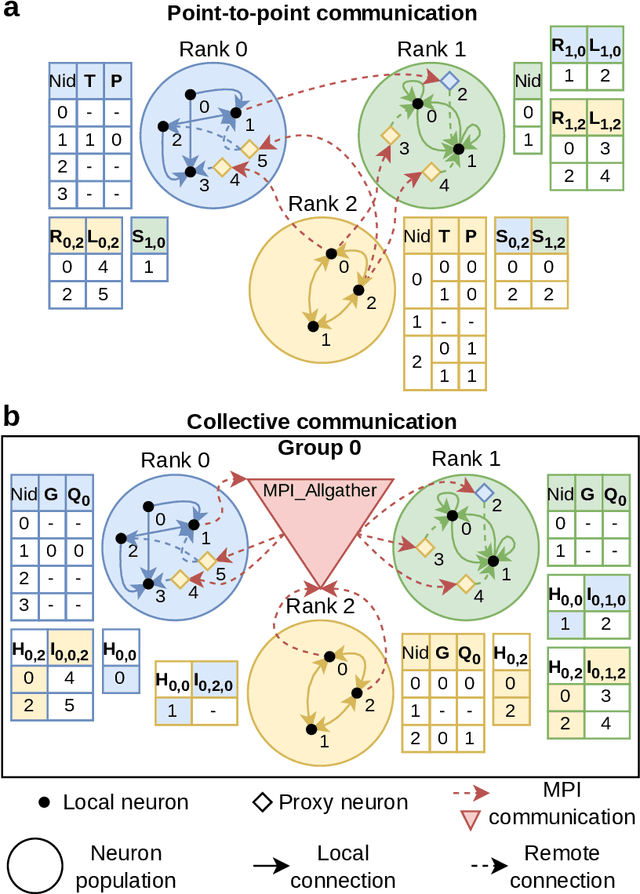
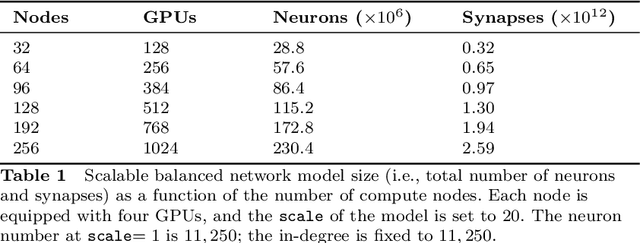
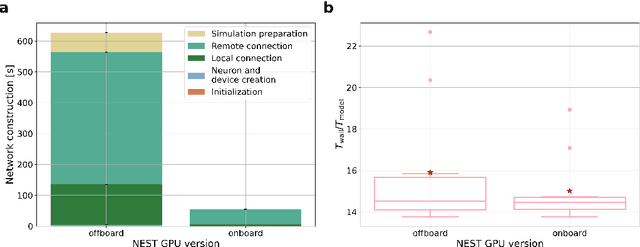
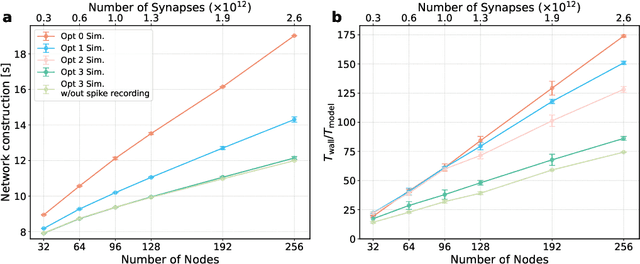
Diverse scientific and engineering research areas deal with discrete, time-stamped changes in large systems of interacting delay differential equations. Simulating such complex systems at scale on high-performance computing clusters demands efficient management of communication and memory. Inspired by the human cerebral cortex -- a sparsely connected network of $\mathcal{O}(10^{10})$ neurons, each forming $\mathcal{O}(10^{3})$--$\mathcal{O}(10^{4})$ synapses and communicating via short electrical pulses called spikes -- we study the simulation of large-scale spiking neural networks for computational neuroscience research. This work presents a novel network construction method for multi-GPU clusters and upcoming exascale supercomputers using the Message Passing Interface (MPI), where each process builds its local connectivity and prepares the data structures for efficient spike exchange across the cluster during state propagation. We demonstrate scaling performance of two cortical models using point-to-point and collective communication, respectively.

Phenomenological modeling of diverse and heterogeneous synaptic dynamics at natural density
Dec 10, 2022This chapter sheds light on the synaptic organization of the brain from the perspective of computational neuroscience. It provides an introductory overview on how to account for empirical data in mathematical models, implement them in software, and perform simulations reflecting experiments. This path is demonstrated with respect to four key aspects of synaptic signaling: the connectivity of brain networks, synaptic transmission, synaptic plasticity, and the heterogeneity across synapses. Each step and aspect of the modeling and simulation workflow comes with its own challenges and pitfalls, which are highlighted and addressed in detail.
Sequence learning in a spiking neuronal network with memristive synapses
Nov 29, 2022Brain-inspired computing proposes a set of algorithmic principles that hold promise for advancing artificial intelligence. They endow systems with self learning capabilities, efficient energy usage, and high storage capacity. A core concept that lies at the heart of brain computation is sequence learning and prediction. This form of computation is essential for almost all our daily tasks such as movement generation, perception, and language. Understanding how the brain performs such a computation is not only important to advance neuroscience but also to pave the way to new technological brain-inspired applications. A previously developed spiking neural network implementation of sequence prediction and recall learns complex, high-order sequences in an unsupervised manner by local, biologically inspired plasticity rules. An emerging type of hardware that holds promise for efficiently running this type of algorithm is neuromorphic hardware. It emulates the way the brain processes information and maps neurons and synapses directly into a physical substrate. Memristive devices have been identified as potential synaptic elements in neuromorphic hardware. In particular, redox-induced resistive random access memories (ReRAM) devices stand out at many aspects. They permit scalability, are energy efficient and fast, and can implement biological plasticity rules. In this work, we study the feasibility of using ReRAM devices as a replacement of the biological synapses in the sequence learning model. We implement and simulate the model including the ReRAM plasticity using the neural simulator NEST. We investigate the effect of different device properties on the performance characteristics of the sequence learning model, and demonstrate resilience with respect to different on-off ratios, conductance resolutions, device variability, and synaptic failure.