 Add to Chrome
 Add to Firefox
 Add to Edge
Delving into Muon and Beyond: Deep Analysis and Extensions
Feb 04, 2026
The Muon optimizer has recently attracted considerable attention for its strong empirical performance and use of orthogonalized updates on matrix-shaped parameters, yet its underlying mechanisms and relationship to adaptive optimizers such as Adam remain insufficiently understood. In this work, we aim to address these questions through a unified spectral perspective. Specifically, we view Muon as the p = 0 endpoint of a family of spectral transformations of the form U \boldsymbolΣ^{p} V' , and consider additional variants with p = 1/2 , p = 1/4 , and p = 1 . These transformations are applied to both first-moment updates, as in momentum SGD, and to root-mean-square (RMS) normalized gradient updates as in Adam. To enable efficient computation, we develop a coupled Newton iteration that avoids explicit singular value decomposition. Across controlled experiments, we find that RMS-normalized updates yield more stable optimization than first-moment updates. Moreover, while spectral compression provides strong stabilization benefits under first-moment updates, the Muon update (p = 0) does not consistently outperform Adam. These results suggest that Muon is best understood as an effective form of spectral normalization, but not a universally superior optimization method. Our source code will be released at https://github.com/Ocram7/BeyondMuon.

SimpleGPT: Improving GPT via A Simple Normalization Strategy
Feb 01, 2026In this work, we revisit Transformer optimization through the lens of second-order geometry and establish a direct connection between architectural design, activation scale, the Hessian matrix, and the maximum tolerable learning rate. We introduce a simple normalization strategy, termed SimpleNorm, which stabilizes intermediate activation scales by construction. Then, by analyzing the Hessian of the loss with respect to network activations, we theoretically show that SimpleNorm significantly reduces the spectral norm of the Hessian, thereby permitting larger stable learning rates. We validate our theoretical findings through extensive experiments on large GPT models at parameter scales 1B, 1.4B, 7B and 8B. Empirically, SimpleGPT, our SimpleNorm-based network, tolerates learning rates 3$\times$-10$\times$ larger than standard convention, consistently demonstrates strong optimization stability, and achieves substantially better performance than well-established baselines. Specifically, when training 7B-scale models for 60K steps, SimpleGPT achieves a training loss that is 0.08 lower than that of LLaMA2 with QKNorm, reducing the loss from 2.290 to 2.208. Our source code will be released at https://github.com/Ocram7/SimpleGPT.
DNT: a Deeply Normalized Transformer that can be trained by Momentum SGD
Jul 23, 2025Transformers have become the de facto backbone of modern deep learning, yet their training typically demands an advanced optimizer with adaptive learning rate like AdamW, rather than a momentum SGDW (mSGDW). Previous works show that it is mainly due to a heavy-tailed distribution of the gradients. In this paper, we introduce a Deeply Normalized Transformer (DNT), which is meticulously engineered to overcome this limitation enabling seamless training with vanilla mSGDW while yielding comparable performance to the Transformers trained via AdamW. To be specific, in DNT, we strategically integrate normalization techniques at proper positions in the Transformers to effectively modulate the Jacobian matrices of each layer, balance the influence of weights, activations, and their interactions, and thus enable the distributions of gradients concentrated. We provide both theoretical justifications of the normalization technique used in our DNT and extensive empirical evaluation on two popular Transformer architectures to validate that: a) DNT outperforms its counterparts (\ie, ViT and GPT), and b) DNT can be effectively trained with vanilla mSGDW.
Señorita-2M: A High-Quality Instruction-based Dataset for General Video Editing by Video Specialists
Feb 10, 2025

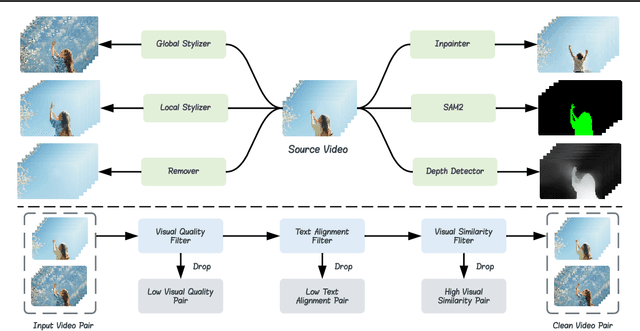
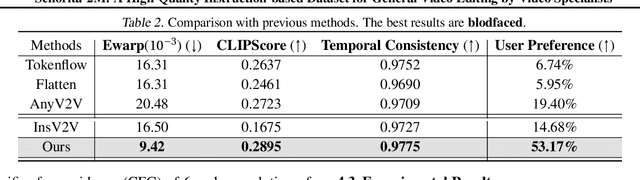
Recent advancements in video generation have spurred the development of video editing techniques, which can be divided into inversion-based and end-to-end methods. However, current video editing methods still suffer from several challenges. Inversion-based methods, though training-free and flexible, are time-consuming during inference, struggle with fine-grained editing instructions, and produce artifacts and jitter. On the other hand, end-to-end methods, which rely on edited video pairs for training, offer faster inference speeds but often produce poor editing results due to a lack of high-quality training video pairs. In this paper, to close the gap in end-to-end methods, we introduce Se\~norita-2M, a high-quality video editing dataset. Se\~norita-2M consists of approximately 2 millions of video editing pairs. It is built by crafting four high-quality, specialized video editing models, each crafted and trained by our team to achieve state-of-the-art editing results. We also propose a filtering pipeline to eliminate poorly edited video pairs. Furthermore, we explore common video editing architectures to identify the most effective structure based on current pre-trained generative model. Extensive experiments show that our dataset can help to yield remarkably high-quality video editing results. More details are available at https://senorita.github.io.