 Add to Chrome
 Add to Firefox
 Add to Edge
Temporal Fusion Nexus: A task-agnostic multi-modal embedding model for clinical narratives and irregular time series in post-kidney transplant care
Jan 13, 2026
We introduce Temporal Fusion Nexus (TFN), a multi-modal and task-agnostic embedding model to integrate irregular time series and unstructured clinical narratives. We analysed TFN in post-kidney transplant (KTx) care, with a retrospective cohort of 3382 patients, on three key outcomes: graft loss, graft rejection, and mortality. Compared to state-of-the-art model in post KTx care, TFN achieved higher performance for graft loss (AUC 0.96 vs. 0.94) and graft rejection (AUC 0.84 vs. 0.74). In mortality prediction, TFN yielded an AUC of 0.86. TFN outperformed unimodal baselines (approx 10% AUC improvement over time series only baseline, approx 5% AUC improvement over time series with static patient data). Integrating clinical text improved performance across all tasks. Disentanglement metrics confirmed robust and interpretable latent factors in the embedding space, and SHAP-based attributions confirmed alignment with clinical reasoning. TFN has potential application in clinical tasks beyond KTx, where heterogeneous data sources, irregular longitudinal data, and rich narrative documentation are available.

A Medical Information Extraction Workbench to Process German Clinical Text
Jul 08, 2022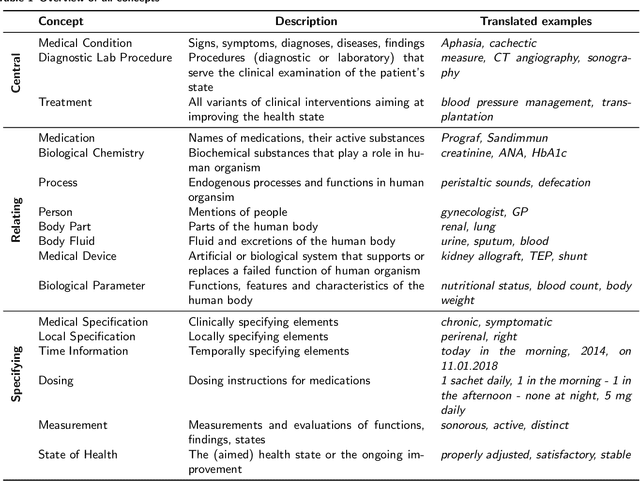
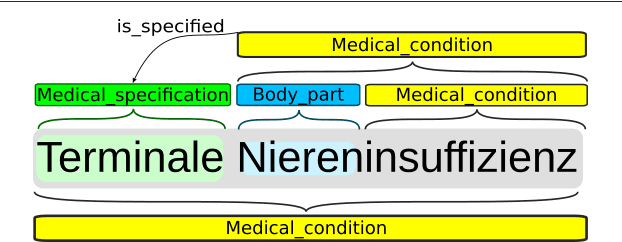
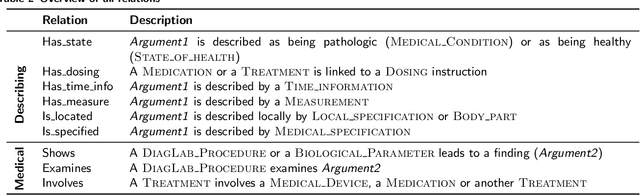
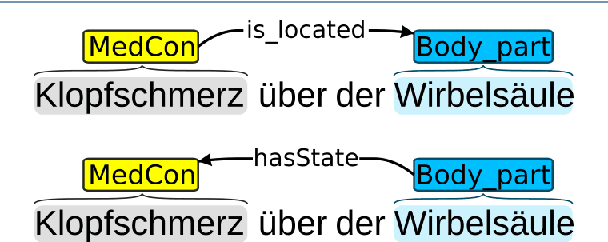
Background: In the information extraction and natural language processing domain, accessible datasets are crucial to reproduce and compare results. Publicly available implementations and tools can serve as benchmark and facilitate the development of more complex applications. However, in the context of clinical text processing the number of accessible datasets is scarce -- and so is the number of existing tools. One of the main reasons is the sensitivity of the data. This problem is even more evident for non-English languages. Approach: In order to address this situation, we introduce a workbench: a collection of German clinical text processing models. The models are trained on a de-identified corpus of German nephrology reports. Result: The presented models provide promising results on in-domain data. Moreover, we show that our models can be also successfully applied to other biomedical text in German. Our workbench is made publicly available so it can be used out of the box, as a benchmark or transferred to related problems.