 Add to Chrome
 Add to Firefox
 Add to Edge
Safe Exploration via Policy Priors
Jan 27, 2026
Safe exploration is a key requirement for reinforcement learning (RL) agents to learn and adapt online, beyond controlled (e.g. simulated) environments. In this work, we tackle this challenge by utilizing suboptimal yet conservative policies (e.g., obtained from offline data or simulators) as priors. Our approach, SOOPER, uses probabilistic dynamics models to optimistically explore, yet pessimistically fall back to the conservative policy prior if needed. We prove that SOOPER guarantees safety throughout learning, and establish convergence to an optimal policy by bounding its cumulative regret. Extensive experiments on key safe RL benchmarks and real-world hardware demonstrate that SOOPER is scalable, outperforms the state-of-the-art and validate our theoretical guarantees in practice.

Training Verifiably Robust Agents Using Set-Based Reinforcement Learning
Aug 17, 2024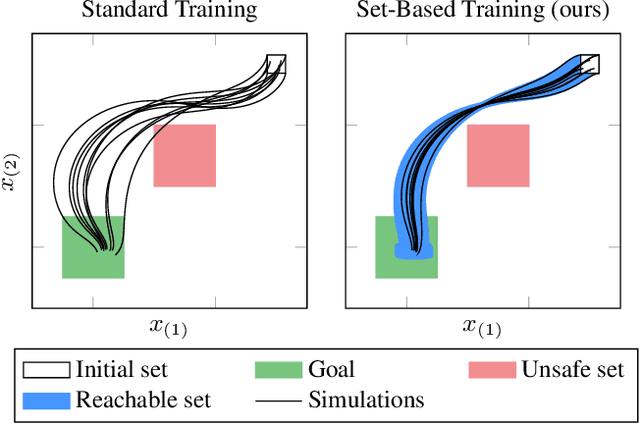
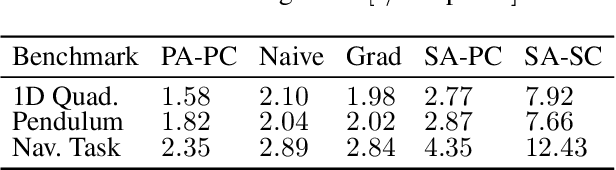
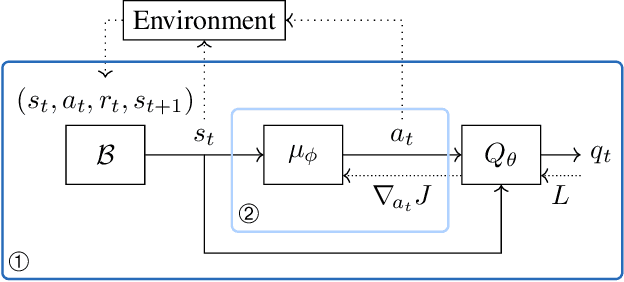
Reinforcement learning often uses neural networks to solve complex control tasks. However, neural networks are sensitive to input perturbations, which makes their deployment in safety-critical environments challenging. This work lifts recent results from formally verifying neural networks against such disturbances to reinforcement learning in continuous state and action spaces using reachability analysis. While previous work mainly focuses on adversarial attacks for robust reinforcement learning, we train neural networks utilizing entire sets of perturbed inputs and maximize the worst-case reward. The obtained agents are verifiably more robust than agents obtained by related work, making them more applicable in safety-critical environments. This is demonstrated with an extensive empirical evaluation of four different benchmarks.