 Add to Chrome
 Add to Firefox
 Add to Edge
FaLW: A Forgetting-aware Loss Reweighting for Long-tailed Unlearning
Jan 26, 2026
Machine unlearning, which aims to efficiently remove the influence of specific data from trained models, is crucial for upholding data privacy regulations like the ``right to be forgotten". However, existing research predominantly evaluates unlearning methods on relatively balanced forget sets. This overlooks a common real-world scenario where data to be forgotten, such as a user's activity records, follows a long-tailed distribution. Our work is the first to investigate this critical research gap. We find that in such long-tailed settings, existing methods suffer from two key issues: \textit{Heterogeneous Unlearning Deviation} and \textit{Skewed Unlearning Deviation}. To address these challenges, we propose FaLW, a plug-and-play, instance-wise dynamic loss reweighting method. FaLW innovatively assesses the unlearning state of each sample by comparing its predictive probability to the distribution of unseen data from the same class. Based on this, it uses a forgetting-aware reweighting scheme, modulated by a balancing factor, to adaptively adjust the unlearning intensity for each sample. Extensive experiments demonstrate that FaLW achieves superior performance. Code is available at \textbf{Supplementary Material}.

Rethinking Crystal Symmetry Prediction: A Decoupled Perspective
Nov 10, 2025Efficiently and accurately determining the symmetry is a crucial step in the structural analysis of crystalline materials. Existing methods usually mindlessly apply deep learning models while ignoring the underlying chemical rules. More importantly, experiments show that they face a serious sub-property confusion SPC problem. To address the above challenges, from a decoupled perspective, we introduce the XRDecoupler framework, a problem-solving arsenal specifically designed to tackle the SPC problem. Imitating the thinking process of chemists, we innovatively incorporate multidimensional crystal symmetry information as superclass guidance to ensure that the model's prediction process aligns with chemical intuition. We further design a hierarchical PXRD pattern learning model and a multi-objective optimization approach to achieve high-quality representation and balanced optimization. Comprehensive evaluations on three mainstream databases (e.g., CCDC, CoREMOF, and InorganicData) demonstrate that XRDecoupler excels in performance, interpretability, and generalization.
Get Rid of Task Isolation: A Continuous Multi-task Spatio-Temporal Learning Framework
Oct 14, 2024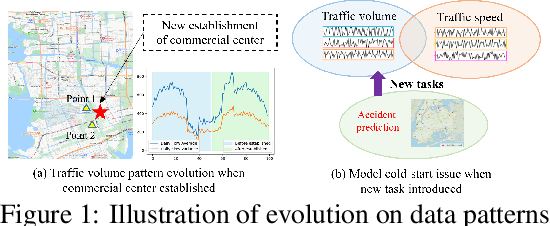
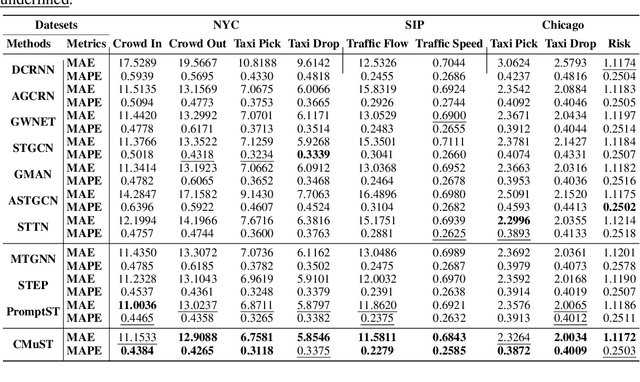
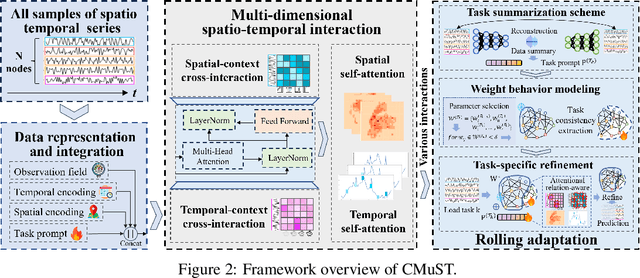
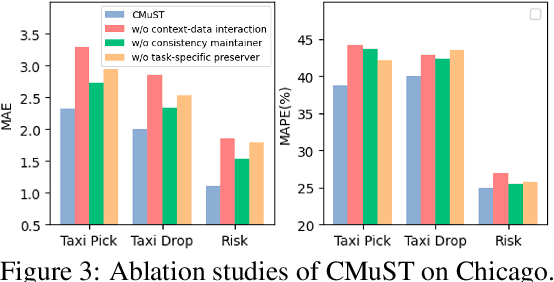
Spatiotemporal learning has become a pivotal technique to enable urban intelligence. Traditional spatiotemporal models mostly focus on a specific task by assuming a same distribution between training and testing sets. However, given that urban systems are usually dynamic, multi-sourced with imbalanced data distributions, current specific task-specific models fail to generalize to new urban conditions and adapt to new domains without explicitly modeling interdependencies across various dimensions and types of urban data. To this end, we argue that there is an essential to propose a Continuous Multi-task Spatio-Temporal learning framework (CMuST) to empower collective urban intelligence, which reforms the urban spatiotemporal learning from single-domain to cooperatively multi-dimensional and multi-task learning. Specifically, CMuST proposes a new multi-dimensional spatiotemporal interaction network (MSTI) to allow cross-interactions between context and main observations as well as self-interactions within spatial and temporal aspects to be exposed, which is also the core for capturing task-level commonality and personalization. To ensure continuous task learning, a novel Rolling Adaptation training scheme (RoAda) is devised, which not only preserves task uniqueness by constructing data summarization-driven task prompts, but also harnesses correlated patterns among tasks by iterative model behavior modeling. We further establish a benchmark of three cities for multi-task spatiotemporal learning, and empirically demonstrate the superiority of CMuST via extensive evaluations on these datasets. The impressive improvements on both few-shot streaming data and new domain tasks against existing SOAT methods are achieved. Code is available at https://github.com/DILab-USTCSZ/CMuST.