 Add to Chrome
 Add to Firefox
 Add to Edge
How vehicles change lanes after encountering crashes: Empirical analysis and modeling
Jan 13, 2026
When a traffic crash occurs, following vehicles need to change lanes to bypass the obstruction. We define these maneuvers as post crash lane changes. In such scenarios, vehicles in the target lane may refuse to yield even after the lane change has already begun, increasing the complexity and crash risk of post crash LCs. However, the behavioral characteristics and motion patterns of post crash LCs remain unknown. To address this gap, we construct a post crash LC dataset by extracting vehicle trajectories from drone videos captured after crashes. Our empirical analysis reveals that, compared to mandatory LCs (MLCs) and discretionary LCs (DLCs), post crash LCs exhibit longer durations, lower insertion speeds, and higher crash risks. Notably, 79.4% of post crash LCs involve at least one instance of non yielding behavior from the new follower, compared to 21.7% for DLCs and 28.6% for MLCs. Building on these findings, we develop a novel trajectory prediction framework for post crash LCs. At its core is a graph based attention module that explicitly models yielding behavior as an auxiliary interaction aware task. This module is designed to guide both a conditional variational autoencoder and a Transformer based decoder to predict the lane changer's trajectory. By incorporating the interaction aware module, our model outperforms existing baselines in trajectory prediction performance by more than 10% in both average displacement error and final displacement error across different prediction horizons. Moreover, our model provides more reliable crash risk analysis by reducing false crash rates and improving conflict prediction accuracy. Finally, we validate the model's transferability using additional post crash LC datasets collected from different sites.

NsBM-GAT: A Non-stationary Block Maximum and Graph Attention Framework for General Traffic Crash Risk Prediction
Mar 06, 2025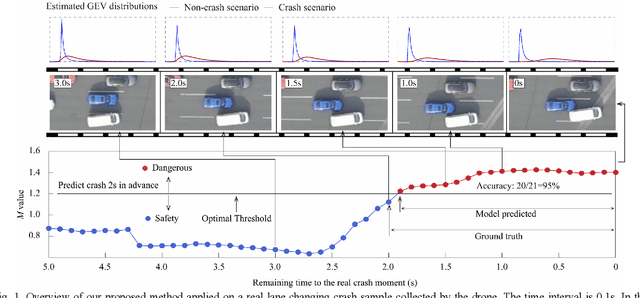
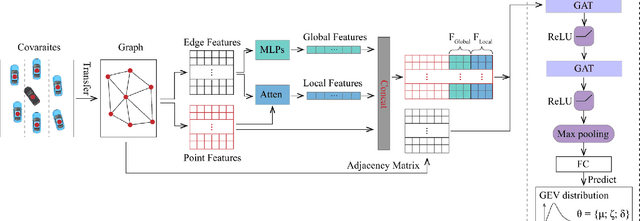
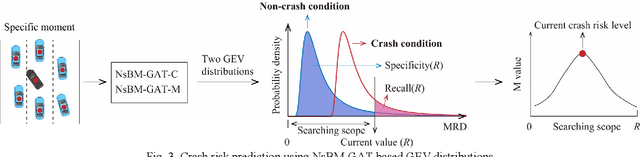
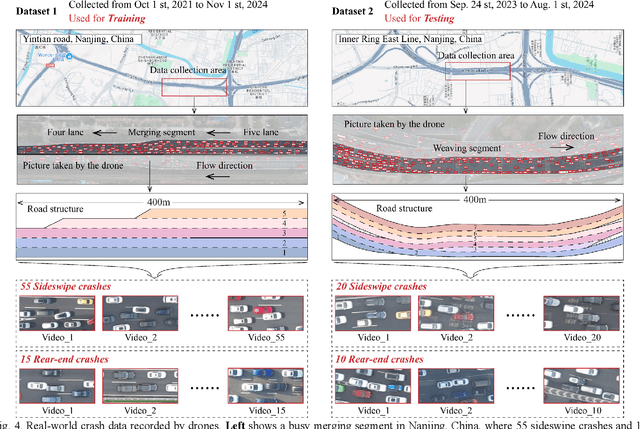
Accurate prediction of traffic crash risks for individual vehicles is essential for enhancing vehicle safety. While significant attention has been given to traffic crash risk prediction, existing studies face two main challenges: First, due to the scarcity of individual vehicle data before crashes, most models rely on hypothetical scenarios deemed dangerous by researchers. This raises doubts about their applicability to actual pre-crash conditions. Second, some crash risk prediction frameworks were learned from dashcam videos. Although such videos capture the pre-crash behavior of individual vehicles, they often lack critical information about the movements of surrounding vehicles. However, the interaction between a vehicle and its surrounding vehicles is highly influential in crash occurrences. To overcome these challenges, we propose a novel non-stationary extreme value theory (EVT), where the covariate function is optimized in a nonlinear fashion using a graph attention network. The EVT component incorporates the stochastic nature of crashes through probability distribution, which enhances model interpretability. Notably, the nonlinear covariate function enables the model to capture the interactive behavior between the target vehicle and its multiple surrounding vehicles, facilitating crash risk prediction across different driving tasks. We train and test our model using 100 sets of vehicle trajectory data before real crashes, collected via drones over three years from merging and weaving segments. We demonstrate that our model successfully learns micro-level precursors of crashes and fits a more accurate distribution with the aid of the nonlinear covariate function. Our experiments on the testing dataset show that the proposed model outperforms existing models by providing more accurate predictions for both rear-end and sideswipe crashes simultaneously.
MMPD: Multi-Domain Mobile Video Physiology Dataset
Feb 08, 2023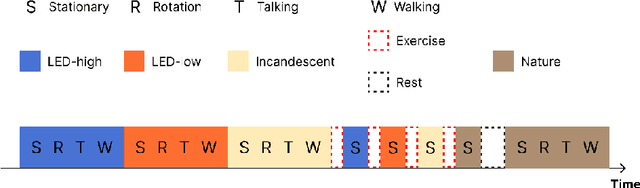
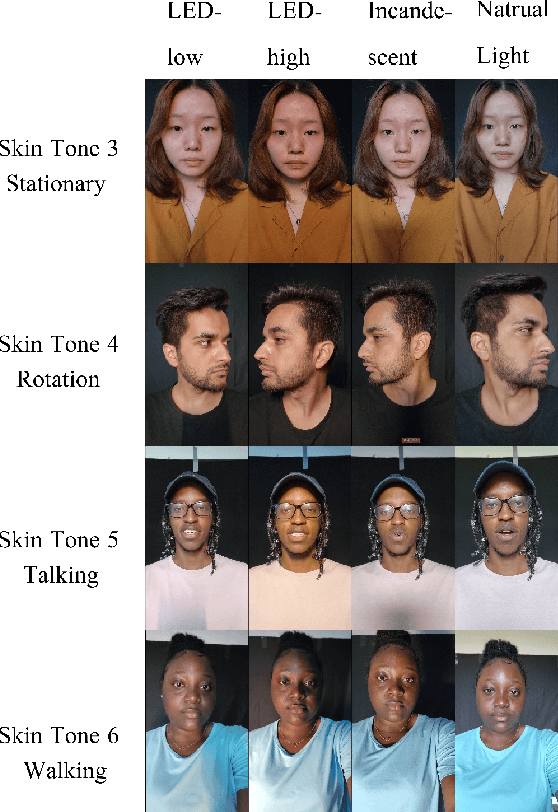
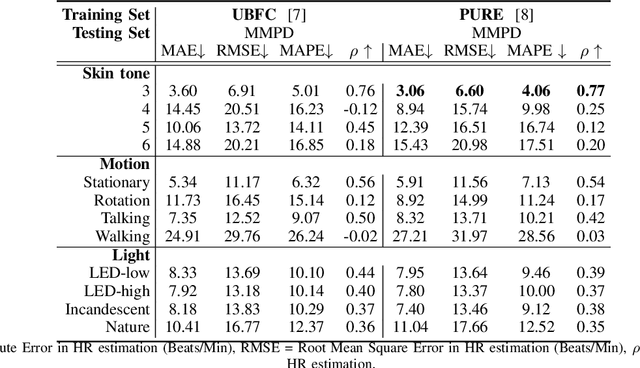
Remote photoplethysmography (rPPG) is an attractive method for noninvasive, convenient and concomitant measurement of physiological vital signals. Public benchmark datasets have served a valuable role in the development of this technology and improvements in accuracy over recent years.However, there remain gaps the public datasets.First, despite the ubiquity of cameras on mobile devices, there are few datasets recorded specifically with mobile phones cameras. Second, most datasets are relatively small and therefore are limited in diversity, both in appearance (e.g., skin tone), behaviors (e.g., motion) and enivornment (e.g., lighting conditions). In an effort to help the field advance, we present the Multi-domain Mobile Video Physiology Dataset (MMPD), comprising 11 hours of recordings from mobile phones of 33 subjects. The dataset was designed to capture videos with greater representation across skin tone, body motion, and lighting conditions. MMPD is comprehensive with eight descriptive labels and can be used in conjunction with the rPPG-toolbox. The Github repository of our dataset: {https://github.com/McJackTang/MMPD_rPPG_dataset}