 Add to Chrome
 Add to Firefox
 Add to Edge
d3LLM: Ultra-Fast Diffusion LLM using Pseudo-Trajectory Distillation
Jan 12, 2026
Diffusion large language models (dLLMs) offer capabilities beyond those of autoregressive (AR) LLMs, such as parallel decoding and random-order generation. However, realizing these benefits in practice is non-trivial, as dLLMs inherently face an accuracy-parallelism trade-off. Despite increasing interest, existing methods typically focus on only one-side of the coin, targeting either efficiency or performance. To address this limitation, we propose d3LLM (Pseudo-Distilled Diffusion Large Language Model), striking a balance between accuracy and parallelism: (i) during training, we introduce pseudo-trajectory distillation to teach the model which tokens can be decoded confidently at early steps, thereby improving parallelism; (ii) during inference, we employ entropy-based multi-block decoding with a KV-cache refresh mechanism to achieve high parallelism while maintaining accuracy. To better evaluate dLLMs, we also introduce AUP (Accuracy Under Parallelism), a new metric that jointly measures accuracy and parallelism. Experiments demonstrate that our d3LLM achieves up to 10$\times$ speedup over vanilla LLaDA/Dream and 5$\times$ speedup over AR models without much accuracy drop. Our code is available at https://github.com/hao-ai-lab/d3LLM.

SpaLLM: Unified Compressive Adaptation of Large Language Models with Sketching
Oct 08, 2024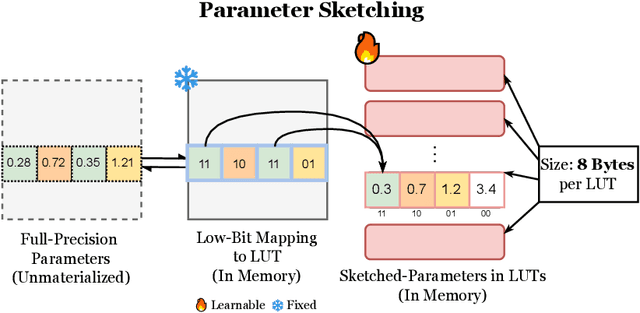
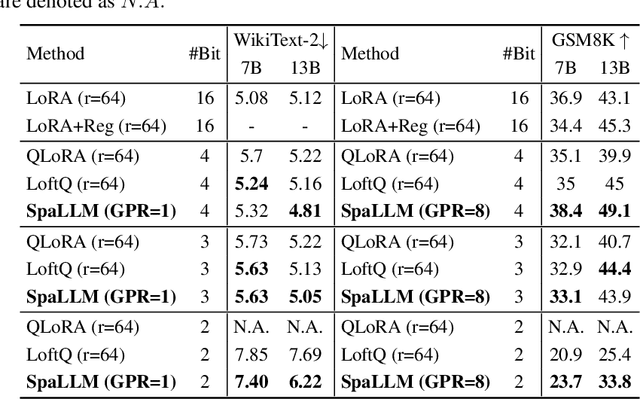
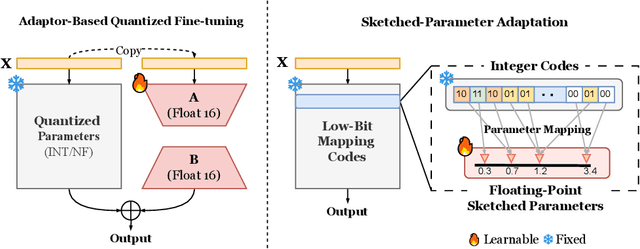

Compressive adaptation approaches, such as QLoRA, are widely popular alternatives for reducing memory requirements during fine-tuning of large language models (LLMs) while producing models capable of handling various downstream tasks. The key idea is to employ a "two-tower" architecture: compressing pre-trained LLM parameters into compact representations and fine-tuning the additive full-precision adapter, which typically has few tunable parameters in low-rank format. However, the strict algebraic assumptions, such as low-rank assumption, and the complexity of composing two-tower architectures are some of the known shortcomings, resulting in a poor accuracy-efficiency trade-off. In response to these known limitations, we propose SpaLLM (Sketched Parameter Adaptation of LLMs), a novel compressive adaptation approach for LLMs. This method is also the first to illustrate parameter-sharing compression methods for LLM fine-tuning, which, unlike QLoRA, are free from strict low-rank algebraic assumptions on adapters. Furthermore, our proposal unifies model compression and adaptation into a single, streamlined process, eliminating the need for two-tower architectures. SpaLLM sketches pre-trained LLM weights into lookup tables and directly fine-tunes the values in these tables. This approach simplifies LLMs' compressive adaptation workflow, potentially improves multi-user serving efficiency, and delivers significantly better accuracy for both natural language understanding and generation tasks. Moreover, by avoiding the "two-tower" architecture, our framework only requires one compressed matrix multiplication per layer during inference, demonstrating superior inference efficiency compared to previous methods.