 Add to Chrome
 Add to Firefox
 Add to Edge
Modeling LLM Agent Reviewer Dynamics in Elo-Ranked Review System
Jan 13, 2026
In this work, we explore the Large Language Model (LLM) agent reviewer dynamics in an Elo-ranked review system using real-world conference paper submissions. Multiple LLM agent reviewers with different personas are engage in multi round review interactions moderated by an Area Chair. We compare a baseline setting with conditions that incorporate Elo ratings and reviewer memory. Our simulation results showcase several interesting findings, including how incorporating Elo improves Area Chair decision accuracy, as well as reviewers' adaptive review strategy that exploits our Elo system without improving review effort. Our code is available at https://github.com/hsiangwei0903/EloReview.

Pan-LUT: Efficient Pan-sharpening via Learnable Look-Up Tables
Mar 31, 2025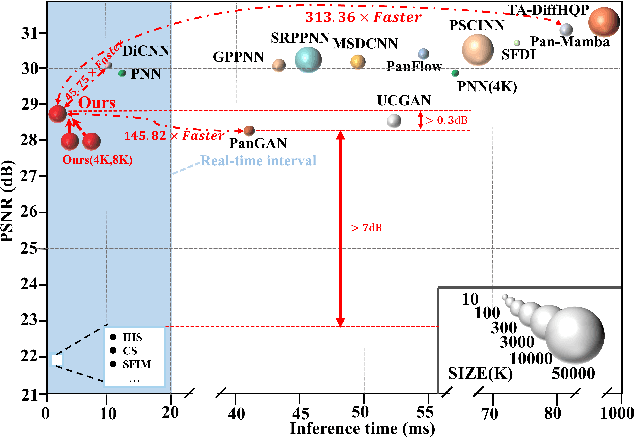
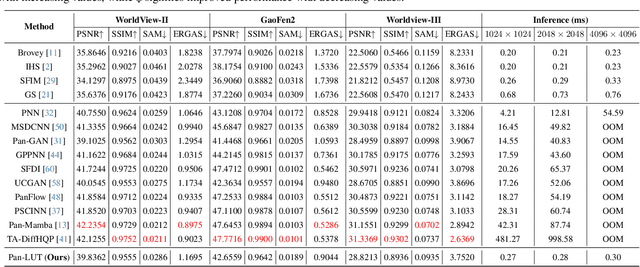
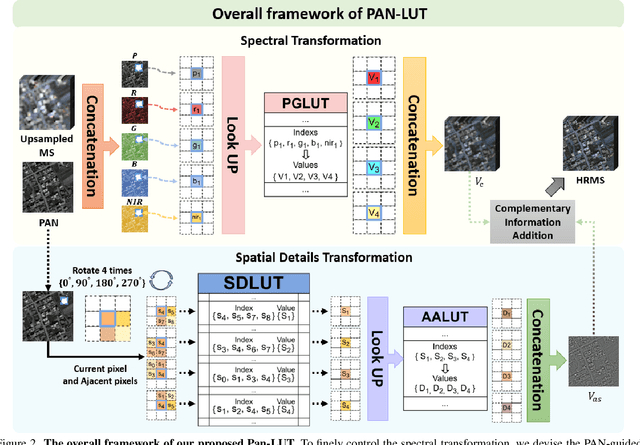
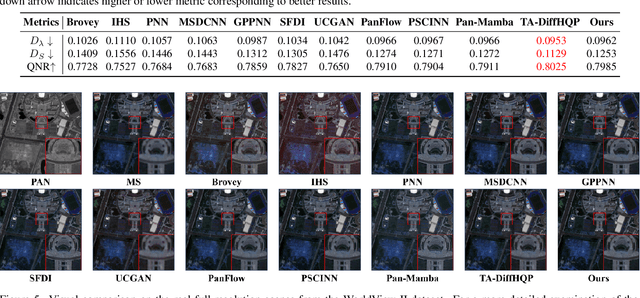
Recently, deep learning-based pan-sharpening algorithms have achieved notable advancements over traditional methods. However, many deep learning-based approaches incur substantial computational overhead during inference, especially with high-resolution images. This excessive computational demand limits the applicability of these methods in real-world scenarios, particularly in the absence of dedicated computing devices such as GPUs and TPUs. To address these challenges, we propose Pan-LUT, a novel learnable look-up table (LUT) framework for pan-sharpening that strikes a balance between performance and computational efficiency for high-resolution remote sensing images. To finely control the spectral transformation, we devise the PAN-guided look-up table (PGLUT) for channel-wise spectral mapping. To effectively capture fine-grained spatial details and adaptively learn local contexts, we introduce the spatial details look-up table (SDLUT) and adaptive aggregation look-up table (AALUT). Our proposed method contains fewer than 300K parameters and processes a 8K resolution image in under 1 ms using a single NVIDIA GeForce RTX 2080 Ti GPU, demonstrating significantly faster performance compared to other methods. Experiments reveal that Pan-LUT efficiently processes large remote sensing images in a lightweight manner, bridging the gap to real-world applications. Furthermore, our model surpasses SOTA methods in full-resolution scenes under real-world conditions, highlighting its effectiveness and efficiency.