 Add to Chrome
 Add to Firefox
 Add to Edge
ComfySearch: Autonomous Exploration and Reasoning for ComfyUI Workflows
Jan 07, 2026
AI-generated content has progressed from monolithic models to modular workflows, especially on platforms like ComfyUI, allowing users to customize complex creative pipelines. However, the large number of components in ComfyUI and the difficulty of maintaining long-horizon structural consistency under strict graph constraints frequently lead to low pass rates and workflows of limited quality. To tackle these limitations, we present ComfySearch, an agentic framework that can effectively explore the component space and generate functional ComfyUI pipelines via validation-guided workflow construction. Experiments demonstrate that ComfySearch substantially outperforms existing methods on complex and creative tasks, achieving higher executability (pass) rates, higher solution rates, and stronger generalization.

DebFlow: Automating Agent Creation via Agent Debate
Mar 31, 2025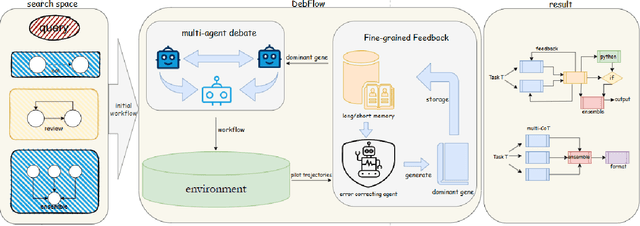
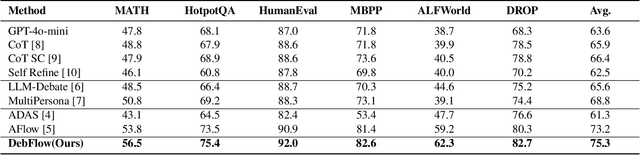
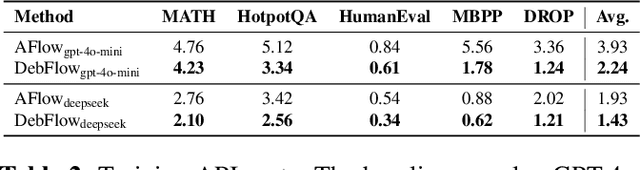
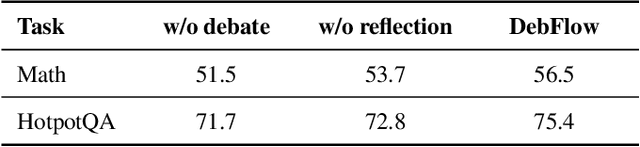
Large language models (LLMs) have demonstrated strong potential and impressive performance in automating the generation and optimization of workflows. However, existing approaches are marked by limited reasoning capabilities, high computational demands, and significant resource requirements. To address these issues, we propose DebFlow, a framework that employs a debate mechanism to optimize workflows and integrates reflexion to improve based on previous experiences. We evaluated our method across six benchmark datasets, including HotpotQA, MATH, and ALFWorld. Our approach achieved a 3\% average performance improvement over the latest baselines, demonstrating its effectiveness in diverse problem domains. In particular, during training, our framework reduces resource consumption by 37\% compared to the state-of-the-art baselines. Additionally, we performed ablation studies. Removing the Debate component resulted in a 4\% performance drop across two benchmark datasets, significantly greater than the 2\% drop observed when the Reflection component was removed. These findings strongly demonstrate the critical role of Debate in enhancing framework performance, while also highlighting the auxiliary contribution of reflexion to overall optimization.