 Add to Chrome
 Add to Firefox
 Add to Edge
Human-in-the-Loop Interactive Report Generation for Chronic Disease Adherence
Jan 10, 2026
Chronic disease management requires regular adherence feedback to prevent avoidable hospitalizations, yet clinicians lack time to produce personalized patient communications. Manual authoring preserves clinical accuracy but does not scale; AI generation scales but can undermine trust in patient-facing contexts. We present a clinician-in-the-loop interface that constrains AI to data organization and preserves physician oversight through recognition-based review. A single-page editor pairs AI-generated section drafts with time-aligned visualizations, enabling inline editing with visual evidence for each claim. This division of labor (AI organizes, clinician decides) targets both efficiency and accountability. In a pilot with three physicians reviewing 24 cases, AI successfully generated clinically personalized drafts matching physicians' manual authoring practice (overall mean 4.86/10 vs. 5.0/10 baseline), requiring minimal physician editing (mean 8.3\% content modification) with zero safety-critical issues, demonstrating effective automation of content generation. However, review time remained comparable to manual practice, revealing an accountability paradox: in high-stakes clinical contexts, professional responsibility requires complete verification regardless of AI accuracy. We contribute three interaction patterns for clinical AI collaboration: bounded generation with recognition-based review via chart-text pairing, automated urgency flagging that analyzes vital trends and adherence patterns with fail-safe escalation for missed critical monitoring tasks, and progressive disclosure controls that reduce cognitive load while maintaining oversight. These patterns indicate that clinical AI efficiency requires not only accurate models, but also mechanisms for selective verification that preserve accountability.

Active Domain Knowledge Acquisition with \$100 Budget: Enhancing LLMs via Cost-Efficient, Expert-Involved Interaction in Sensitive Domains
Aug 24, 2025Large Language Models (LLMs) have demonstrated an impressive level of general knowledge. However, they often struggle in highly specialized and cost-sensitive domains such as drug discovery and rare disease research due to the lack of expert knowledge. In this paper, we propose a novel framework (PU-ADKA) designed to efficiently enhance domain-specific LLMs by actively engaging domain experts within a fixed budget. Unlike traditional fine-tuning approaches, PU-ADKA selectively identifies and queries the most appropriate expert from a team, taking into account each expert's availability, knowledge boundaries, and consultation costs. We train PU-ADKA using simulations on PubMed data and validate it through both controlled expert interactions and real-world deployment with a drug development team, demonstrating its effectiveness in enhancing LLM performance in specialized domains under strict budget constraints. In addition to outlining our methodological innovations and experimental results, we introduce a new benchmark dataset, CKAD, for cost-effective LLM domain knowledge acquisition to foster further research in this challenging area.
ROSE: A Reward-Oriented Data Selection Framework for LLM Task-Specific Instruction Tuning
Dec 01, 2024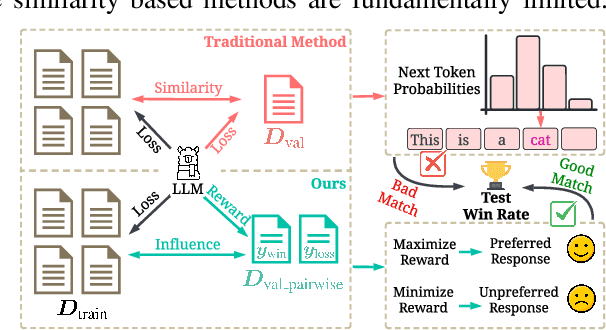
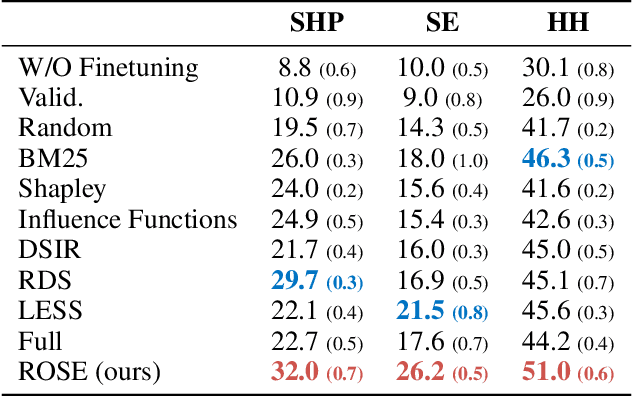
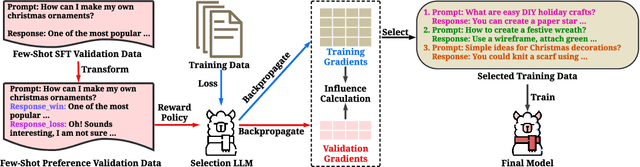
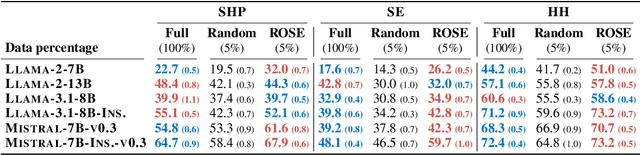
Instruction tuning has underscored the significant potential of large language models (LLMs) in producing more human-controllable and effective outputs in various domains. In this work, we focus on the data selection problem for task-specific instruction tuning of LLMs. Prevailing methods primarily rely on the crafted similarity metrics to select training data that aligns with the test data distribution. The goal is to minimize instruction tuning loss on the test data, ultimately improving performance on the target task. However, it has been widely observed that instruction tuning loss (i.e., cross-entropy loss for next token prediction) in LLMs often fails to exhibit a monotonic relationship with actual task performance. This misalignment undermines the effectiveness of current data selection methods for task-specific instruction tuning. To address this issue, we introduce ROSE, a novel Reward-Oriented inStruction data sElection method which leverages pairwise preference loss as a reward signal to optimize data selection for task-specific instruction tuning. Specifically, ROSE adapts an influence formulation to approximate the influence of training data points relative to a few-shot preference validation set to select the most task-related training data points. Experimental results show that by selecting just 5% of the training data using ROSE, our approach can achieve competitive results compared to fine-tuning with the full training dataset, and it surpasses other state-of-the-art data selection methods for task-specific instruction tuning. Our qualitative analysis further confirms the robust generalizability of our method across multiple benchmark datasets and diverse model architectures.