 Add to Chrome
 Add to Firefox
 Add to Edge
Conversational Time Series Foundation Models: Towards Explainable and Effective Forecasting
Dec 17, 2025
The proliferation of time series foundation models has created a landscape where no single method achieves consistent superiority, framing the central challenge not as finding the best model, but as orchestrating an optimal ensemble with interpretability. While Large Language Models (LLMs) offer powerful reasoning capabilities, their direct application to time series forecasting has proven ineffective. We address this gap by repositioning the LLM as an intelligent judge that evaluates, explains, and strategically coordinates an ensemble of foundation models. To overcome the LLM's inherent lack of domain-specific knowledge on time series, we introduce an R1-style finetuning process, guided by SHAP-based faithfulness scores, which teaches the model to interpret ensemble weights as meaningful causal statements about temporal dynamics. The trained agent then engages in iterative, multi-turn conversations to perform forward-looking assessments, provide causally-grounded explanations for its weighting decisions, and adaptively refine the optimization strategy. Validated on the GIFT-Eval benchmark on 23 datasets across 97 settings, our approach significantly outperforms leading time series foundation models on both CRPS and MASE metrics, establishing new state-of-the-art results.

Real-time scheduling of renewable power systems through planning-based reinforcement learning
Mar 13, 2023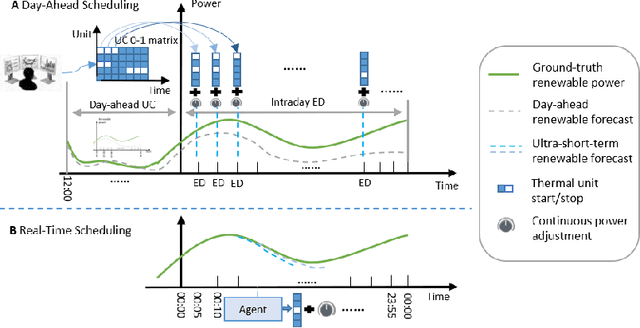
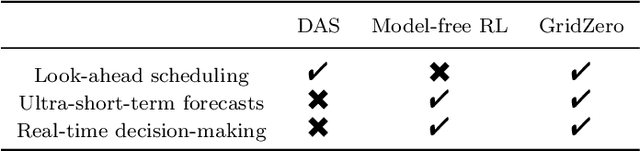
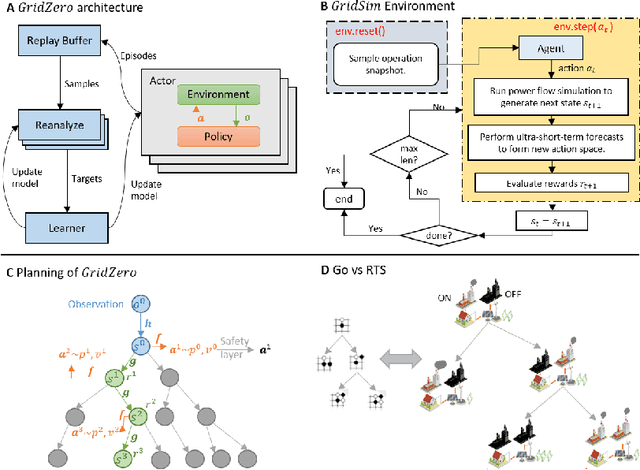
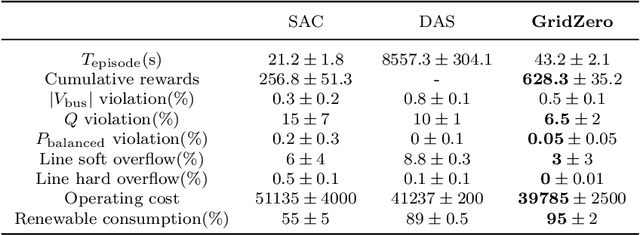
The growing renewable energy sources have posed significant challenges to traditional power scheduling. It is difficult for operators to obtain accurate day-ahead forecasts of renewable generation, thereby requiring the future scheduling system to make real-time scheduling decisions aligning with ultra-short-term forecasts. Restricted by the computation speed, traditional optimization-based methods can not solve this problem. Recent developments in reinforcement learning (RL) have demonstrated the potential to solve this challenge. However, the existing RL methods are inadequate in terms of constraint complexity, algorithm performance, and environment fidelity. We are the first to propose a systematic solution based on the state-of-the-art reinforcement learning algorithm and the real power grid environment. The proposed approach enables planning and finer time resolution adjustments of power generators, including unit commitment and economic dispatch, thus increasing the grid's ability to admit more renewable energy. The well-trained scheduling agent significantly reduces renewable curtailment and load shedding, which are issues arising from traditional scheduling's reliance on inaccurate day-ahead forecasts. High-frequency control decisions exploit the existing units' flexibility, reducing the power grid's dependence on hardware transformations and saving investment and operating costs, as demonstrated in experimental results. This research exhibits the potential of reinforcement learning in promoting low-carbon and intelligent power systems and represents a solid step toward sustainable electricity generation.