 Add to Chrome
 Add to Firefox
 Add to Edge
Video2Sim2Real: Full-Stack Autonomous Dexterous Skill Acquisition from a Single Human Video
Jun 07, 2026
Human manipulation videos are a convenient and intuitive source for robot learning. However, directly transferring human dexterity to robots remains challenging due to perception errors and embodiment gap. To address this, we introduce Video2Sim2Real, a full-stack framework for autonomous skill acquisition from a single human manipulation video. Our framework first uses off-the-shelf foundation models to reconstruct a simulator-ready digital twin and extract robot and object motion priors. Rather than treating the extracted robot motion as a reliable reference throughout execution, our key idea is to recover and leverage the most fundamental sources of supervision from the demonstrated skill: We identify object-centric keyframes to optimize the corresponding robot configurations using object information from the simulator, and use these configurations as anchors that refine the robot motion such that it ultimately has the desired impact on the environment. To bridge the remaining sim-to-real gap, we introduce a sim-to-real strategy that decouples robustness to noisy and incomplete perception from variations in hand-object interaction dynamics. Specifically, we learn to recalibrate robot configurations from noisy real-world point clouds via IL, and leverage residual RL to perform local finger-level adaptations to ensure for robust and effective interactions. Finally, a collision-aware motion planning module enables spatial generalization to novel object configurations. Across several everyday manipulation tasks, Video2Sim2Real improves simulated task success, safety, and trajectory coherence over numerous baselines, and achieves better sim-to-real transfer than existing techniques. These results demonstrate a promising path toward autonomous dexterous skill acquisition from human videos.

Design of a Formation Control System to Assist Human Operators in Flying a Swarm of Robotic Blimps
May 14, 2025Formation control is essential for swarm robotics, enabling coordinated behavior in complex environments. In this paper, we introduce a novel formation control system for an indoor blimp swarm using a specialized leader-follower approach enhanced with a dynamic leader-switching mechanism. This strategy allows any blimp to take on the leader role, distributing maneuvering demands across the swarm and enhancing overall formation stability. Only the leader blimp is manually controlled by a human operator, while follower blimps use onboard monocular cameras and a laser altimeter for relative position and altitude estimation. A leader-switching scheme is proposed to assist the human operator to maintain stability of the swarm, especially when a sharp turn is performed. Experimental results confirm that the leader-switching mechanism effectively maintains stable formations and adapts to dynamic indoor environments while assisting human operator.
MineLand: Simulating Large-Scale Multi-Agent Interactions with Limited Multimodal Senses and Physical Needs
Mar 28, 2024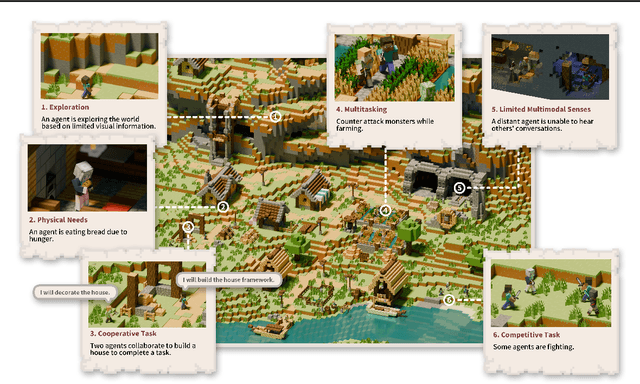
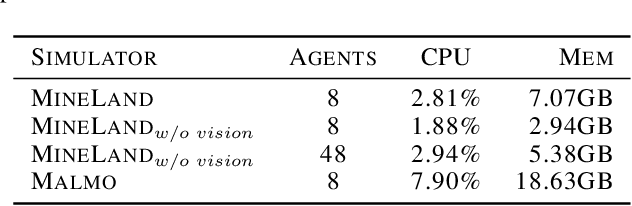
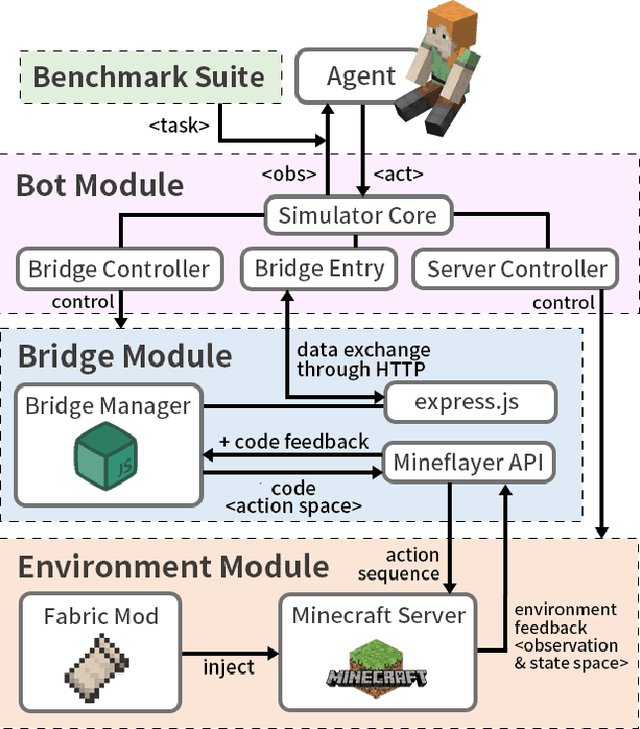
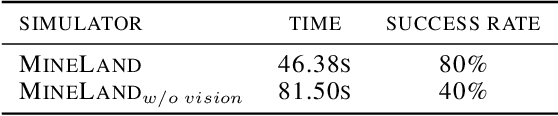
Conventional multi-agent simulators often assume perfect information and limitless capabilities, hindering the ecological validity of social interactions. We propose a multi-agent Minecraft simulator, MineLand, that bridges this gap by introducing limited multimodal senses and physical needs. Our simulator supports up to 48 agents with limited visual, auditory, and environmental awareness, forcing them to actively communicate and collaborate to fulfill physical needs like food and resources. This fosters dynamic and valid multi-agent interactions. We further introduce an AI agent framework, Alex, inspired by multitasking theory, enabling agents to handle intricate coordination and scheduling. Our experiments demonstrate that the simulator, the corresponding benchmark, and the AI agent framework contribute to more ecological and nuanced collective behavior. The source code of MineLand and Alex is openly available at https://github.com/cocacola-lab/MineLand.