 Add to Chrome
 Add to Firefox
 Add to Edge
AscendKernelGen: A Systematic Study of LLM-Based Kernel Generation for Neural Processing Units
Jan 12, 2026
To meet the ever-increasing demand for computational efficiency, Neural Processing Units (NPUs) have become critical in modern AI infrastructure. However, unlocking their full potential requires developing high-performance compute kernels using vendor-specific Domain-Specific Languages (DSLs), a task that demands deep hardware expertise and is labor-intensive. While Large Language Models (LLMs) have shown promise in general code generation, they struggle with the strict constraints and scarcity of training data in the NPU domain. Our preliminary study reveals that state-of-the-art general-purpose LLMs fail to generate functional complex kernels for Ascend NPUs, yielding a near-zero success rate. To address these challenges, we propose AscendKernelGen, a generation-evaluation integrated framework for NPU kernel development. We introduce Ascend-CoT, a high-quality dataset incorporating chain-of-thought reasoning derived from real-world kernel implementations, and KernelGen-LM, a domain-adaptive model trained via supervised fine-tuning and reinforcement learning with execution feedback. Furthermore, we design NPUKernelBench, a comprehensive benchmark for assessing compilation, correctness, and performance across varying complexity levels. Experimental results demonstrate that our approach significantly bridges the gap between general LLMs and hardware-specific coding. Specifically, the compilation success rate on complex Level-2 kernels improves from 0% to 95.5% (Pass@10), while functional correctness achieves 64.3% compared to the baseline's complete failure. These results highlight the critical role of domain-specific reasoning and rigorous evaluation in automating accelerator-aware code generation.

Knowledge Prompt-tuning for Sequential Recommendation
Aug 14, 2023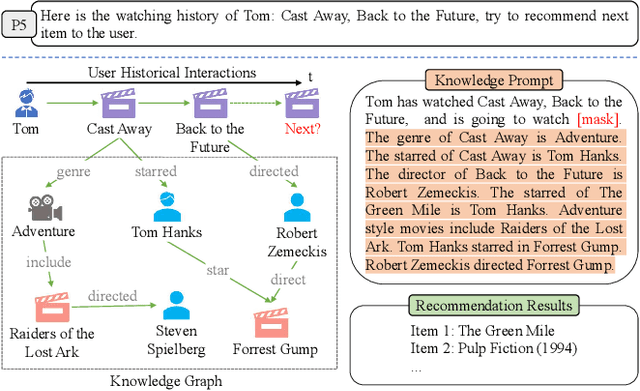
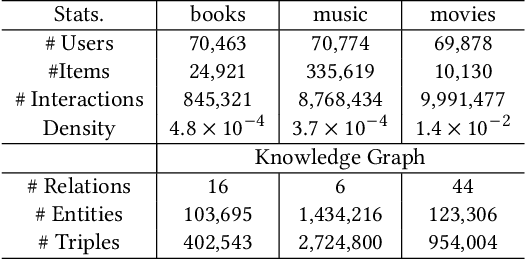
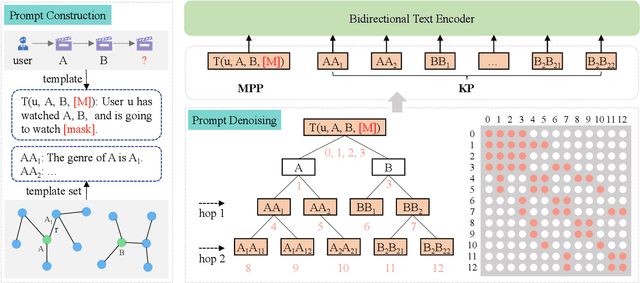
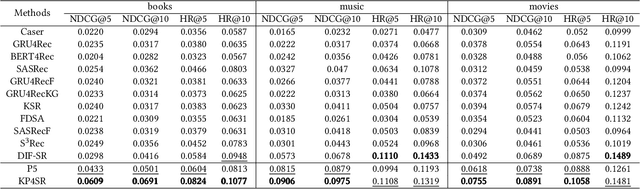
Pre-trained language models (PLMs) have demonstrated strong performance in sequential recommendation (SR), which are utilized to extract general knowledge. However, existing methods still lack domain knowledge and struggle to capture users' fine-grained preferences. Meanwhile, many traditional SR methods improve this issue by integrating side information while suffering from information loss. To summarize, we believe that a good recommendation system should utilize both general and domain knowledge simultaneously. Therefore, we introduce an external knowledge base and propose Knowledge Prompt-tuning for Sequential Recommendation (\textbf{KP4SR}). Specifically, we construct a set of relationship templates and transform a structured knowledge graph (KG) into knowledge prompts to solve the problem of the semantic gap. However, knowledge prompts disrupt the original data structure and introduce a significant amount of noise. We further construct a knowledge tree and propose a knowledge tree mask, which restores the data structure in a mask matrix form, thus mitigating the noise problem. We evaluate KP4SR on three real-world datasets, and experimental results show that our approach outperforms state-of-the-art methods on multiple evaluation metrics. Specifically, compared with PLM-based methods, our method improves NDCG@5 and HR@5 by \textcolor{red}{40.65\%} and \textcolor{red}{36.42\%} on the books dataset, \textcolor{red}{11.17\%} and \textcolor{red}{11.47\%} on the music dataset, and \textcolor{red}{22.17\%} and \textcolor{red}{19.14\%} on the movies dataset, respectively. Our code is publicly available at the link: \href{https://github.com/zhaijianyang/KP4SR}{\textcolor{blue}{https://github.com/zhaijianyang/KP4SR}.}