 Add to Chrome
 Add to Firefox
 Add to Edge
Swordsman: Entropy-Driven Adaptive Block Partition for Efficient Diffusion Language Models
Feb 04, 2026
Block-wise decoding effectively improves the inference speed and quality in diffusion language models (DLMs) by combining inter-block sequential denoising and intra-block parallel unmasking. However, existing block-wise decoding methods typically partition blocks in a rigid and fixed manner, which inevitably fragments complete semantic or syntactic constituents, leading to suboptimal performance. Inspired by the entropy reduction hypothesis (ERH), we recognize that constituent boundaries offer greater opportunities for uncertainty reduction, which motivates us to employ entropy analysis for identifying constituent boundaries. Therefore, we propose Swordsman, an entropy-driven adaptive block-wise decoding framework for DLMs. Swordsman adaptively partitions blocks by identifying entropy shifts between adjacent tokens to better align with semantic or syntactic constituent boundaries. In addition, Swordsman dynamically adjusts unmasking thresholds conditioned on the real-time unmasking status within a block, further improving both efficiency and stability. As a training-free framework, supported by KV Cache, Swordsman demonstrates state-of-the-art performance across extensive evaluations.

Enhancing Text-to-Image Diffusion Transformer via Split-Text Conditioning
May 25, 2025Current text-to-image diffusion generation typically employs complete-text conditioning. Due to the intricate syntax, diffusion transformers (DiTs) inherently suffer from a comprehension defect of complete-text captions. One-fly complete-text input either overlooks critical semantic details or causes semantic confusion by simultaneously modeling diverse semantic primitive types. To mitigate this defect of DiTs, we propose a novel split-text conditioning framework named DiT-ST. This framework converts a complete-text caption into a split-text caption, a collection of simplified sentences, to explicitly express various semantic primitives and their interconnections. The split-text caption is then injected into different denoising stages of DiT-ST in a hierarchical and incremental manner. Specifically, DiT-ST leverages Large Language Models to parse captions, extracting diverse primitives and hierarchically sorting out and constructing these primitives into a split-text input. Moreover, we partition the diffusion denoising process according to its differential sensitivities to diverse semantic primitive types and determine the appropriate timesteps to incrementally inject tokens of diverse semantic primitive types into input tokens via cross-attention. In this way, DiT-ST enhances the representation learning of specific semantic primitive types across different stages. Extensive experiments validate the effectiveness of our proposed DiT-ST in mitigating the complete-text comprehension defect.
Wills Aligner: A Robust Multi-Subject Brain Representation Learner
Apr 20, 2024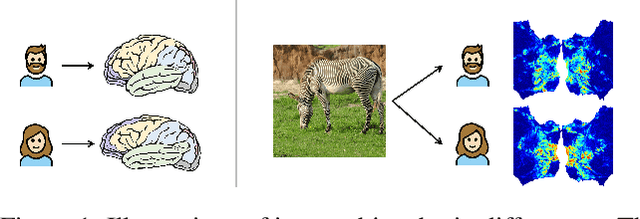
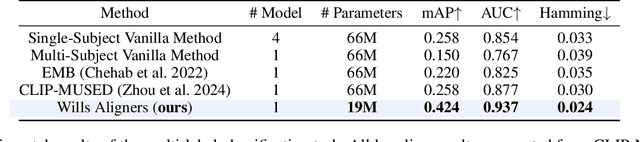
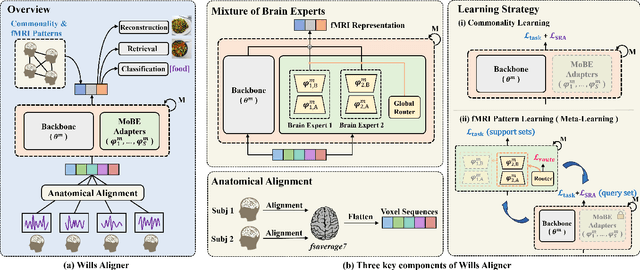
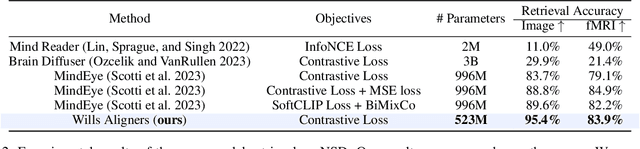
Decoding visual information from human brain activity has seen remarkable advancements in recent research. However, due to the significant variability in cortical parcellation and cognition patterns across subjects, current approaches personalized deep models for each subject, constraining the practicality of this technology in real-world contexts. To tackle the challenges, we introduce Wills Aligner, a robust multi-subject brain representation learner. Our Wills Aligner initially aligns different subjects' brains at the anatomical level. Subsequently, it incorporates a mixture of brain experts to learn individual cognition patterns. Additionally, it decouples the multi-subject learning task into a two-stage training, propelling the deep model and its plugin network to learn inter-subject commonality knowledge and various cognition patterns, respectively. Wills Aligner enables us to overcome anatomical differences and to efficiently leverage a single model for multi-subject brain representation learning. We meticulously evaluate the performance of our approach across coarse-grained and fine-grained visual decoding tasks. The experimental results demonstrate that our Wills Aligner achieves state-of-the-art performance.