 Add to Chrome
 Add to Firefox
 Add to Edge
$G^2$-Reader: Dual Evolving Graphs for Multimodal Document QA
Jan 29, 2026
Retrieval-augmented generation is a practical paradigm for question answering over long documents, but it remains brittle for multimodal reading where text, tables, and figures are interleaved across many pages. First, flat chunking breaks document-native structure and cross-modal alignment, yielding semantic fragments that are hard to interpret in isolation. Second, even iterative retrieval can fail in long contexts by looping on partial evidence or drifting into irrelevant sections as noise accumulates, since each step is guided only by the current snippet without a persistent global search state. We introduce $G^2$-Reader, a dual-graph system, to address both issues. It evolves a Content Graph to preserve document-native structure and cross-modal semantics, and maintains a Planning Graph, an agentic directed acyclic graph of sub-questions, to track intermediate findings and guide stepwise navigation for evidence completion. On VisDoMBench across five multimodal domains, $G^2$-Reader with Qwen3-VL-32B-Instruct reaches 66.21\% average accuracy, outperforming strong baselines and a standalone GPT-5 (53.08\%).

PointFlowHop: Green and Interpretable Scene Flow Estimation from Consecutive Point Clouds
Feb 27, 2023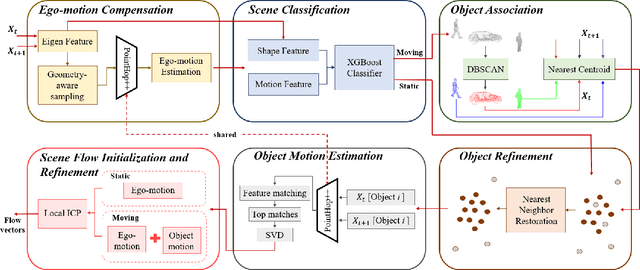
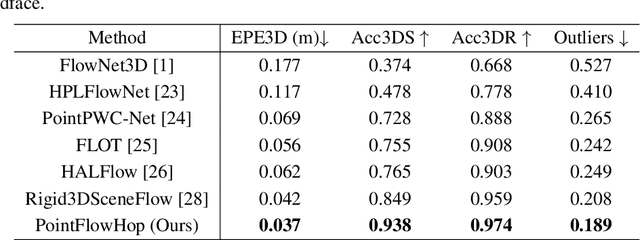
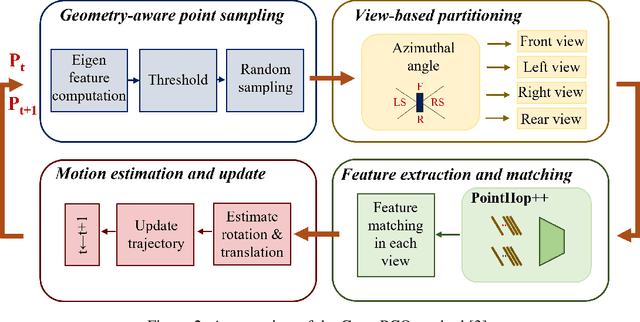
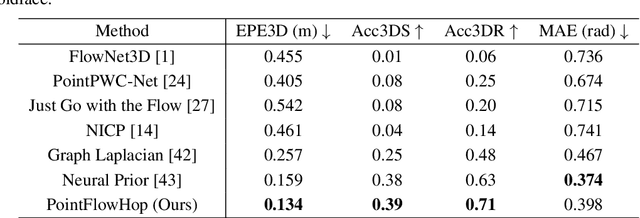
An efficient 3D scene flow estimation method called PointFlowHop is proposed in this work. PointFlowHop takes two consecutive point clouds and determines the 3D flow vectors for every point in the first point cloud. PointFlowHop decomposes the scene flow estimation task into a set of subtasks, including ego-motion compensation, object association and object-wise motion estimation. It follows the green learning (GL) pipeline and adopts the feedforward data processing path. As a result, its underlying mechanism is more transparent than deep-learning (DL) solutions based on end-to-end optimization of network parameters. We conduct experiments on the stereoKITTI and the Argoverse LiDAR point cloud datasets and demonstrate that PointFlowHop outperforms deep-learning methods with a small model size and less training time. Furthermore, we compare the Floating Point Operations (FLOPs) required by PointFlowHop and other learning-based methods in inference, and show its big savings in computational complexity.