 Add to Chrome
 Add to Firefox
 Add to Edge
Adversarial Samples Are Not Created Equal
Jan 02, 2026
Over the past decade, numerous theories have been proposed to explain the widespread vulnerability of deep neural networks to adversarial evasion attacks. Among these, the theory of non-robust features proposed by Ilyas et al. has been widely accepted, showing that brittle but predictive features of the data distribution can be directly exploited by attackers. However, this theory overlooks adversarial samples that do not directly utilize these features. In this work, we advocate that these two kinds of samples - those which use use brittle but predictive features and those that do not - comprise two types of adversarial weaknesses and should be differentiated when evaluating adversarial robustness. For this purpose, we propose an ensemble-based metric to measure the manipulation of non-robust features by adversarial perturbations and use this metric to analyze the makeup of adversarial samples generated by attackers. This new perspective also allows us to re-examine multiple phenomena, including the impact of sharpness-aware minimization on adversarial robustness and the robustness gap observed between adversarially training and standard training on robust datasets.

UniCat: Crafting a Stronger Fusion Baseline for Multimodal Re-Identification
Oct 28, 2023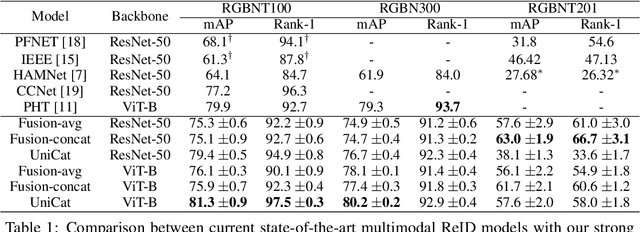

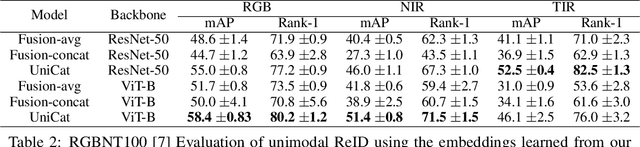
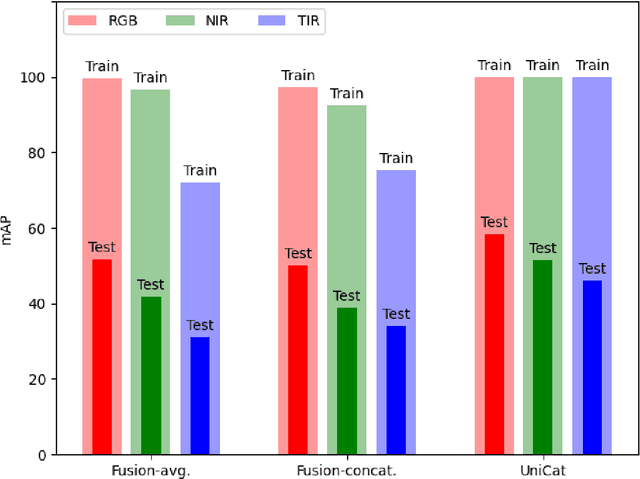
Multimodal Re-Identification (ReID) is a popular retrieval task that aims to re-identify objects across diverse data streams, prompting many researchers to integrate multiple modalities into a unified representation. While such fusion promises a holistic view, our investigations shed light on potential pitfalls. We uncover that prevailing late-fusion techniques often produce suboptimal latent representations when compared to methods that train modalities in isolation. We argue that this effect is largely due to the inadvertent relaxation of the training objectives on individual modalities when using fusion, what others have termed modality laziness. We present a nuanced point-of-view that this relaxation can lead to certain modalities failing to fully harness available task-relevant information, and yet, offers a protective veil to noisy modalities, preventing them from overfitting to task-irrelevant data. Our findings also show that unimodal concatenation (UniCat) and other late-fusion ensembling of unimodal backbones, when paired with best-known training techniques, exceed the current state-of-the-art performance across several multimodal ReID benchmarks. By unveiling the double-edged sword of "modality laziness", we motivate future research in balancing local modality strengths with global representations.