 Add to Chrome
 Add to Firefox
 Add to Edge
BLENDER: Blended Text Embeddings and Diffusion Residuals for Intra-Class Image Synthesis in Deep Metric Learning
Jan 28, 2026
The rise of Deep Generative Models (DGM) has enabled the generation of high-quality synthetic data. When used to augment authentic data in Deep Metric Learning (DML), these synthetic samples enhance intra-class diversity and improve the performance of downstream DML tasks. We introduce BLenDeR, a diffusion sampling method designed to increase intra-class diversity for DML in a controllable way by leveraging set-theory inspired union and intersection operations on denoising residuals. The union operation encourages any attribute present across multiple prompts, while the intersection extracts the common direction through a principal component surrogate. These operations enable controlled synthesis of diverse attribute combinations within each class, addressing key limitations of existing generative approaches. Experiments on standard DML benchmarks demonstrate that BLenDeR consistently outperforms state-of-the-art baselines across multiple datasets and backbones. Specifically, BLenDeR achieves 3.7% increase in Recall@1 on CUB-200 and a 1.8% increase on Cars-196, compared to state-of-the-art baselines under standard experimental settings.

DeepSafeMPC: Deep Learning-Based Model Predictive Control for Safe Multi-Agent Reinforcement Learning
Mar 12, 2024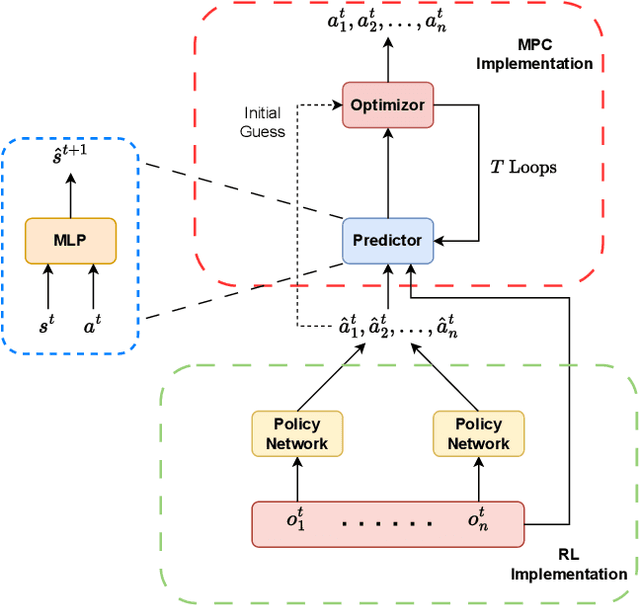
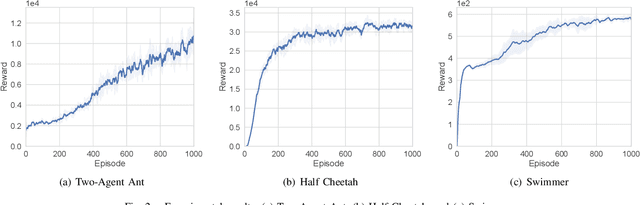
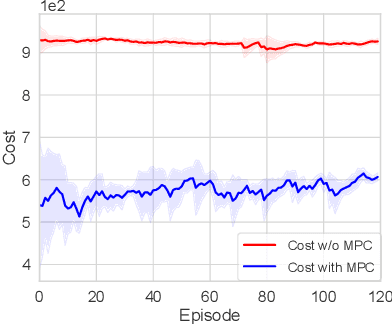
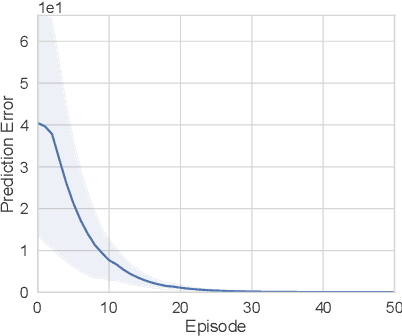
Safe Multi-agent reinforcement learning (safe MARL) has increasingly gained attention in recent years, emphasizing the need for agents to not only optimize the global return but also adhere to safety requirements through behavioral constraints. Some recent work has integrated control theory with multi-agent reinforcement learning to address the challenge of ensuring safety. However, there have been only very limited applications of Model Predictive Control (MPC) methods in this domain, primarily due to the complex and implicit dynamics characteristic of multi-agent environments. To bridge this gap, we propose a novel method called Deep Learning-Based Model Predictive Control for Safe Multi-Agent Reinforcement Learning (DeepSafeMPC). The key insight of DeepSafeMPC is leveraging a entralized deep learning model to well predict environmental dynamics. Our method applies MARL principles to search for optimal solutions. Through the employment of MPC, the actions of agents can be restricted within safe states concurrently. We demonstrate the effectiveness of our approach using the Safe Multi-agent MuJoCo environment, showcasing significant advancements in addressing safety concerns in MARL.