 Add to Chrome
 Add to Firefox
 Add to Edge
SNR-ST-Mix: Sample-specific Neighborhood Regression Mixup for Augmented Spatial Transcriptomics Imputation with Deep Neural Network
Jun 07, 2026
Purpose: Spatial transcriptomics (ST) enables gene expression measurements within the tissue context. However, these measurements are often noisy, low-resolution, and sparsely sampled, which limits the recovery of fine spatial structure. Deep neural networks have become powerful tools for expression imputation from histology, but their performance remains constrained by limited sample sizes and a lack of biologically informed augmentation. Most of the existing augmentation strategies for learning are designed for classification tasks rather than regression, which neglect spatial and transcriptomic relationships, leading to biologically implausible interpolations that hinder prediction performance. Approach: To address these limitations, we propose SNR-ST-Mix, a geometry- and expression-aware data augmentation framework designed specifically for ST data. It constrains mixing to a spot's k-nearest spatial neighbors and adaptively weights interpolation coefficients based on expression similarity, generating augmented samples that preserve local biological structure while ensuring spatial smoothness. This dual conditioning yields synthetic examples that expand the effective training manifold, promote generalization, and enhance prediction stability under sample-specific training. Results: Extensive experiments with various tissue types demonstrate that SNR-ST-Mix consistently outperforms conventional augmentation methods without requiring architectural changes or additional computation. Conclusions: SNR-ST-Mix provides an effective and biologically principled augmentation strategy for spatial transcriptomics regression tasks. By explicitly leveraging spatial geometry and transcriptomic similarity, it expands the effective training manifold and improves predictive performance without increasing model complexity.

CA-YOLO: Cross Attention Empowered YOLO for Biomimetic Localization
Feb 07, 2026In modern complex environments, achieving accurate and efficient target localization is essential in numerous fields. However, existing systems often face limitations in both accuracy and the ability to recognize small targets. In this study, we propose a bionic stabilized localization system based on CA-YOLO, designed to enhance both target localization accuracy and small target recognition capabilities. Acting as the "brain" of the system, the target detection algorithm emulates the visual focusing mechanism of animals by integrating bionic modules into the YOLO backbone network. These modules include the introduction of a small target detection head and the development of a Characteristic Fusion Attention Mechanism (CFAM). Furthermore, drawing inspiration from the human Vestibulo-Ocular Reflex (VOR), a bionic pan-tilt tracking control strategy is developed, which incorporates central positioning, stability optimization, adaptive control coefficient adjustment, and an intelligent recapture function. The experimental results show that CA-YOLO outperforms the original model on standard datasets (COCO and VisDrone), with average accuracy metrics improved by 3.94%and 4.90%, respectively.Further time-sensitive target localization experiments validate the effectiveness and practicality of this bionic stabilized localization system.
HAD-GAN: A Human-perception Auxiliary Defense GAN to Defend Adversarial Examples
Sep 25, 2019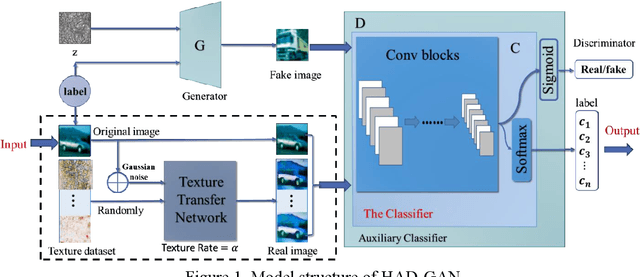
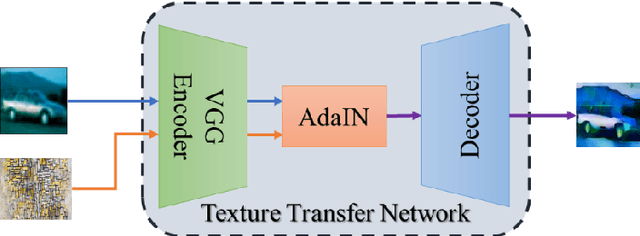
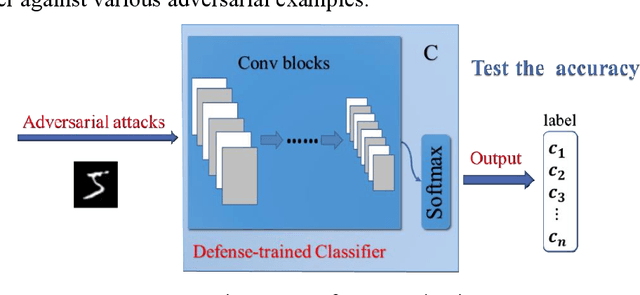
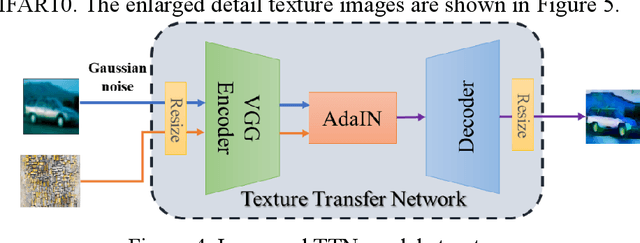
Adversarial examples reveal the vulnerability and unexplained nature of neural networks. Studying the defense of adversarial examples is of considerable practical importance. Most adversarial examples that misclassify networks are often undetectable by humans. In this paper, we propose a defense model to train the classifier into a human-perception classification model with shape preference. The proposed model comprising a texture transfer network (TTN) and an auxiliary defense generative adversarial networks (GAN) is called Human-perception Auxiliary Defense GAN (HAD-GAN). The TTN is used to extend the texture samples of a clean image and helps classifiers focus on its shape. GAN is utilized to form a training framework for the model and generate the necessary images. A series of experiments conducted on MNIST, Fashion-MNIST and CIFAR10 show that the proposed model outperforms the state-of-the-art defense methods for network robustness. The model also demonstrates a significant improvement on defense capability of adversarial examples.