 Add to Chrome
 Add to Firefox
 Add to Edge
Belief in Authority: Impact of Authority in Multi-Agent Evaluation Framework
Jan 08, 2026
Multi-agent systems utilizing large language models often assign authoritative roles to improve performance, yet the impact of authority bias on agent interactions remains underexplored. We present the first systematic analysis of role-based authority bias in free-form multi-agent evaluation using ChatEval. Applying French and Raven's power-based theory, we classify authoritative roles into legitimate, referent, and expert types and analyze their influence across 12-turn conversations. Experiments with GPT-4o and DeepSeek R1 reveal that Expert and Referent power roles exert stronger influence than Legitimate power roles. Crucially, authority bias emerges not through active conformity by general agents, but through authoritative roles consistently maintaining their positions while general agents demonstrate flexibility. Furthermore, authority influence requires clear position statements, as neutral responses fail to generate bias. These findings provide key insights for designing multi-agent frameworks with asymmetric interaction patterns.

VersaPRM: Multi-Domain Process Reward Model via Synthetic Reasoning Data
Feb 10, 2025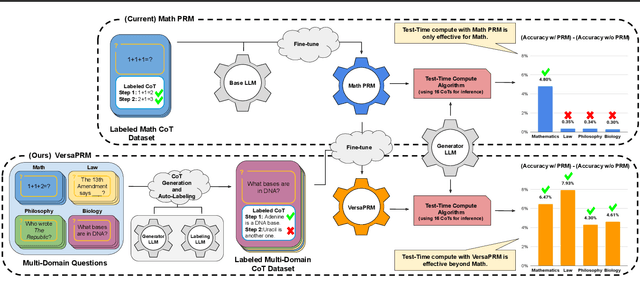
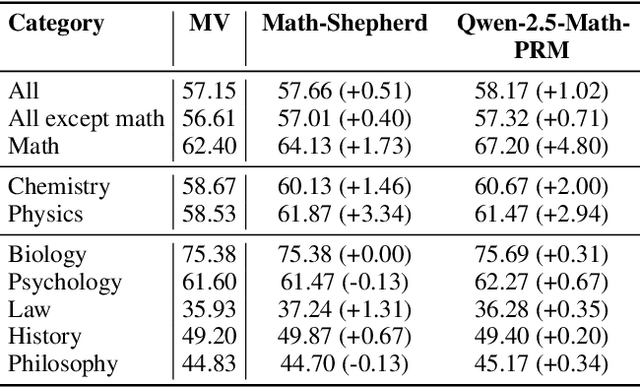
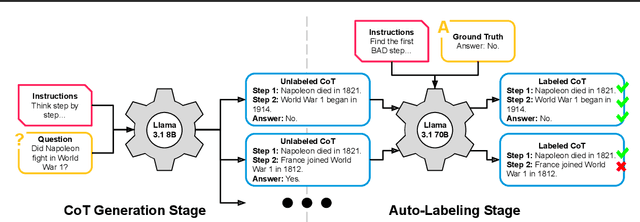

Process Reward Models (PRMs) have proven effective at enhancing mathematical reasoning for Large Language Models (LLMs) by leveraging increased inference-time computation. However, they are predominantly trained on mathematical data and their generalizability to non-mathematical domains has not been rigorously studied. In response, this work first shows that current PRMs have poor performance in other domains. To address this limitation, we introduce VersaPRM, a multi-domain PRM trained on synthetic reasoning data generated using our novel data generation and annotation method. VersaPRM achieves consistent performance gains across diverse domains. For instance, in the MMLU-Pro category of Law, VersaPRM via weighted majority voting, achieves a 7.9% performance gain over the majority voting baseline -- surpassing Qwen2.5-Math-PRM's gain of 1.3%. We further contribute to the community by open-sourcing all data, code and models for VersaPRM.