 Add to Chrome
 Add to Firefox
 Add to Edge
TABED: Test-Time Adaptive Ensemble Drafting for Robust Speculative Decoding in LVLMs
Jan 28, 2026
Speculative decoding (SD) has proven effective for accelerating LLM inference by quickly generating draft tokens and verifying them in parallel. However, SD remains largely unexplored for Large Vision-Language Models (LVLMs), which extend LLMs to process both image and text prompts. To address this gap, we benchmark existing inference methods with small draft models on 11 datasets across diverse input scenarios and observe scenario-specific performance fluctuations. Motivated by these findings, we propose Test-time Adaptive Batched Ensemble Drafting (TABED), which dynamically ensembles multiple drafts obtained via batch inference by leveraging deviations from past ground truths available in the SD setting. The dynamic ensemble method achieves an average robust walltime speedup of 1.74x over autoregressive decoding and a 5% improvement over single drafting methods, while remaining training-free and keeping ensembling costs negligible through parameter sharing. With its plug-and-play compatibility, we further enhance TABED by integrating advanced verification and alternative drafting methods. Code and custom-trained models are available at https://github.com/furiosa-ai/TABED.

VersaPRM: Multi-Domain Process Reward Model via Synthetic Reasoning Data
Feb 10, 2025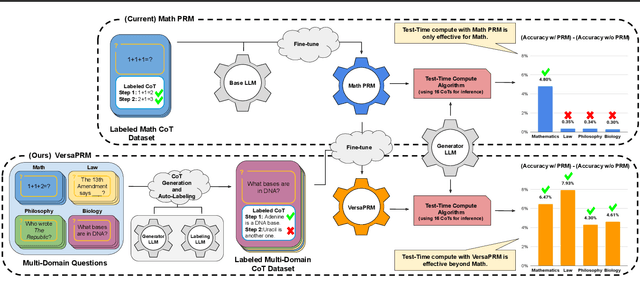
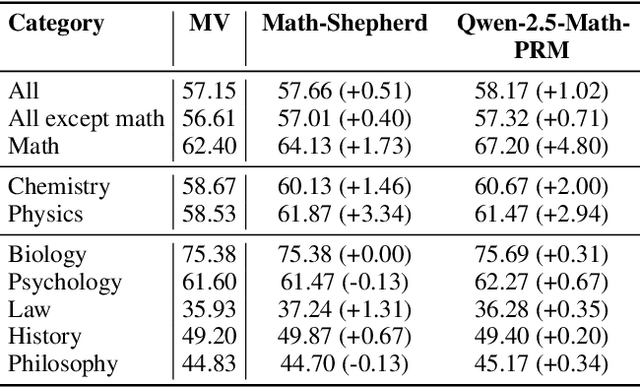
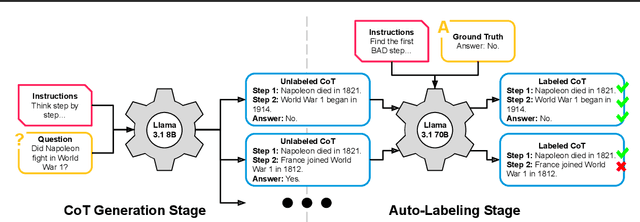

Process Reward Models (PRMs) have proven effective at enhancing mathematical reasoning for Large Language Models (LLMs) by leveraging increased inference-time computation. However, they are predominantly trained on mathematical data and their generalizability to non-mathematical domains has not been rigorously studied. In response, this work first shows that current PRMs have poor performance in other domains. To address this limitation, we introduce VersaPRM, a multi-domain PRM trained on synthetic reasoning data generated using our novel data generation and annotation method. VersaPRM achieves consistent performance gains across diverse domains. For instance, in the MMLU-Pro category of Law, VersaPRM via weighted majority voting, achieves a 7.9% performance gain over the majority voting baseline -- surpassing Qwen2.5-Math-PRM's gain of 1.3%. We further contribute to the community by open-sourcing all data, code and models for VersaPRM.