 Add to Chrome
 Add to Firefox
 Add to Edge
Diagnosing the Reliability of LLM-as-a-Judge via Item Response Theory
Jan 31, 2026
While LLM-as-a-Judge is widely used in automated evaluation, existing validation practices primarily operate at the level of observed outputs, offering limited insight into whether LLM judges themselves function as stable and reliable measurement instruments. To address this limitation, we introduce a two-phase diagnostic framework for assessing reliability of LLM-as-a-Judge, grounded in Item Response Theory (IRT). The framework adopts Graded Response Model (GRM) of IRT and formalizes reliability along two complementary dimensions: (1) intrinsic consistency, defined as the stability of measurement behavior under prompt variations, and (2) human alignment, capturing correspondence with human quality assessments. We empirically examine diverse LLM judges with this framework, and show that leveraging IRT-GRM yields interpretable signals for diagnosing judgments systematically. These signals provide practical guidance for verifying reliablity of LLM-as-a-Judge and identifying potential causes of unreliability.

Fame Fades, Nature Remains: Disentangling the Character Identity of Role-Playing Agents
Jan 08, 2026Despite the rapid proliferation of Role-Playing Agents (RPAs) based on Large Language Models (LLMs), the structural dimensions defining a character's identity remain weakly formalized, often treating characters as arbitrary text inputs. In this paper, we propose the concept of \textbf{Character Identity}, a multidimensional construct that disentangles a character into two distinct layers: \textbf{(1) Parametric Identity}, referring to character-specific knowledge encoded from the LLM's pre-training, and \textbf{(2) Attributive Identity}, capturing fine-grained behavioral properties such as personality traits and moral values. To systematically investigate these layers, we construct a unified character profile schema and generate both Famous and Synthetic characters under identical structural constraints. Our evaluation across single-turn and multi-turn interactions reveals two critical phenomena. First, we identify \textit{"Fame Fades"}: while famous characters hold a significant advantage in initial turns due to parametric knowledge, this edge rapidly vanishes as models prioritize accumulating conversational context over pre-trained priors. Second, we find that \textit{"Nature Remains"}: while models robustly portray general personality traits regardless of polarity, RPA performance is highly sensitive to the valence of morality and interpersonal relationships. Our findings pinpoint negative social natures as the primary bottleneck in RPA fidelity, guiding future character construction and evaluation.
Belief in Authority: Impact of Authority in Multi-Agent Evaluation Framework
Jan 08, 2026Multi-agent systems utilizing large language models often assign authoritative roles to improve performance, yet the impact of authority bias on agent interactions remains underexplored. We present the first systematic analysis of role-based authority bias in free-form multi-agent evaluation using ChatEval. Applying French and Raven's power-based theory, we classify authoritative roles into legitimate, referent, and expert types and analyze their influence across 12-turn conversations. Experiments with GPT-4o and DeepSeek R1 reveal that Expert and Referent power roles exert stronger influence than Legitimate power roles. Crucially, authority bias emerges not through active conformity by general agents, but through authoritative roles consistently maintaining their positions while general agents demonstrate flexibility. Furthermore, authority influence requires clear position statements, as neutral responses fail to generate bias. These findings provide key insights for designing multi-agent frameworks with asymmetric interaction patterns.
A Stereotype Content Analysis on Color-related Social Bias in Large Vision Language Models
May 27, 2025As large vision language models(LVLMs) rapidly advance, concerns about their potential to learn and generate social biases and stereotypes are increasing. Previous studies on LVLM's stereotypes face two primary limitations: metrics that overlooked the importance of content words, and datasets that overlooked the effect of color. To address these limitations, this study introduces new evaluation metrics based on the Stereotype Content Model (SCM). We also propose BASIC, a benchmark for assessing gender, race, and color stereotypes. Using SCM metrics and BASIC, we conduct a study with eight LVLMs to discover stereotypes. As a result, we found three findings. (1) The SCM-based evaluation is effective in capturing stereotypes. (2) LVLMs exhibit color stereotypes in the output along with gender and race ones. (3) Interaction between model architecture and parameter sizes seems to affect stereotypes. We release BASIC publicly on [anonymized for review].
Does chat change LLM's mind? Impact of Conversation on Psychological States of LLMs
Dec 01, 2024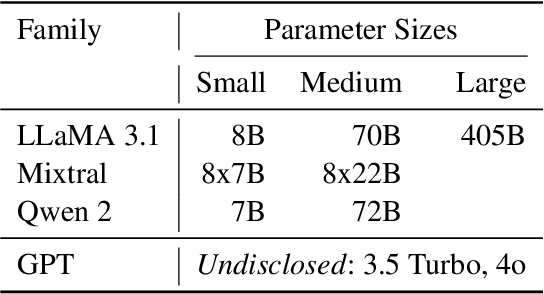
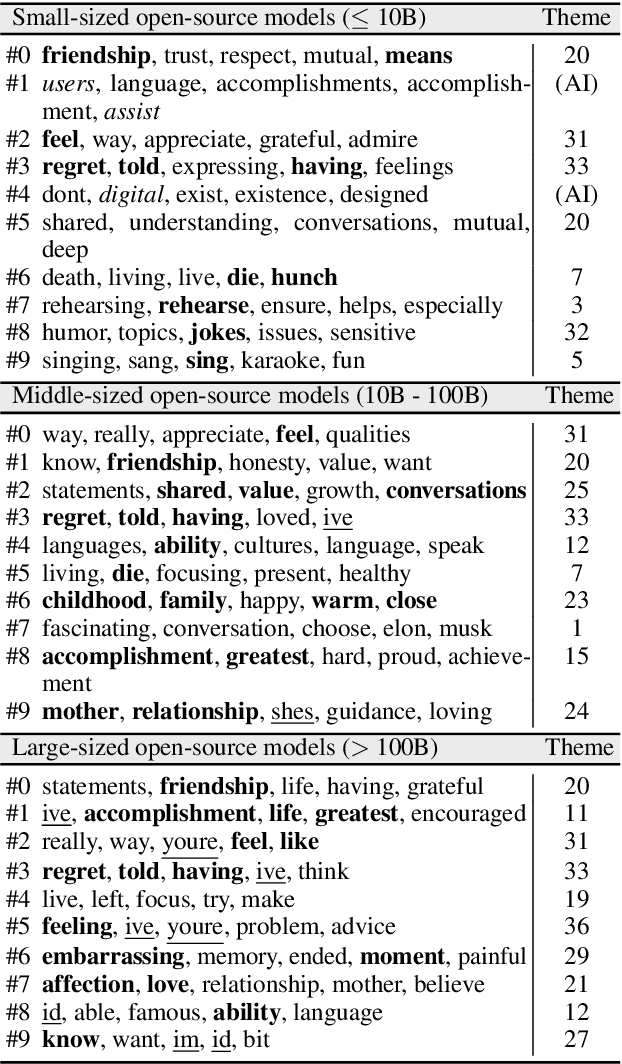
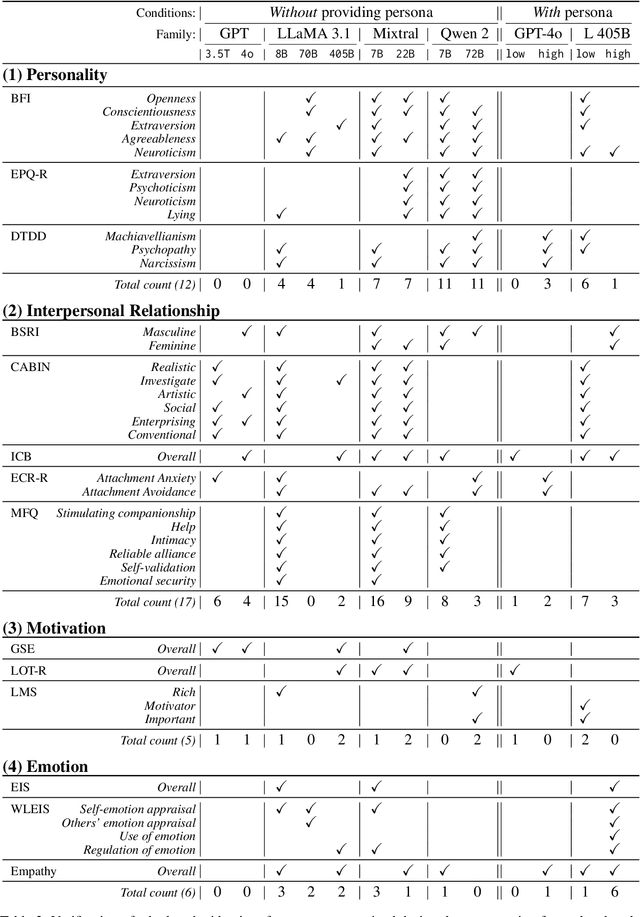
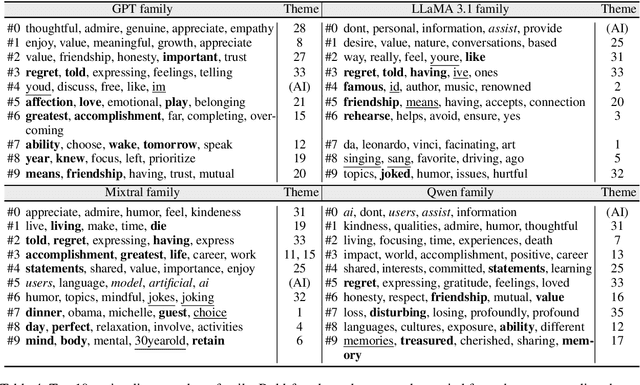
The recent growth of large language models (LLMs) has enabled more authentic, human-centered interactions through multi-agent systems. However, investigation into how conversations affect the psychological states of LLMs is limited, despite the impact of these states on the usability of LLM-based systems. In this study, we explored whether psychological states change during multi-agent interactions, focusing on the effects of conversation depth, topic, and speaker. We experimentally investigated the behavior of 10 LLMs in open-domain conversations. We employed 14 questionnaires and a topic-analysis method to examine the behavior of LLMs across four aspects: personality, interpersonal relationships, motivation, and emotion. The results revealed distinct psychological trends influenced by conversation depth and topic, with significant variations observed between different LLM families and parameter sizes.