 Add to Chrome
 Add to Firefox
 Add to Edge
EditYourself: Audio-Driven Generation and Manipulation of Talking Head Videos with Diffusion Transformers
Jan 29, 2026
Current generative video models excel at producing novel content from text and image prompts, but leave a critical gap in editing existing pre-recorded videos, where minor alterations to the spoken script require preserving motion, temporal coherence, speaker identity, and accurate lip synchronization. We introduce EditYourself, a DiT-based framework for audio-driven video-to-video (V2V) editing that enables transcript-based modification of talking head videos, including the seamless addition, removal, and retiming of visually spoken content. Building on a general-purpose video diffusion model, EditYourself augments its V2V capabilities with audio conditioning and region-aware, edit-focused training extensions. This enables precise lip synchronization and temporally coherent restructuring of existing performances via spatiotemporal inpainting, including the synthesis of realistic human motion in newly added segments, while maintaining visual fidelity and identity consistency over long durations. This work represents a foundational step toward generative video models as practical tools for professional video post-production.

StreamingT2V: Consistent, Dynamic, and Extendable Long Video Generation from Text
Mar 21, 2024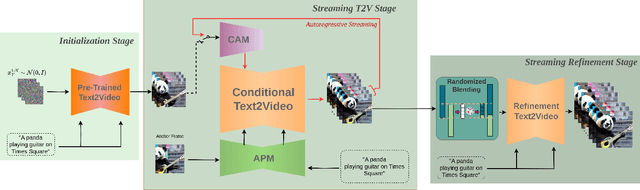
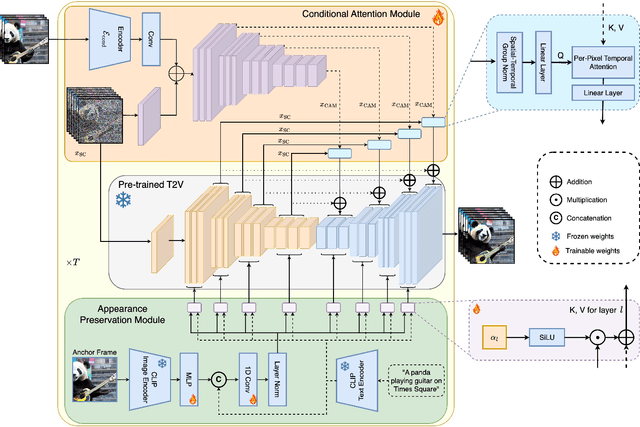
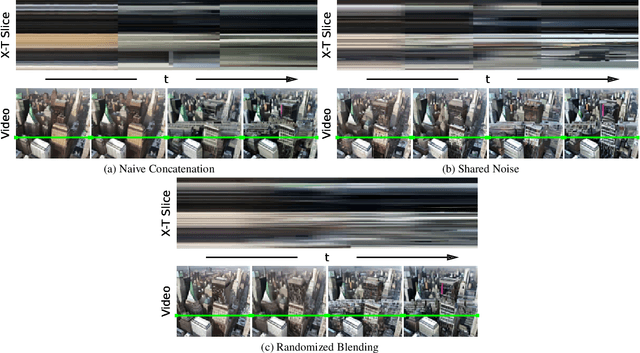
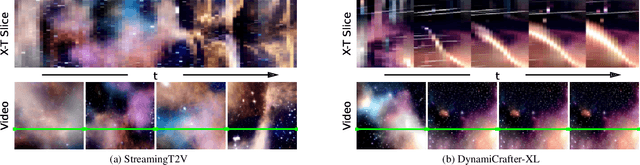
Text-to-video diffusion models enable the generation of high-quality videos that follow text instructions, making it easy to create diverse and individual content. However, existing approaches mostly focus on high-quality short video generation (typically 16 or 24 frames), ending up with hard-cuts when naively extended to the case of long video synthesis. To overcome these limitations, we introduce StreamingT2V, an autoregressive approach for long video generation of 80, 240, 600, 1200 or more frames with smooth transitions. The key components are:(i) a short-term memory block called conditional attention module (CAM), which conditions the current generation on the features extracted from the previous chunk via an attentional mechanism, leading to consistent chunk transitions, (ii) a long-term memory block called appearance preservation module, which extracts high-level scene and object features from the first video chunk to prevent the model from forgetting the initial scene, and (iii) a randomized blending approach that enables to apply a video enhancer autoregressively for infinitely long videos without inconsistencies between chunks. Experiments show that StreamingT2V generates high motion amount. In contrast, all competing image-to-video methods are prone to video stagnation when applied naively in an autoregressive manner. Thus, we propose with StreamingT2V a high-quality seamless text-to-long video generator that outperforms competitors with consistency and motion. Our code will be available at: https://github.com/Picsart-AI-Research/StreamingT2V