 Add to Chrome
 Add to Firefox
 Add to Edge
EverybodyDance: Bipartite Graph-Based Identity Correspondence for Multi-Character Animation
Dec 18, 2025
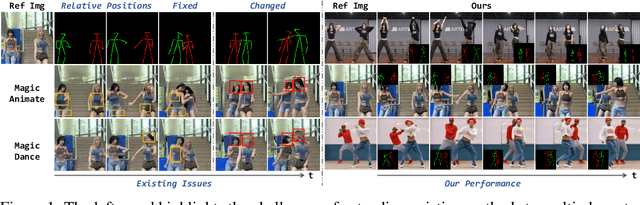
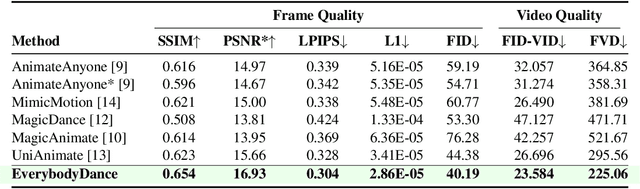
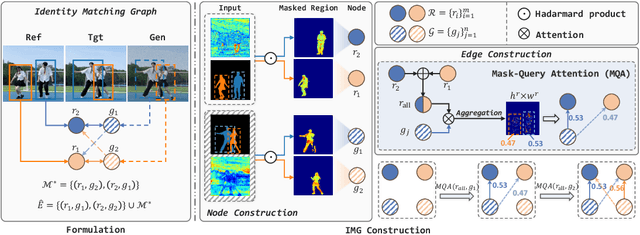
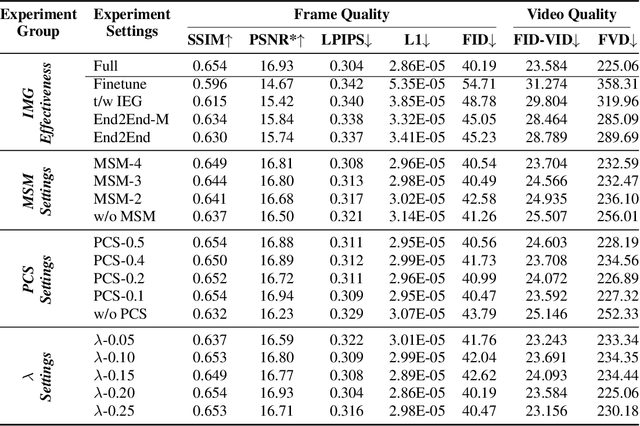
Consistent pose-driven character animation has achieved remarkable progress in single-character scenarios. However, extending these advances to multi-character settings is non-trivial, especially when position swap is involved. Beyond mere scaling, the core challenge lies in enforcing correct Identity Correspondence (IC) between characters in reference and generated frames. To address this, we introduce EverybodyDance, a systematic solution targeting IC correctness in multi-character animation. EverybodyDance is built around the Identity Matching Graph (IMG), which models characters in the generated and reference frames as two node sets in a weighted complete bipartite graph. Edge weights, computed via our proposed Mask-Query Attention (MQA), quantify the affinity between each pair of characters. Our key insight is to formalize IC correctness as a graph structural metric and to optimize it during training. We also propose a series of targeted strategies tailored for multi-character animation, including identity-embedded guidance, a multi-scale matching strategy, and pre-classified sampling, which work synergistically. Finally, to evaluate IC performance, we curate the Identity Correspondence Evaluation benchmark, dedicated to multi-character IC correctness. Extensive experiments demonstrate that EverybodyDance substantially outperforms state-of-the-art baselines in both IC and visual fidelity.

Learning to Stop Cut Generation for Efficient Mixed-Integer Linear Programming
Feb 02, 2024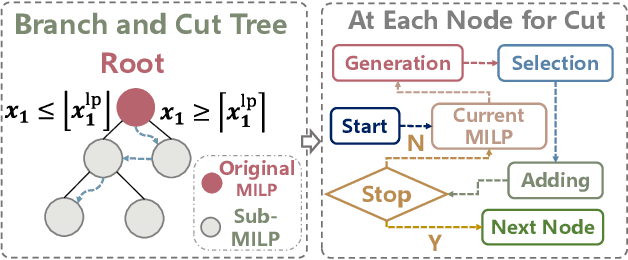
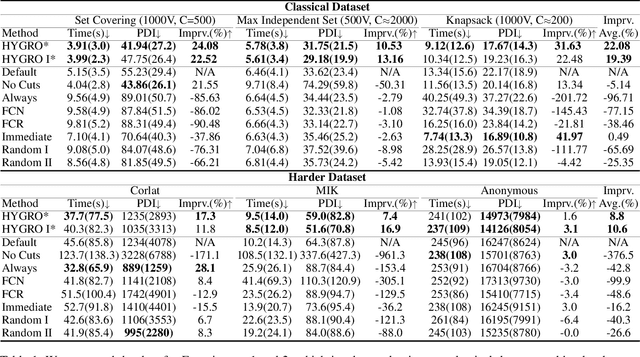
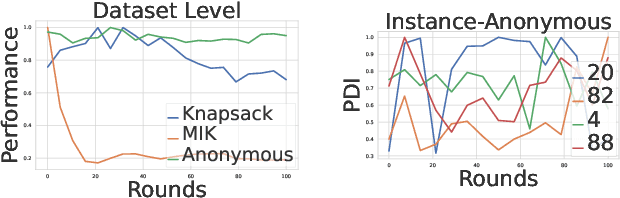
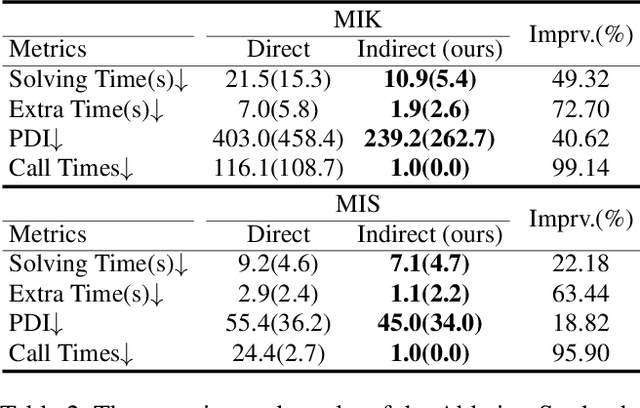
Cutting planes (cuts) play an important role in solving mixed-integer linear programs (MILPs), as they significantly tighten the dual bounds and improve the solving performance. A key problem for cuts is when to stop cuts generation, which is important for the efficiency of solving MILPs. However, many modern MILP solvers employ hard-coded heuristics to tackle this problem, which tends to neglect underlying patterns among MILPs from certain applications. To address this challenge, we formulate the cuts generation stopping problem as a reinforcement learning problem and propose a novel hybrid graph representation model (HYGRO) to learn effective stopping strategies. An appealing feature of HYGRO is that it can effectively capture both the dynamic and static features of MILPs, enabling dynamic decision-making for the stopping strategies. To the best of our knowledge, HYGRO is the first data-driven method to tackle the cuts generation stopping problem. By integrating our approach with modern solvers, experiments demonstrate that HYGRO significantly improves the efficiency of solving MILPs compared to competitive baselines, achieving up to 31% improvement.