 Add to Chrome
 Add to Firefox
 Add to Edge
MedAD-R1: Eliciting Consistent Reasoning in Interpretible Medical Anomaly Detection via Consistency-Reinforced Policy Optimization
Feb 01, 2026
Medical Anomaly Detection (MedAD) presents a significant opportunity to enhance diagnostic accuracy using Large Multimodal Models (LMMs) to interpret and answer questions based on medical images. However, the reliance on Supervised Fine-Tuning (SFT) on simplistic and fragmented datasets has hindered the development of models capable of plausible reasoning and robust multimodal generalization. To overcome this, we introduce MedAD-38K, the first large-scale, multi-modal, and multi-center benchmark for MedAD featuring diagnostic Chain-of-Thought (CoT) annotations alongside structured Visual Question-Answering (VQA) pairs. On this foundation, we propose a two-stage training framework. The first stage, Cognitive Injection, uses SFT to instill foundational medical knowledge and align the model with a structured think-then-answer paradigm. Given that standard policy optimization can produce reasoning that is disconnected from the final answer, the second stage incorporates Consistency Group Relative Policy Optimization (Con-GRPO). This novel algorithm incorporates a crucial consistency reward to ensure the generated reasoning process is relevant and logically coherent with the final diagnosis. Our proposed model, MedAD-R1, achieves state-of-the-art (SOTA) performance on the MedAD-38K benchmark, outperforming strong baselines by more than 10\%. This superior performance stems from its ability to generate transparent and logically consistent reasoning pathways, offering a promising approach to enhancing the trustworthiness and interpretability of AI for clinical decision support.

AFSC: Adaptive Fourier Space Compression for Anomaly Detection
Apr 17, 2022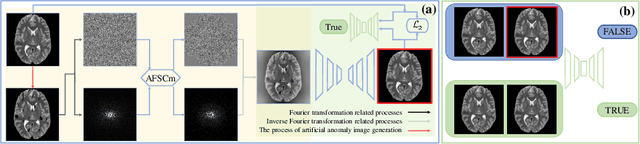
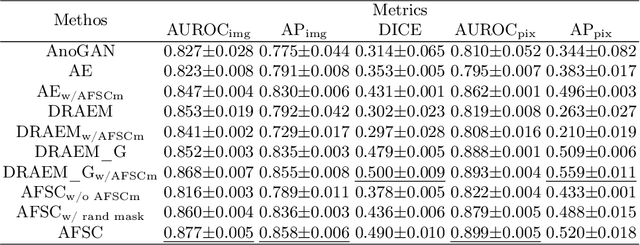
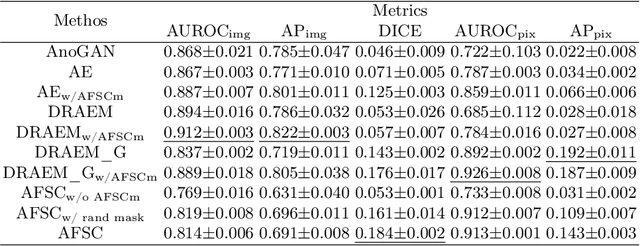
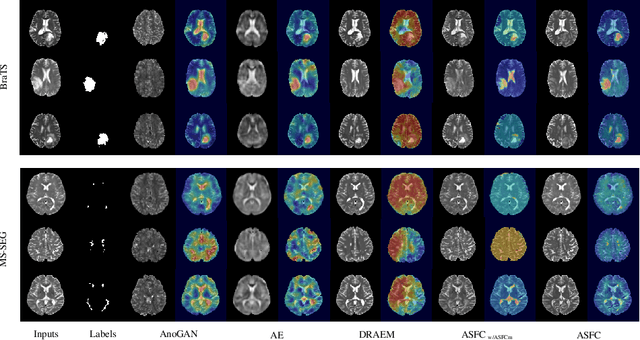
Anomaly Detection (AD) on medical images enables a model to recognize any type of anomaly pattern without lesion-specific supervised learning. Data augmentation based methods construct pseudo-healthy images by "pasting" fake lesions on real healthy ones, and a network is trained to predict healthy images in a supervised manner. The lesion can be found by difference between the unhealthy input and pseudo-healthy output. However, using only manually designed fake lesions fail to approximate to irregular real lesions, hence limiting the model generalization. We assume by exploring the intrinsic data property within images, we can distinguish previously unseen lesions from healthy regions in an unhealthy image. In this study, we propose an Adaptive Fourier Space Compression (AFSC) module to distill healthy feature for AD. The compression of both magnitude and phase in frequency domain addresses the hyper intensity and diverse position of lesions. Experimental results on the BraTS and MS-SEG datasets demonstrate an AFSC baseline is able to produce promising detection results, and an AFSC module can be effectively embedded into existing AD methods.