 Add to Chrome
 Add to Firefox
 Add to Edge
Fairness over Equality: Correcting Social Incentives in Asymmetric Sequential Social Dilemmas
Feb 17, 2026
Sequential Social Dilemmas (SSDs) provide a key framework for studying how cooperation emerges when individual incentives conflict with collective welfare. In Multi-Agent Reinforcement Learning, these problems are often addressed by incorporating intrinsic drives that encourage prosocial or fair behavior. However, most existing methods assume that agents face identical incentives in the dilemma and require continuous access to global information about other agents to assess fairness. In this work, we introduce asymmetric variants of well-known SSD environments and examine how natural differences between agents influence cooperation dynamics. Our findings reveal that existing fairness-based methods struggle to adapt under asymmetric conditions by enforcing raw equality that wrongfully incentivize defection. To address this, we propose three modifications: (i) redefining fairness by accounting for agents' reward ranges, (ii) introducing an agent-based weighting mechanism to better handle inherent asymmetries, and (iii) localizing social feedback to make the methods effective under partial observability without requiring global information sharing. Experimental results show that in asymmetric scenarios, our method fosters faster emergence of cooperative policies compared to existing approaches, without sacrificing scalability or practicality.

SHARPIE: A Modular Framework for Reinforcement Learning and Human-AI Interaction Experiments
Jan 31, 2025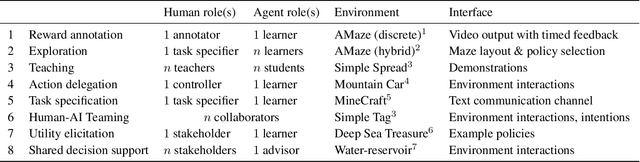
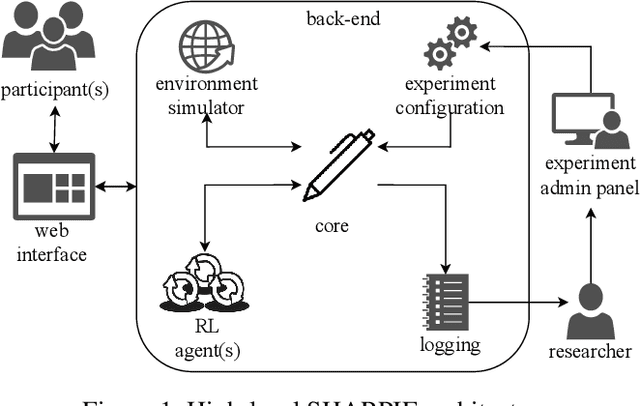

Reinforcement learning (RL) offers a general approach for modeling and training AI agents, including human-AI interaction scenarios. In this paper, we propose SHARPIE (Shared Human-AI Reinforcement Learning Platform for Interactive Experiments) to address the need for a generic framework to support experiments with RL agents and humans. Its modular design consists of a versatile wrapper for RL environments and algorithm libraries, a participant-facing web interface, logging utilities, deployment on popular cloud and participant recruitment platforms. It empowers researchers to study a wide variety of research questions related to the interaction between humans and RL agents, including those related to interactive reward specification and learning, learning from human feedback, action delegation, preference elicitation, user-modeling, and human-AI teaming. The platform is based on a generic interface for human-RL interactions that aims to standardize the field of study on RL in human contexts.