 Add to Chrome
 Add to Firefox
 Add to Edge
CHiRPE: A Step Towards Real-World Clinical NLP with Clinician-Oriented Model Explanations
Jan 26, 2026
The medical adoption of NLP tools requires interpretability by end users, yet traditional explainable AI (XAI) methods are misaligned with clinical reasoning and lack clinician input. We introduce CHiRPE (Clinical High-Risk Prediction with Explainability), an NLP pipeline that takes transcribed semi-structured clinical interviews to: (i) predict psychosis risk; and (ii) generate novel SHAP explanation formats co-developed with clinicians. Trained on 944 semi-structured interview transcripts across 24 international clinics of the AMP-SCZ study, the CHiRPE pipeline integrates symptom-domain mapping, LLM summarisation, and BERT classification. CHiRPE achieved over 90% accuracy across three BERT variants and outperformed baseline models. Explanation formats were evaluated by 28 clinical experts who indicated a strong preference for our novel concept-guided explanations, especially hybrid graph-and-text summary formats. CHiRPE demonstrates that clinically-guided model development produces both accurate and interpretable results. Our next step is focused on real-world testing across our 24 international sites.

Which Generative Adversarial Network Yields High-Quality Synthetic Medical Images: Investigation Using AMD Image Datasets
Mar 25, 2022
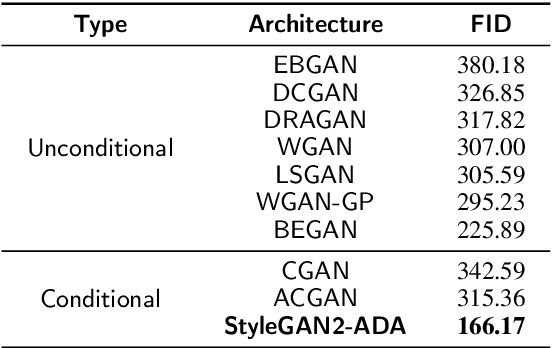

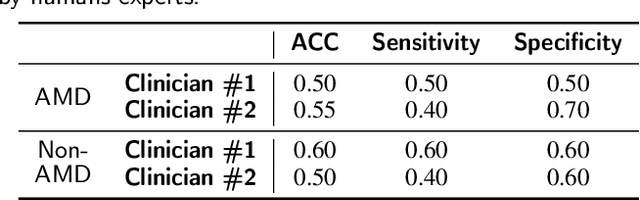
Deep learning has been proposed for the assessment and classification of medical images. However, many medical image databases with appropriately labeled and annotated images are small and imbalanced, and thus unsuitable to train and validate such models. The option is to generate synthetic images and one successful technique has been patented which limits its use for others. We have developed a free-access, alternate method for generating synthetic high-resolution images using Generative Adversarial Networks (GAN) for data augmentation and showed their effectiveness using eye-fundus images for Age-Related Macular Degeneration (AMD) identification. Ten different GAN architectures were compared to generate synthetic eye-fundus images with and without AMD. Data from three public databases were evaluated using the Fr\'echet Inception Distance (FID), two clinical experts and deep-learning classification. The results show that StyleGAN2 reached the lowest FID (166.17), and clinicians could not accurately differentiate between real and synthetic images. ResNet-18 architecture obtained the best performance with 85% accuracy and outperformed the two experts in detecting AMD fundus images, whose average accuracy was 77.5%. These results are similar to a recently patented method, and will provide an alternative to generating high-quality synthetic medical images. Free access has been provided to the entire method to facilitate the further development of this field.