 Add to Chrome
 Add to Firefox
 Add to Edge
Towards Any-Quality Image Segmentation via Generative and Adaptive Latent Space Enhancement
Jan 05, 2026
Segment Anything Models (SAMs), known for their exceptional zero-shot segmentation performance, have garnered significant attention in the research community. Nevertheless, their performance drops significantly on severely degraded, low-quality images, limiting their effectiveness in real-world scenarios. To address this, we propose GleSAM++, which utilizes Generative Latent space Enhancement to boost robustness on low-quality images, thus enabling generalization across various image qualities. Additionally, to improve compatibility between the pre-trained diffusion model and the segmentation framework, we introduce two techniques, i.e., Feature Distribution Alignment (FDA) and Channel Replication and Expansion (CRE). However, the above components lack explicit guidance regarding the degree of degradation. The model is forced to implicitly fit a complex noise distribution that spans conditions from mild noise to severe artifacts, which substantially increases the learning burden and leads to suboptimal reconstructions. To address this issue, we further introduce a Degradation-aware Adaptive Enhancement (DAE) mechanism. The key principle of DAE is to decouple the reconstruction process for arbitrary-quality features into two stages: degradation-level prediction and degradation-aware reconstruction. Our method can be applied to pre-trained SAM and SAM2 with only minimal additional learnable parameters, allowing for efficient optimization. Extensive experiments demonstrate that GleSAM++ significantly improves segmentation robustness on complex degradations while maintaining generalization to clear images. Furthermore, GleSAM++ also performs well on unseen degradations, underscoring the versatility of our approach and dataset.

Boosting Segment Anything Model to Generalize Visually Non-Salient Scenarios
Jan 02, 2026Segment Anything Model (SAM), known for its remarkable zero-shot segmentation capabilities, has garnered significant attention in the community. Nevertheless, its performance is challenged when dealing with what we refer to as visually non-salient scenarios, where there is low contrast between the foreground and background. In these cases, existing methods often cannot capture accurate contours and fail to produce promising segmentation results. In this paper, we propose Visually Non-Salient SAM (VNS-SAM), aiming to enhance SAM's perception of visually non-salient scenarios while preserving its original zero-shot generalizability. We achieve this by effectively exploiting SAM's low-level features through two designs: Mask-Edge Token Interactive decoder and Non-Salient Feature Mining module. These designs help the SAM decoder gain a deeper understanding of non-salient characteristics with only marginal parameter increments and computational requirements. The additional parameters of VNS-SAM can be optimized within 4 hours, demonstrating its feasibility and practicality. In terms of data, we established VNS-SEG, a unified dataset for various VNS scenarios, with more than 35K images, in contrast to previous single-task adaptations. It is designed to make the model learn more robust VNS features and comprehensively benchmark the model's segmentation performance and generalizability on VNS scenarios. Extensive experiments across various VNS segmentation tasks demonstrate the superior performance of VNS-SAM, particularly under zero-shot settings, highlighting its potential for broad real-world applications. Codes and datasets are publicly available at https://guangqian-guo.github.io/VNS-SAM.
Segment Any-Quality Images with Generative Latent Space Enhancement
Mar 16, 2025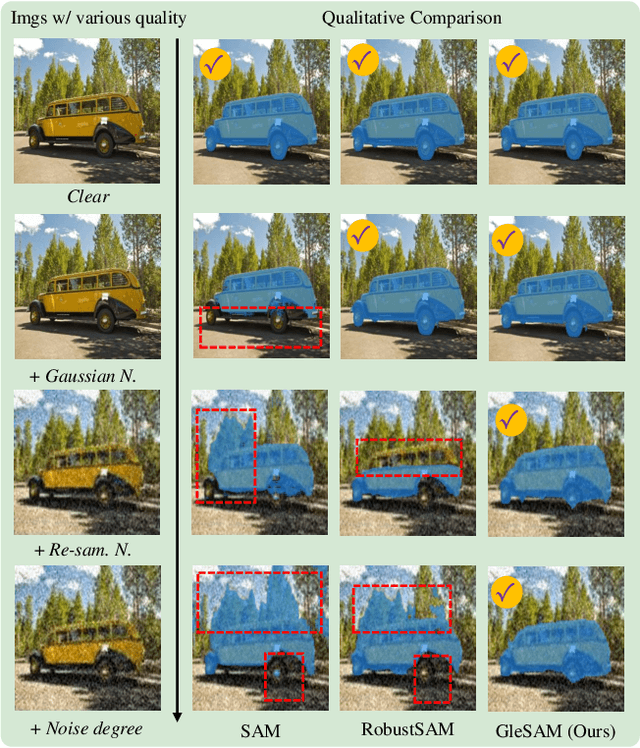
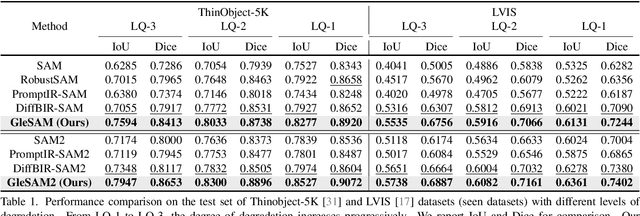
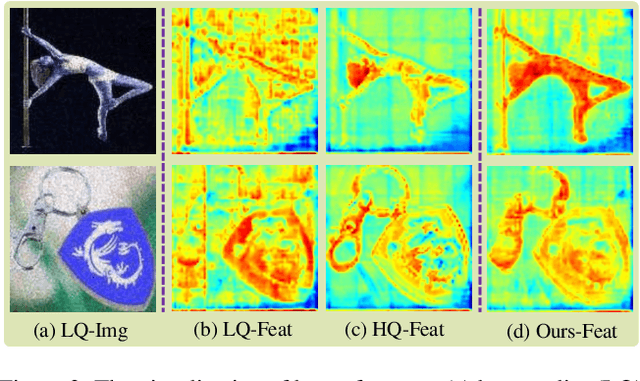
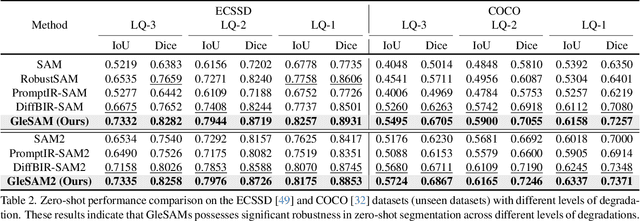
Despite their success, Segment Anything Models (SAMs) experience significant performance drops on severely degraded, low-quality images, limiting their effectiveness in real-world scenarios. To address this, we propose GleSAM, which utilizes Generative Latent space Enhancement to boost robustness on low-quality images, thus enabling generalization across various image qualities. Specifically, we adapt the concept of latent diffusion to SAM-based segmentation frameworks and perform the generative diffusion process in the latent space of SAM to reconstruct high-quality representation, thereby improving segmentation. Additionally, we introduce two techniques to improve compatibility between the pre-trained diffusion model and the segmentation framework. Our method can be applied to pre-trained SAM and SAM2 with only minimal additional learnable parameters, allowing for efficient optimization. We also construct the LQSeg dataset with a greater diversity of degradation types and levels for training and evaluating the model. Extensive experiments demonstrate that GleSAM significantly improves segmentation robustness on complex degradations while maintaining generalization to clear images. Furthermore, GleSAM also performs well on unseen degradations, underscoring the versatility of our approach and dataset.
Why mamba is effective? Exploit Linear Transformer-Mamba Network for Multi-Modality Image Fusion
Sep 05, 2024Multi-modality image fusion aims to integrate the merits of images from different sources and render high-quality fusion images. However, existing feature extraction and fusion methods are either constrained by inherent local reduction bias and static parameters during inference (CNN) or limited by quadratic computational complexity (Transformers), and cannot effectively extract and fuse features. To solve this problem, we propose a dual-branch image fusion network called Tmamba. It consists of linear Transformer and Mamba, which has global modeling capabilities while maintaining linear complexity. Due to the difference between the Transformer and Mamba structures, the features extracted by the two branches carry channel and position information respectively. T-M interaction structure is designed between the two branches, using global learnable parameters and convolutional layers to transfer position and channel information respectively. We further propose cross-modal interaction at the attention level to obtain cross-modal attention. Experiments show that our Tmamba achieves promising results in multiple fusion tasks, including infrared-visible image fusion and medical image fusion. Code with checkpoints will be available after the peer-review process.
Just a Hint: Point-Supervised Camouflaged Object Detection
Aug 20, 2024Camouflaged Object Detection (COD) demands models to expeditiously and accurately distinguish objects which conceal themselves seamlessly in the environment. Owing to the subtle differences and ambiguous boundaries, COD is not only a remarkably challenging task for models but also for human annotators, requiring huge efforts to provide pixel-wise annotations. To alleviate the heavy annotation burden, we propose to fulfill this task with the help of only one point supervision. Specifically, by swiftly clicking on each object, we first adaptively expand the original point-based annotation to a reasonable hint area. Then, to avoid partial localization around discriminative parts, we propose an attention regulator to scatter model attention to the whole object through partially masking labeled regions. Moreover, to solve the unstable feature representation of camouflaged objects under only point-based annotation, we perform unsupervised contrastive learning based on differently augmented image pairs (e.g. changing color or doing translation). On three mainstream COD benchmarks, experimental results show that our model outperforms several weakly-supervised methods by a large margin across various metrics.
SAM-COD: SAM-guided Unified Framework for Weakly-Supervised Camouflaged Object Detection
Aug 20, 2024Most Camouflaged Object Detection (COD) methods heavily rely on mask annotations, which are time-consuming and labor-intensive to acquire. Existing weakly-supervised COD approaches exhibit significantly inferior performance compared to fully-supervised methods and struggle to simultaneously support all the existing types of camouflaged object labels, including scribbles, bounding boxes, and points. Even for Segment Anything Model (SAM), it is still problematic to handle the weakly-supervised COD and it typically encounters challenges of prompt compatibility of the scribble labels, extreme response, semantically erroneous response, and unstable feature representations, producing unsatisfactory results in camouflaged scenes. To mitigate these issues, we propose a unified COD framework in this paper, termed SAM-COD, which is capable of supporting arbitrary weakly-supervised labels. Our SAM-COD employs a prompt adapter to handle scribbles as prompts based on SAM. Meanwhile, we introduce response filter and semantic matcher modules to improve the quality of the masks obtained by SAM under COD prompts. To alleviate the negative impacts of inaccurate mask predictions, a new strategy of prompt-adaptive knowledge distillation is utilized to ensure a reliable feature representation. To validate the effectiveness of our approach, we have conducted extensive empirical experiments on three mainstream COD benchmarks. The results demonstrate the superiority of our method against state-of-the-art weakly-supervised and even fully-supervised methods.