 Add to Chrome
 Add to Firefox
 Add to Edge
Reinforcement Learning for Active Perception in Autonomous Navigation
Feb 01, 2026
This paper addresses the challenge of active perception within autonomous navigation in complex, unknown environments. Revisiting the foundational principles of active perception, we introduce an end-to-end reinforcement learning framework in which a robot must not only reach a goal while avoiding obstacles, but also actively control its onboard camera to enhance situational awareness. The policy receives observations comprising the robot state, the current depth frame, and a particularly local geometry representation built from a short history of depth readings. To couple collision-free motion planning with information-driven active camera control, we augment the navigation reward with a voxel-based information metric. This enables an aerial robot to learn a robust policy that balances goal-directed motion with exploratory sensing. Extensive evaluation demonstrates that our strategy achieves safer flight compared to using fixed, non-actuated camera baselines while also inducing intrinsic exploratory behaviors.

Isaac Lab: A GPU-Accelerated Simulation Framework for Multi-Modal Robot Learning
Nov 06, 2025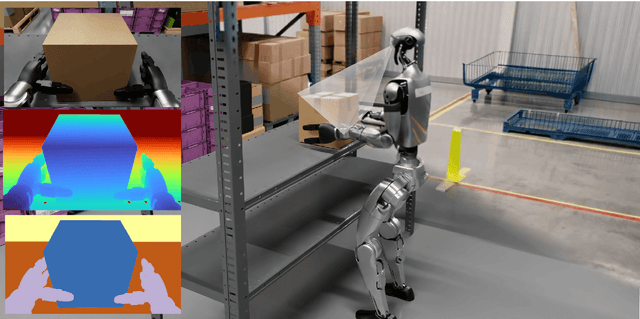
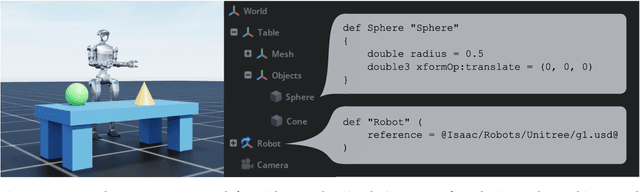
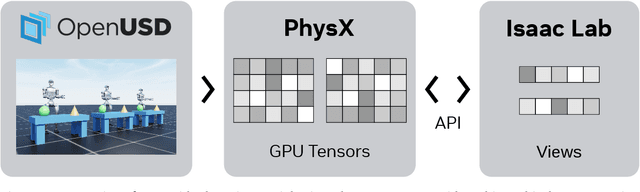
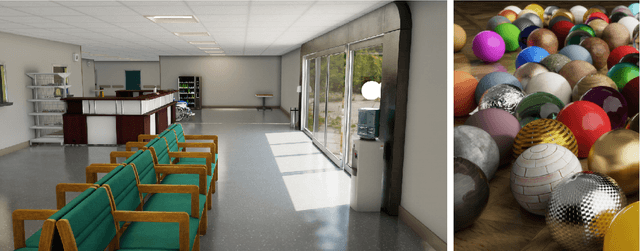
We present Isaac Lab, the natural successor to Isaac Gym, which extends the paradigm of GPU-native robotics simulation into the era of large-scale multi-modal learning. Isaac Lab combines high-fidelity GPU parallel physics, photorealistic rendering, and a modular, composable architecture for designing environments and training robot policies. Beyond physics and rendering, the framework integrates actuator models, multi-frequency sensor simulation, data collection pipelines, and domain randomization tools, unifying best practices for reinforcement and imitation learning at scale within a single extensible platform. We highlight its application to a diverse set of challenges, including whole-body control, cross-embodiment mobility, contact-rich and dexterous manipulation, and the integration of human demonstrations for skill acquisition. Finally, we discuss upcoming integration with the differentiable, GPU-accelerated Newton physics engine, which promises new opportunities for scalable, data-efficient, and gradient-based approaches to robot learning. We believe Isaac Lab's combination of advanced simulation capabilities, rich sensing, and data-center scale execution will help unlock the next generation of breakthroughs in robotics research.
Semantically-driven Deep Reinforcement Learning for Inspection Path Planning
May 20, 2025This paper introduces a novel semantics-aware inspection planning policy derived through deep reinforcement learning. Reflecting the fact that within autonomous informative path planning missions in unknown environments, it is often only a sparse set of objects of interest that need to be inspected, the method contributes an end-to-end policy that simultaneously performs semantic object visual inspection combined with collision-free navigation. Assuming access only to the instantaneous depth map, the associated segmentation image, the ego-centric local occupancy, and the history of past positions in the robot's neighborhood, the method demonstrates robust generalizability and successful crossing of the sim2real gap. Beyond simulations and extensive comparison studies, the approach is verified in experimental evaluations onboard a flying robot deployed in novel environments with previously unseen semantics and overall geometric configurations.
Olympus: A Jumping Quadruped for Planetary Exploration Utilizing Reinforcement Learning for In-Flight Attitude Control
Mar 05, 2025Exploring planetary bodies with lower gravity, such as the moon and Mars, allows legged robots to utilize jumping as an efficient form of locomotion thus giving them a valuable advantage over traditional rovers for exploration. Motivated by this fact, this paper presents the design, simulation, and learning-based "in-flight" attitude control of Olympus, a jumping legged robot tailored to the gravity of Mars. First, the design requirements are outlined followed by detailing how simulation enabled optimizing the robot's design - from its legs to the overall configuration - towards high vertical jumping, forward jumping distance, and in-flight attitude reorientation. Subsequently, the reinforcement learning policy used to track desired in-flight attitude maneuvers is presented. Successfully crossing the sim2real gap, extensive experimental studies of attitude reorientation tests are demonstrated.