 Add to Chrome
 Add to Firefox
 Add to Edge
ParkingTwin: Training-Free Streaming 3D Reconstruction for Parking-Lot Digital Twins
Jan 20, 2026
High-fidelity parking-lot digital twins provide essential priors for path planning, collision checking, and perception validation in Automated Valet Parking (AVP). Yet robot-oriented reconstruction faces a trilemma: sparse forward-facing views cause weak parallax and ill-posed geometry; dynamic occlusions and extreme lighting hinder stable texture fusion; and neural rendering typically needs expensive offline optimization, violating edge-side streaming constraints. We propose ParkingTwin, a training-free, lightweight system for online streaming 3D reconstruction. First, OSM-prior-driven geometric construction uses OpenStreetMap semantic topology to directly generate a metric-consistent TSDF, replacing blind geometric search with deterministic mapping and avoiding costly optimization. Second, geometry-aware dynamic filtering employs a quad-modal constraint field (normal/height/depth consistency) to reject moving vehicles and transient occlusions in real time. Third, illumination-robust fusion in CIELAB decouples luminance and chromaticity via adaptive L-channel weighting and depth-gradient suppression, reducing seams under abrupt lighting changes. ParkingTwin runs at 30+ FPS on an entry-level GTX 1660. On a 68,000 m^2 real-world dataset, it achieves SSIM 0.87 (+16.0%), delivers about 15x end-to-end speedup, and reduces GPU memory by 83.3% compared with state-of-the-art 3D Gaussian Splatting (3DGS) that typically requires high-end GPUs (RTX 4090D). The system outputs explicit triangle meshes compatible with Unity/Unreal digital-twin pipelines. Project page: https://mihoutao-liu.github.io/ParkingTwin/

Structural damage detection via hierarchical damage information with volumetric assessment
Jul 29, 2024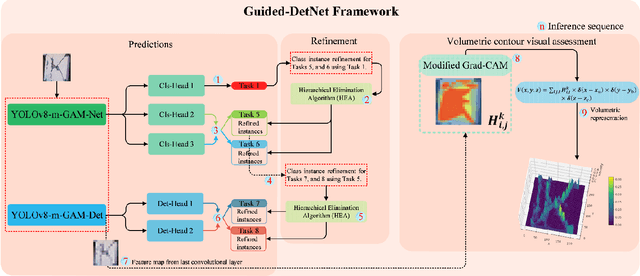


Image environments and noisy labels hinder deep learning-based inference models in structural damage detection. Post-detection, there is the challenge of reliance on manual assessments of detected damages. As a result, Guided-DetNet, characterized by Generative Attention Module (GAM), Hierarchical Elimination Algorithm (HEA), and Volumetric Contour Visual Assessment (VCVA), is proposed to mitigate complex image environments, noisy labeling, and post-detection manual assessment of structural damages. GAM leverages cross-horizontal and cross-vertical patch merging and cross foreground-background feature fusion to generate varied features to mitigate complex image environments. HEA addresses noisy labeling using hierarchical relationships among classes to refine instances given an image by eliminating unlikely class categories. VCVA assesses the severity of detected damages via volumetric representation and quantification leveraging the Dirac delta distribution. A comprehensive quantitative study, two robustness tests, and an application scenario based on the PEER Hub Image-Net dataset substantiate Guided-DetNet's promising performances. Guided-DetNet outperformed the best-compared models in a triple classification task by a difference of not less than 3% and not less than 2% in a dual detection task under varying metrics.