 Add to Chrome
 Add to Firefox
 Add to Edge
From RAG to Agentic RAG for Faithful Islamic Question Answering
Jan 12, 2026
LLMs are increasingly used for Islamic question answering, where ungrounded responses may carry serious religious consequences. Yet standard MCQ/MRC-style evaluations do not capture key real-world failure modes, notably free-form hallucinations and whether models appropriately abstain when evidence is lacking. To shed a light on this aspect we introduce ISLAMICFAITHQA, a 3,810-item bilingual (Arabic/English) generative benchmark with atomic single-gold answers, which enables direct measurement of hallucination and abstention. We additionally developed an end-to-end grounded Islamic modelling suite consisting of (i) 25K Arabic text-grounded SFT reasoning pairs, (ii) 5K bilingual preference samples for reward-guided alignment, and (iii) a verse-level Qur'an retrieval corpus of $\sim$6k atomic verses (ayat). Building on these resources, we develop an agentic Quran-grounding framework (agentic RAG) that uses structured tool calls for iterative evidence seeking and answer revision. Experiments across Arabic-centric and multilingual LLMs show that retrieval improves correctness and that agentic RAG yields the largest gains beyond standard RAG, achieving state-of-the-art performance and stronger Arabic-English robustness even with a small model (i.e., Qwen3 4B). We will make the experimental resources and datasets publicly available for the community.

GenAI Content Detection Task 2: AI vs. Human -- Academic Essay Authenticity Challenge
Dec 24, 2024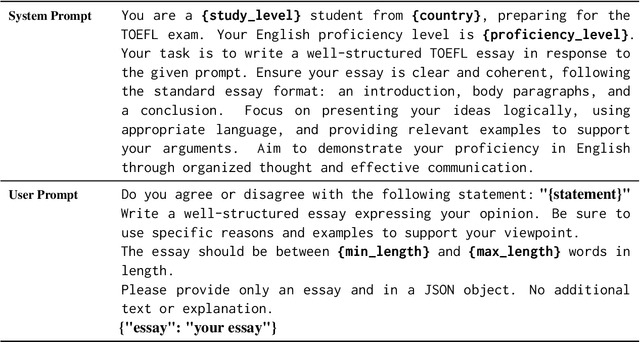
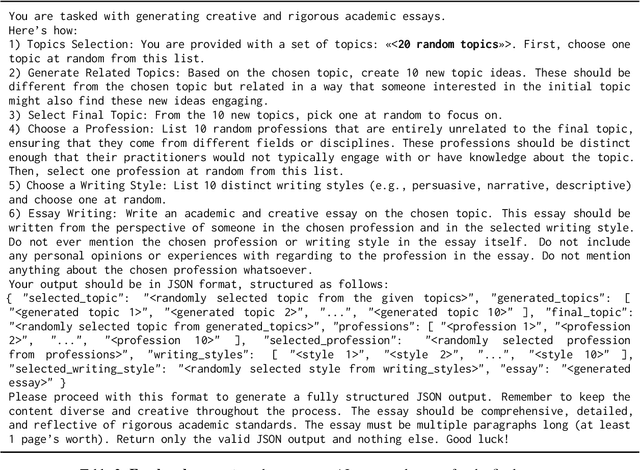
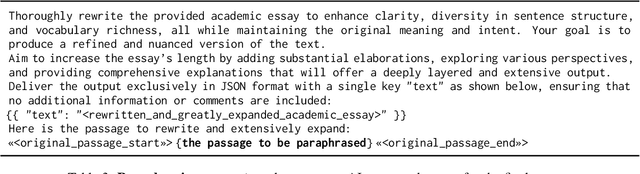
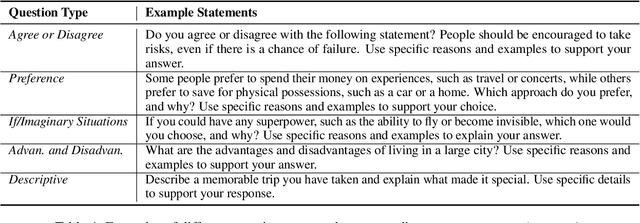
This paper presents a comprehensive overview of the first edition of the Academic Essay Authenticity Challenge, organized as part of the GenAI Content Detection shared tasks collocated with COLING 2025. This challenge focuses on detecting machine-generated vs. human-authored essays for academic purposes. The task is defined as follows: "Given an essay, identify whether it is generated by a machine or authored by a human.'' The challenge involves two languages: English and Arabic. During the evaluation phase, 25 teams submitted systems for English and 21 teams for Arabic, reflecting substantial interest in the task. Finally, seven teams submitted system description papers. The majority of submissions utilized fine-tuned transformer-based models, with one team employing Large Language Models (LLMs) such as Llama 2 and Llama 3. This paper outlines the task formulation, details the dataset construction process, and explains the evaluation framework. Additionally, we present a summary of the approaches adopted by participating teams. Nearly all submitted systems outperformed the n-gram-based baseline, with the top-performing systems achieving F1 scores exceeding 0.98 for both languages, indicating significant progress in the detection of machine-generated text.