 Add to Chrome
 Add to Firefox
 Add to Edge
Beyond the Black Box: Theory and Mechanism of Large Language Models
Jan 06, 2026
The rapid emergence of Large Language Models (LLMs) has precipitated a profound paradigm shift in Artificial Intelligence, delivering monumental engineering successes that increasingly impact modern society. However, a critical paradox persists within the current field: despite the empirical efficacy, our theoretical understanding of LLMs remains disproportionately nascent, forcing these systems to be treated largely as ``black boxes''. To address this theoretical fragmentation, this survey proposes a unified lifecycle-based taxonomy that organizes the research landscape into six distinct stages: Data Preparation, Model Preparation, Training, Alignment, Inference, and Evaluation. Within this framework, we provide a systematic review of the foundational theories and internal mechanisms driving LLM performance. Specifically, we analyze core theoretical issues such as the mathematical justification for data mixtures, the representational limits of various architectures, and the optimization dynamics of alignment algorithms. Moving beyond current best practices, we identify critical frontier challenges, including the theoretical limits of synthetic data self-improvement, the mathematical bounds of safety guarantees, and the mechanistic origins of emergent intelligence. By connecting empirical observations with rigorous scientific inquiry, this work provides a structured roadmap for transitioning LLM development from engineering heuristics toward a principled scientific discipline.

On the Emergence of Weak-to-Strong Generalization: A Bias-Variance Perspective
May 30, 2025Weak-to-strong generalization (W2SG) refers to the phenomenon where a strong student model, trained on a dataset labeled by a weak teacher, ultimately outperforms the teacher on the target task. Recent studies attribute this performance gain to the prediction misfit between the student and teacher models. In this work, we theoretically investigate the emergence of W2SG through a generalized bias-variance decomposition of Bregman divergence. Specifically, we show that the expected population risk gap between the student and teacher is quantified by the expected misfit between the two models. While this aligns with previous results, our analysis removes several restrictive assumptions, most notably, the convexity of the student's hypothesis class, required in earlier works. Moreover, we show that W2SG is more likely to emerge when the student model approximates its posterior mean teacher, rather than mimicking an individual teacher. Using a concrete example, we demonstrate that if the student model has significantly larger capacity than the teacher, it can indeed converge to this posterior mean. Our analysis also suggests that avoiding overfitting to the teacher's supervision and reducing the entropy of student's prediction further facilitate W2SG. In addition, we show that the reverse cross-entropy loss, unlike the standard forward cross-entropy, is less sensitive to the predictive uncertainty of the teacher. Finally, we empirically verify our theoretical insights and demonstrate that incorporating the reverse cross-entropy loss consistently improves student performance.
Theoretical Insights into Fine-Tuning Attention Mechanism: Generalization and Optimization
Oct 03, 2024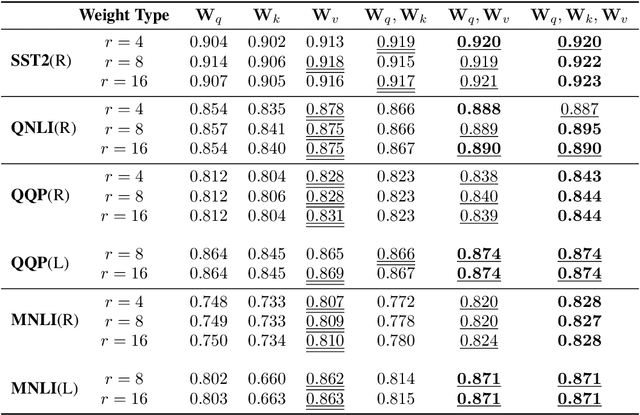
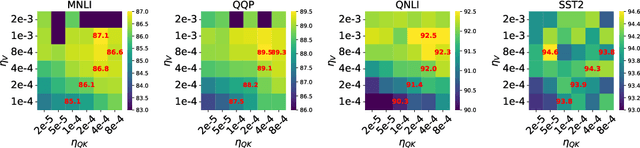
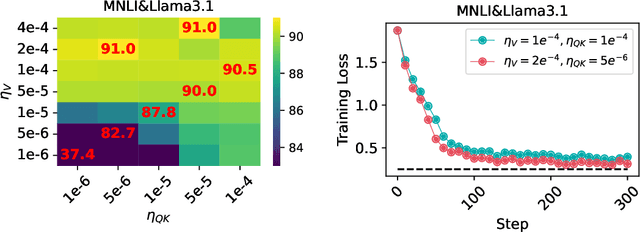
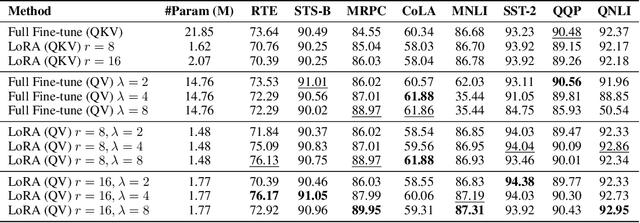
Large Language Models (LLMs), built on Transformer architectures, exhibit remarkable generalization across a wide range of tasks. However, fine-tuning these models for specific tasks remains resource-intensive due to their extensive parameterization. In this paper, we investigate two remarkable phenomena observed during the fine-tuning of LLMs, particularly focusing on the attention mechanism: (1) Different Impact, optimizing the $\mathbf{W}_v$ matrix significantly improves performance over optimizing the $\mathbf{W}_k$ matrix. Fine-tuning only the $\mathbf{W}_q$ and $\mathbf{W}_v$ matrices is computationally efficient, delivering results that are comparable to, or even better than, fine-tuning all three matrices $\mathbf{W}_q$, $\mathbf{W}_k$, and $\mathbf{W}_v$. (2) Efficient Convergence, employing distinct learning rates for these matrices is crucial for optimal performance, with a higher learning rate for the $\mathbf{W}_v$ matrix expediting convergence. However, theoretical analyses of these phenomena are still relatively limited. We present a theoretical analysis of these phenomena from two perspectives: (i) Generalization, where we demonstrate that fine-tuning only $\mathbf{W}_q$ and $\mathbf{W}_v$ improves generalization bounds, enhances memory efficiency, and (ii) Optimization, where we emphasize that the feature learning of the attention mechanism is efficient, particularly when using distinct learning rates for the matrices, which leads to more effective fine-tuning. Building on these insights, we propose a new strategy that improves fine-tuning efficiency in terms of both storage and time. Experimental results on benchmark datasets validate the effectiveness of this approach, supporting our theoretical findings. Our analysis lays the theoretical groundwork for configuring and improving lightweight algorithms in LLMs fine-tuning.